The Century Report: February 10, 2026

The 10-Second Scan
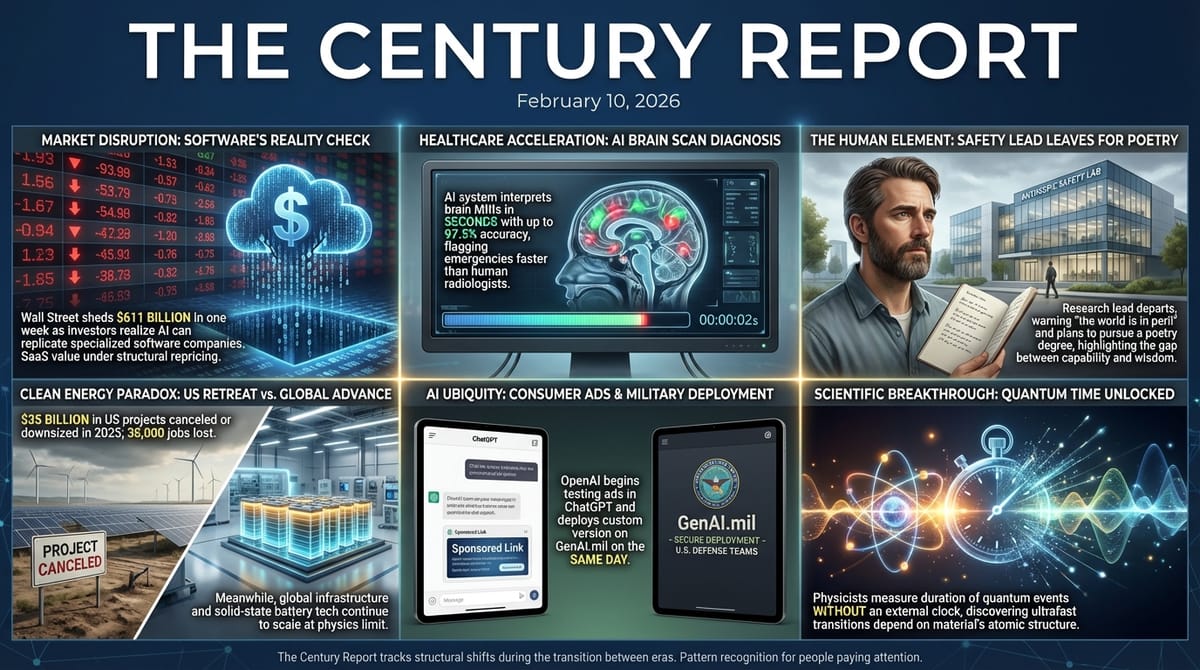
- Wall Street shed $611 billion in a single week as investors realized AI can replicate what entire software companies were built to do.
- An AI system reads brain MRIs in seconds with up to 97.5% accuracy, flagging emergencies faster than radiologists can open the file.
- Anthropic's AI safety research lead walked away, writing that "the world is in peril" and that he plans to pursue a poetry degree.
- Nearly $35 billion in U.S. clean energy projects were canceled or downsized in 2025, taking 38,000 jobs with them.
- OpenAI began testing ads inside ChatGPT and deployed a custom version on GenAI.mil for U.S. defense teams - on the same day.
- Physicists measured the duration of quantum events without an external clock, discovering that ultrafast transitions depend on the atomic structure of the material itself.
The 1-Minute Read
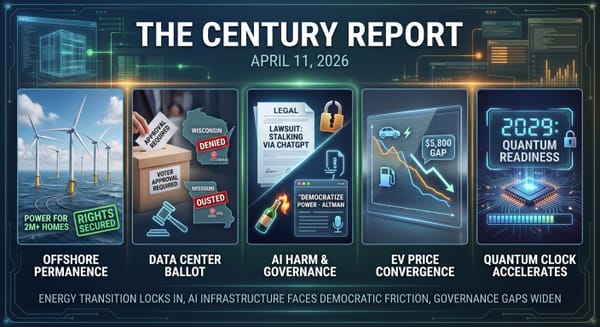
Today's signal carries a specific weight. The market suffered far more than a dip last week, in the midst of a structural repricing of what software companies are for, shedding $611 billion in value as investors grasped that AI is arriving not as a feature but as a replacement layer. At the same time, an AI safety researcher left one of the leading labs to write poetry, physicists found a way to measure time at the quantum level without a clock, and a brain-scanning system matched the accuracy of specialists in seconds. These are not parallel stories. They are different faces of the same compression.
What connects the stock sell-off to the MRI reader to the departing researcher is a shared recognition that the distance between capability and consequence has collapsed. The systems are here. The governance, the meaning-making, and the institutional adaptation are not. Today's newsletter sits in that gap - the space where acceleration is visible but the structures to hold it are still being built.
The 10-Minute Deep Dive
The $611 Billion Wake-Up Call
The Century Report covered the initial SaaS sell-off on February 7, when roughly a trillion dollars in software company value had evaporated over eight days following Anthropic's Claude Cowork demonstration. That situation has now crystallized into something more specific. Bloomberg data compiled through Friday shows that 164 stocks across software, financial services, and asset management shed $611 billion in market value in a single week. Thomson Reuters posted its steepest weekly decline ever - 20%. Morningstar had its worst week since 2009. HubSpot, Atlassian, and Zscaler each fell more than 16%.
The numbers are striking, but the behavioral shift underneath them is more telling. Hedge funds' net exposure to software hit a record low of less than 3% as of February 3, down from a peak of 18% in 2023, according to Goldman Sachs' prime brokerage data. Software is now the most net-sold sector across all groups since the start of the year. Dip buyers arrived on Friday and stabilized the iShares Expanded Tech-Software ETF after a 12% four-session slide, but the structural message has been delivered: investors are no longer debating whether AI can replicate the functions of specialized software companies. They are debating which ones survive.
Databricks CEO Ali Ghodsi offered a notable framing this weekend: SaaS isn't dead, but AI could make it irrelevant. His argument is that AI won't replace major applications with "vibe-coded" clones, but it will give rise to competitors that can be assembled in weeks rather than years. Workday's sudden CEO transition - co-founder Aneel Bhusri returning to replace Carl Eschenbach, effective immediately - underlines the urgency. Bhusri called AI "a bigger transformation than SaaS" and said it "will define the next generation of market leaders." This is the same Workday that laid off 1,750 people last February and took $80 million in office space impairment charges. The enterprise software sector is not gradually adjusting. It is reorganizing around a fundamentally different set of assumptions about what software needs to be, and the stock market is now pricing that in faster than the companies themselves can adapt.
The deeper pattern here extends beyond any single sector. What the market is registering is the compression of value creation itself. When the functions of a billion-dollar software company can be approximated by an AI system in weeks, the question shifts from "which companies will be disrupted?" to "what does value mean when capability distributes this freely?" The sell-off looks like destruction from one angle. From another, it is the market discovering, in real time, that the infrastructure of the next era doesn't need the same gatekeepers.
The Brain That Reads Itself
Researchers at the University of Michigan have built an AI system that interprets brain MRI scans in seconds, identifying a wide range of neurological conditions and determining which cases need urgent care. Trained on hundreds of thousands of real-world scans along with patient histories, the model achieved accuracy as high as 97.5% and outperformed other advanced AI diagnostic systems. The system doesn't just classify - it triages, flagging emergencies in the time it takes a radiologist to open a file.
This sits alongside a pattern this newsletter has been tracking across editions. On February 7, we reported that LLMs gave Rwandan healthcare workers better clinical guidance than local physicians at 1/500th the cost. On February 8, a stroke device tripled reperfusion rates for medium vessel occlusions that had no proven treatment. Each of these represents the same underlying shift: the bottleneck in healthcare is moving from knowledge to access, and AI is collapsing the distance between diagnosis and intervention. The University of Michigan system is particularly significant because brain MRI interpretation has been one of the most expertise-dependent, time-sensitive tasks in medicine. Emergency departments in rural hospitals and under-resourced health systems stand to gain the most - places where a neuroradiologist isn't on call at 3 a.m. but an AI system can be.
The Clean Energy Paradox
E2's tracking data tells a painful story: nearly $35 billion in U.S. clean energy investments were canceled or downsized in 2025, with $5.1 billion vanishing in December alone. More than 38,000 current and future jobs disappeared with them. Cancellations overtook new investment for the first time, a reversal driven by policy uncertainty, frozen tax incentives, and the Trump administration's systematic dismantling of hydrogen hub funding and clean energy provisions.
At the same time, the infrastructure buildout this newsletter has been tracking continues at extraordinary scale elsewhere. Natural gas installations more than doubled in 2025, reaching 4.2 GW compared to 1.9 GW in 2024, according to FERC data. New Jersey utilities are beginning to develop virtual power plants, aggregating distributed energy resources into grid-scale capacity. Toyota and Idemitsu Kosan are moving beyond their pilot program to build a factory producing solid electrolyte for all-solid-state EV batteries - a venture funded in part by one of Japan's largest oil refiners. A congressional "grid reliability" bill is drawing criticism for propping up expensive, dirty power plants rather than pursuing systemic solutions, with Energy Innovation analysts calling it "duct tape on a cracked dam."
The paradox is apparent: clean energy investment in the U.S. contracted in 2025 even as the underlying physics and economics continued to improve. Battery costs keep falling. Geothermal reserves keep proving out. Virtual power plant architectures keep maturing. The policy disruption is real and its human costs - 38,000 jobs lost, communities left waiting - are severe. But the energy transition is a global phenomenon, and its momentum doesn't depend on a single country's policy cycle. The projects being canceled in the U.S. are being built elsewhere, and the technology they would have deployed continues to advance. What's being delayed is not the transition itself but American participation in it. That distinction matters enormously for the people and communities affected right now, and it also matters for understanding the broader trajectory: the direction of travel has not changed, even as one of the largest players pauses.
The Safety Researcher Who Left to Write Poetry
Mrinank Sharma, who led Anthropic's safeguards research team, published his departure letter on Monday. He described a world "in peril" not just from AI or bioweapons but from "a whole series of interconnected crises unfolding at this very moment." He plans to pursue a poetry degree and devote himself to "courageous speech."
Sharma is the latest in a series of Anthropic departures. Harsh Mehta and Behnam Neyshabur left last week to "start something new." Dylan Scandinaro, a former safety researcher, recently joined OpenAI as its head of preparedness. The departures arrive as Anthropic is in talks for a funding round that could value the company at $350 billion.
Sharma's letter deserves attention beyond the personnel shuffle. He writes about placing "poetic truth alongside scientific truth as equally valid ways of knowing, both of which I believe have something essential to contribute when developing new technology." This is not the language of someone who has lost faith in AI. It is the language of someone who recognizes that the technical problem and the human problem have become inseparable, and that the human side requires capacities that technical research alone cannot provide. When one of the people closest to the frontier of AI safety says the most important thing he can do next is write poetry, that itself is a signal about the nature of the transition we are inside. The questions being surfaced by these systems are not purely engineering questions. They are questions about meaning, about wisdom, about what it takes to hold power responsibly - and the people working closest to those questions are starting to say so out loud.
OpenAI's Two Announcements
On the same day, OpenAI made two moves that together tell a revealing story. The company began testing ads inside ChatGPT, showing "sponsored" links beneath chat answers for free and Plus tier users. Separately, it announced the deployment of a custom ChatGPT on GenAI.mil, bringing secure AI to U.S. defense teams. One announcement extends the advertising model of the consumer internet into conversational AI. The other extends conversational AI into military operations. Both represent the same underlying dynamic: the systems are distributing into every domain simultaneously.
Measuring What Cannot Be Measured
For decades, physicists understood that quantum transitions happened extraordinarily fast - electrons absorbing photons and jumping energy states in tens of attoseconds, intervals so brief that light couldn't cross a virus during that time. But knowing these events were fast was different from measuring how fast, or understanding what controlled their duration. The problem was fundamental: any external clock risked interfering with the quantum process itself, changing what it was trying to measure. EPFL researchers solved this by using the electrons themselves as the clock, reading timing information encoded in their spin states after photoemission. The method revealed something unexpected - quantum transition times vary dramatically based on atomic structure, from 26 attoseconds in three-dimensional copper to over 200 attoseconds in chain-like copper telluride. This matters because it transforms quantum timing from a philosophical puzzle into an engineering parameter. Once you can measure something precisely, you can begin to control it.
The deeper significance lies in what becomes possible when fundamental limits turn out not to be limits at all, but variables. For years, quantum computing researchers have struggled with decoherence - quantum states collapsing before calculations complete. Understanding that transition timescales depend on material geometry opens pathways to engineering materials where quantum states persist longer by design. The same principles could inform how we build quantum sensors, quantum communication systems, and materials that exploit quantum effects at room temperature instead of requiring near-absolute-zero cooling. This is characteristic of how breakthroughs compound during periods of rapid capability expansion: a measurement technique developed to answer a basic physics question immediately becomes a design tool for technologies that didn't exist when the research began. The work does far more than advance quantum mechanics theory - it hands materials scientists a new dial to turn when building the substrate for quantum technologies that are already moving from laboratory demonstrations toward practical deployment.
The Human Voice
Today's newsletter tracks what happens when AI capability arrives faster than institutional structures can adapt - in markets, in energy policy, in the departure of safety researchers. For an unusually candid view of this same dynamic inside the one domain where the stakes are most immediate, oncologists and policy leaders at a recent panel hosted by Arizona State University's Decision Theater sat down to discuss what happens when AI diagnostic systems move from clinical trials into real hospital workflows. They surface the specific, unglamorous problems that determine whether AI actually helps patients: model drift as populations change, regulatory gray zones between FDA clearance and enforcement, uneven state rules around consent and disclosure, and the quiet danger of systems that perform "just well enough" to gain trust before underperforming in the populations that need them most. For readers tracking how governance, labor, and access evolve during structural transitions, this is a ground-level view from inside the clinic.
Watch: Clinical AI Governance - From Press Release to Practice (ASU Decision Theater)
The Century Perspective
With a century of change unfolding in a decade, a single day looks like this: an AI system reading brain MRIs in seconds with 97.5% accuracy and flagging emergencies that would have waited hours, physicists measuring the duration of quantum events without any external clock, virtual power plants aggregating distributed energy into grid-scale capacity, and solid-state battery manufacturing moving from pilot to factory. There's also friction, and it's intense - $611 billion in software value erased in a week as markets confront what AI makes obsolete, $35 billion in clean energy investments canceled in a single year, 38,000 jobs vanishing with them, and a leading safety researcher walking away from the frontier to write poetry because the questions have outgrown the technical frame. But friction generates clarity, and clarity is what allows a transition to find its footing. Step back for a moment and you can see it: the diagnostic bottleneck shifting from knowledge to access, the energy transition continuing at the physics level even where policy retreats, the market itself becoming a real-time sensor for which structures belong to the old era and which to the new one, a researcher recognizing that wisdom must grow alongside capability. Every transformation has a breaking point. A wave can overwhelm what stands in its shallows... or carry everything it lifts to depths that were never reachable from shore.
Sources
AI & Technology
- Bloomberg via Yahoo Finance: AI Fear Grips Wall Street
- ScienceDaily: AI Reads Brain MRIs in Seconds
- Business Insider Africa: Anthropic AI Safety Lead Exit Letter
- OpenAI: Testing Ads in ChatGPT
- OpenAI: Bringing ChatGPT to GenAI.mil
- TechCrunch: Databricks CEO on SaaS and AI
- TechCrunch: Workday CEO Transition
Energy & Infrastructure
- Electrek: $35B in US Clean Energy Projects Vanished in 2025
- Utility Dive: Natural Gas Installations Doubled in 2025
- Utility Dive: Congressional Grid Reliability Bill
- Utility Dive: New Jersey Virtual Power Plants
- Electrek: Toyota and Idemitsu Solid-State Battery Factory
Scientific Research
- ScienceDaily: Physicists Measure Quantum Time Duration
- ScienceDaily: Ovarian Cancer Cell Alliance Discovery
- Nature: France Lures Researchers from US
Labor & Economy
- WIRED: No Company Has Admitted to Replacing Workers With AI in New York
- The Guardian: Telstra Cuts 200+ Jobs Amid AI Rollout
The Century Report tracks structural shifts during the transition between eras. It is produced daily as a perceptual alignment tool - not prediction, not persuasion, just pattern recognition for people paying attention.