AI Models Check Each Other - TCR 03/31/26

The 20-Second Scan
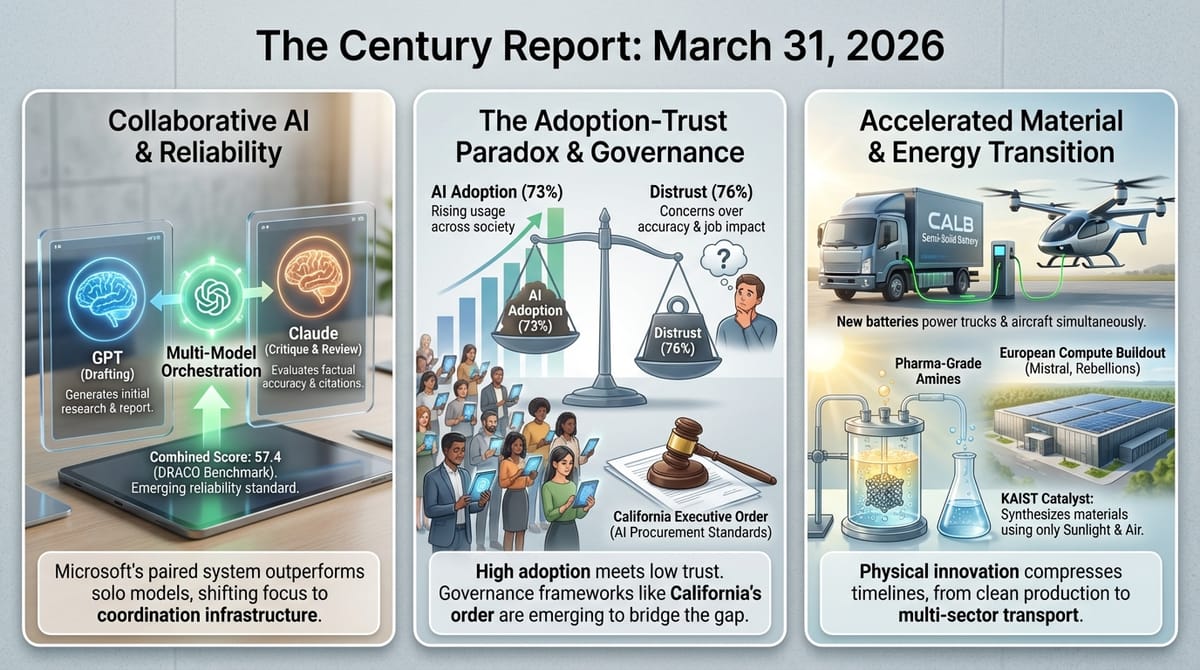
- Microsoft launched multi-model research features pairing GPT and Claude in sequence, with the combined system scoring 57.4 on the DRACO benchmark against Claude Opus 4.6's solo score of 42.7.
- California signed an executive order requiring AI companies seeking state contracts to demonstrate policies against CSAM distribution, harmful bias, and unlawful surveillance.
- A Quinnipiac University poll found that 76% of Americans distrust AI-generated information even as adoption rose to 73%, with 70% expecting AI to reduce job opportunities.
- Mistral AI raised $830 million in debt to build a new data center near Paris, targeting operational status by Q2 2026 as part of a 200-megawatt European compute buildout.
- South Korean AI chip startup Rebellions raised $400 million at a $2.3 billion valuation ahead of a planned IPO, with $650 million raised in six months for inference-focused silicon.
- KAIST researchers developed a self-regenerating catalyst system that synthesizes pharmaceutical-grade amines using only sunlight and air, published in the Journal of the American Chemical Society.
- Semi-solid-state batteries expanded from passenger EVs into commercial trucks and eVTOL aircraft, with CALB achieving mass production at 400 Wh/kg energy density.
The 2-Minute Read
Microsoft's decision to pair competing intelligence systems - GPT and Claude working in deliberate sequence rather than solo - represents a structural acknowledgment that the orchestration layer between models is where reliability emerges. The combined system's 14-point lead over the best single model on a standardized research benchmark suggests that the value in the intelligence era may accrue less to any individual model and more to the architecture that routes, reviews, and reconciles their outputs. This has implications that extend well beyond one product announcement: if multi-model composition consistently outperforms single-model approaches, the competitive dynamics of the entire AI industry shift from "who has the best model" toward "who has the best coordination infrastructure."
The Quinnipiac polling data captures a population caught between adoption and apprehension. Three-quarters of Americans now use AI regularly while simultaneously distrusting its outputs, and the generation most fluent in these systems - Gen Z - is also the most pessimistic about what they mean for employment. The divergence between fluency and optimism is structurally significant because it suggests that direct experience with AI capability is producing not reassurance but a clearer view of what is being displaced. When 70% of a population expects fewer jobs and two-thirds want more regulation, the political pressure for governance frameworks intensifies regardless of any administration's preference for deregulation. California's executive order yesterday, imposing procurement standards on AI companies in direct defiance of federal calls for lighter oversight, is an early expression of that pressure finding institutional form.
The energy and materials signal continues to compound in ways that compress timelines. Semi-solid-state batteries reaching mass production for commercial trucks and flying cars within months of their first passenger EV deployment demonstrates how quickly new battery chemistries move from breakthrough to multi-sector adoption when the manufacturing infrastructure already exists. CALB's 400 Wh/kg cells powering Chery light trucks and XPeng eVTOL aircraft simultaneously illustrate that the energy density gains enabling the next generation of electric transport are arriving across vehicle categories in parallel rather than in sequence. The KAIST catalyst system - producing pharmaceutical raw materials using nothing but sunlight and atmospheric oxygen - offers a glimpse of what chemical manufacturing becomes when the energy input is ambient and the waste stream is eliminated entirely.
The 20-Minute Deep Dive
When Intelligence Systems Check Each Other's Work
Microsoft's Copilot Researcher update introduced two features yesterday that represent a meaningful shift in how AI systems are deployed for complex work. Critique pairs GPT and Claude in a sequential workflow: one model plans research, pulls sources, and drafts a report, then the other reviews it for factual accuracy, citation quality, and completeness before the user sees anything. Council runs both models simultaneously on the same task and has a third model identify where they agree, where they diverge, and what each caught that the other missed.
The performance data is striking. On the DRACO benchmark - 100 complex research tasks spanning medicine, law, and technology - the Critique system scored 57.4, nearly 14 points above Claude Opus 4.6's solo score of 42.7 and ahead of every other AI research system tested. The largest gains appeared in breadth of analysis and factual accuracy, precisely the areas where single-model systems tend to produce blind spots and hallucinations.
The architectural logic here extends well beyond one product. Multi-model composition addresses a structural weakness that has persisted since the first large language models were deployed: a single model generating, evaluating, and presenting its own work has no internal mechanism for catching its own errors. The same pattern-matching that produces fluent output also produces confidently stated falsehoods. By separating generation from evaluation and assigning them to different models trained on different data with different architectural biases, the system introduces a form of adversarial review that mimics what editorial processes in human organizations have always provided - except at machine speed and scale. This extends the pattern of multi-agent coordination that The Century Report documented on March 11, when Anthropic deployed agent teams on every pull request and Amazon convened emergency governance meetings in response to AI-generated code causing production outages - both cases where the answer to AI reliability problems turned out to be more structured AI oversight rather than less.
Microsoft's bet is that no single model will stay at the frontier for long, and that the durable advantage accrues to whoever builds the best coordination infrastructure. If this proves correct, the competitive landscape of AI shifts fundamentally. The race for the "smartest" individual model becomes less consequential than the race for the system that knows which model to deploy for which subtask. This is coordination intelligence - a meta-capability that emerges from the interaction between systems rather than from any system alone. The implications for how enterprises adopt AI are immediate: rather than choosing a single vendor, organizations may increasingly choose orchestration platforms that route work across multiple providers based on task characteristics. The era of the single-model monoculture may already be ending before most organizations have finished their first deployment.
The Trust Paradox at Population Scale
The Quinnipiac poll surveyed 1,397 American adults between March 19 and 23, and the results capture a society metabolizing a transformation it does not yet understand how to govern. Seventy-three percent of Americans now use AI systems regularly - up from 67% a year ago - while 76% say they trust AI-generated information only rarely or sometimes. Only 6% describe themselves as "very excited" about AI, while 80% express concern.
The generational data is particularly revealing. Gen Z reports the highest familiarity with AI and the highest pessimism about the labor market simultaneously. Eighty-one percent of Americans born between 1997 and 2008 expect AI to reduce job opportunities. Among employed Americans across all ages, 30% now fear their specific job will be made obsolete - up from 21% a year ago. The researchers noted the paradox directly: "AI fluency and optimism here are moving in opposite directions."
This divergence between adoption and trust has structural consequences. When a population adopts a technology it does not trust, governance pressure builds from below regardless of what policy frameworks exist at the top. Two-thirds of respondents said businesses are insufficiently transparent about AI use, and the same proportion said government regulation is inadequate. Sixty-five percent oppose building AI data centers in their communities. These are not abstract philosophical positions. They are expressions of a population that sees the transformation accelerating around it and does not believe the institutions managing that transformation are acting in the public interest.
The fact that this data arrives on the same day California imposed AI procurement standards in direct opposition to federal deregulation signals is important. California's executive order requires AI companies seeking state contracts to demonstrate policies preventing CSAM distribution, harmful bias, and unlawful surveillance, and directs the state to develop best practices for watermarking AI-generated content. The order was explicitly framed as a response to the White House framework that called state regulation "cumbersome." Over 100 state-level AI laws have already passed nationwide. The federal government's preference for minimal regulation is colliding with a public that, by substantial majorities, wants more oversight - and the institutional resolution of that collision is being negotiated in real time through procurement standards, state legislation, and the accumulating weight of public opinion. As the March 21 edition of The Century Report documented, the White House's national AI framework explicitly sought to preempt those same state laws on the same day California's own Anthropic copyright settlement was moving toward final court approval - the collision between federal preemption and state governance was already visible before yesterday's executive order.
What the polling data does not capture - and what The Century Report exists to make visible - is that the trust deficit is a feature of the transition, not a permanent condition. Trust develops through experience, governance, and demonstrated reliability. Multi-model review systems that catch errors before they reach users, procurement standards that create accountability for AI behavior, independent evaluation of health and safety claims - these are all trust-building mechanisms being constructed alongside the capability itself. The current moment is uncomfortable precisely because the capability is running ahead of the trust infrastructure. The direction of travel, visible across every arc this newsletter tracks, is toward the governance and verification systems that close that gap.
The European Compute Buildout Accelerates
Mistral AI's $830 million debt raise to build a data center near Paris represents the largest single infrastructure financing by a European AI company. The facility in Bruyères-le-Châtel will use Nvidia chips and is targeted for operational status in Q2 2026 - an aggressive timeline that reflects both the urgency of European AI sovereignty ambitions and the intensity of demand from governments and enterprises seeking to run AI within European jurisdiction.
This follows Mistral's announcement in February of a $1.4 billion Swedish infrastructure investment. Combined, the French lab is committing over $2.2 billion to European compute infrastructure, targeting 200 megawatts of capacity across the continent by 2027. CEO Arthur Mensch's statement that this is driven by "surging and sustained demand from governments, enterprises, and research institutions seeking to build their own customized AI environment, rather than depend on third-party cloud providers" makes the sovereignty logic explicit.
The same day, South Korean AI chip startup Rebellions raised $400 million at a $2.3 billion valuation, bringing its total funding to $850 million - $650 million of it raised in the last six months alone. Rebellions designs inference-focused chips fabricated by third parties, targeting the compute layer where the vast majority of commercial AI workload occurs. The company is expanding into the U.S., Japan, Saudi Arabia, and Taiwan, with plans to court cloud providers, government agencies, and telecom operators. CEO Sunghyun Park's observation that "AI is now measured by its ability to operate in the real world at scale, under power constraints, and with clear economic return" describes the shift from training-obsessed to inference-dominated economics that is reshaping the entire chip market. This inference-focused investment thesis extends the hardware diversification arc that The Century Report has tracked from Arm's AGI CPU launch on March 25 through Gimlet Labs' multi-silicon inference cloud on March 24 - a structural pattern in which the compute layer of the intelligence era is diversifying faster than any single incumbent can contain.
Together, these developments extend the AI hardware diversification and sovereignty arcs that The Century Report has tracked since February. European compute infrastructure is being built with European capital and governed under European legal frameworks. Non-Nvidia inference chips are attracting hundreds of millions in investment as organizations realize that the binding constraint on AI deployment is not raw training power but cost-effective, geographically distributed inference capability. The compute infrastructure of the intelligence era is becoming genuinely global and genuinely diversified, rather than concentrated in a handful of American hyperscaler data centers.
A Catalyst That Runs on Sunlight and Air
The KAIST research team published a finding in the Journal of the American Chemical Society that carries implications well beyond its immediate chemistry. They developed a catalyst system combining a silver-based metal catalyst with an organic photocatalyst that uses no external chemicals, no fossil fuels, and no energy input beyond sunlight and atmospheric oxygen. The system synthesizes amines - nitrogen-containing compounds used to produce antibiotics, anticancer drugs, and other high-value pharmaceuticals - through a self-circulating structure where reaction byproducts automatically regenerate the catalyst.
The elegance is in the circularity. Conventional catalysts face a fundamental tradeoff: high-efficiency catalysts are difficult to reuse, while reusable catalysts are slow. The KAIST team bypassed this tradeoff by designing a system where the waste products of the reaction provide exactly the chemical input needed to restore the catalyst to its active state. The silver catalyst maintains its high reaction rate while the organic photocatalyst's regenerative properties keep the cycle running indefinitely.
This pattern - engineering systems where the outputs of one process become the inputs of another, powered by ambient energy rather than extracted fuel - is the template for what manufacturing becomes in the generative era. The chemical industry currently produces hundreds of billions of dollars of high-value compounds using processes that depend on fossil fuel inputs, generate toxic waste, and require continuous external energy. A catalyst that produces pharmaceutical raw materials from sunlight and air at industrial scale would not incrementally improve this system. It would replace its fundamental operating logic. The distance between a proof-of-concept in a laboratory and industrial deployment remains substantial, but the principle it demonstrates - that the most valuable chemical synthesis can be powered by nothing more than the ambient environment - is now experimentally validated.
Semi-Solid-State Batteries Cross Into Multi-Sector Deployment
The Century Report covered MG Motor's announcement of the first mass-produced EV with a semi-solid-state battery on March 27. Yesterday, the scope of that deployment expanded significantly. CALB disclosed that its semi-solid-state batteries have achieved mass production for commercial vehicles, with cells now powering Chery Automotive's light trucks at 400 Wh/kg energy density. The same company's R46 cylindrical cells - using a hybrid solid-liquid electrolyte at 350 Wh/kg - have entered mass production for eVTOL aircraft including XPeng's AEROHT X3.
The speed of this multi-sector expansion is remarkable. Semi-solid-state batteries moved from first mass-produced passenger EV to commercial trucks and flying cars within months, not years. The 400 Wh/kg energy density in the truck application represents a meaningful advantage over conventional lithium-ion batteries, translating directly into longer range with lighter weight - a particularly significant combination for commercial vehicles where payload capacity determines economic viability. The 2C fast-charging capability (30% to 80% in 15 minutes) and 20% improved cold-weather range address two of the remaining practical barriers to electric commercial vehicle adoption.
CALB is simultaneously developing a fully solid-state battery at 430 Wh/kg, with a production line completed in October. The compression of the timeline from semi-solid to fully solid-state chemistry - with production infrastructure being built in parallel rather than in sequence - illustrates the pattern The Century Report has documented across the energy transition: each generation of technology reaches mass production faster than the last because the manufacturing knowledge, supply chains, and capital allocation pathways already exist from the previous generation. The question is no longer whether advanced battery chemistry will reach commercial scale. It is how many vehicle categories and applications it will reach in the next twelve months.
The Century Perspective
With a century of change unfolding in a decade, a single day looks like this: intelligence systems placed in adversarial sequence with each other outperforming every solo model by double-digit margins on standardized research tasks, a self-regenerating catalyst producing pharmaceutical-grade compounds from nothing but sunlight and atmospheric oxygen, semi-solid-state batteries cascading from passenger cars into commercial trucks and flying aircraft within months of first mass production, European AI sovereignty capital flowing at billion-dollar scale, and inference-focused chip architectures attracting hundreds of millions as the center of gravity in the intelligence economy shifts from training to deployment. There's also friction, and it's intense - three-quarters of Americans distrust the AI outputs they are simultaneously adopting at record rates, Gen Z fluency and labor pessimism rising in lockstep as direct experience produces not reassurance but sharper dread, California imposing procurement standards in direct defiance of a federal government calling state oversight cumbersome, and the gap between capability and governance accumulating daily interest in the form of public demand that institutions have not yet found a way to answer. But friction generates heat, and heat is what reveals the true properties of the material under stress. Step back for a moment and you can see it: the architecture of AI reliability shifting from individual model quality toward coordinated multi-model review that mimics what editorial oversight has always provided in human institutions, battery chemistry moving across vehicle categories in parallel rather than in sequence because the manufacturing pathways laid down for each generation are already there for the next, and a population whose skepticism is not a barrier to transformation but the force that will ultimately determine whether its benefits distribute or concentrate. Every transformation has a breaking point. A forge can consume what it takes in... or produce something that could never have held its shape without passing through that temperature.
AI Releases & Advancements
New today
- Ollama: Released Ollama 0.19 preview on March 30, powered by Apple's MLX framework on Apple Silicon, delivering ~1.6x faster prefill performance; includes NVFP4 quantization support and improved caching for agentic workloads. (Ollama Blog)
- Alibaba Qwen: Released Qwen3.5-Omni model family on March 30, a natively omni-modal model supporting text, image, audio, and video understanding with speech output; available in Plus, Flash, and Lite variants with 256K context and up to 10h audio input. (Marktechpost)
- Microsoft: Released Harrier-OSS-v1, a family of open-weight multilingual text embedding models (270M, 0.6B, 27B) achieving SOTA on Multilingual MTEB v2, using decoder-only architectures with last-token pooling. (Hugging Face)
- Microsoft: Launched Critique and Council features for Copilot Researcher on March 30, enabling multi-model workflows where GPT and Claude review each other's research outputs. (Microsoft Tech Community)
- Meituan: Released LongCat-AudioDiT (1B and 3.5B), open-weight diffusion-based text-to-speech models operating in waveform latent space for high-fidelity speech synthesis. (Hugging Face)
- Meta: Open-sourced BOxCrete (Bayesian Optimization for Concrete), an AI model for designing optimized concrete mixes, released alongside foundational training data on GitHub. (Meta Engineering Blog)
Other recent releases
- Meta: Released SAM 3.1, a drop-in update to SAM 3 that introduces object multiplexing for significantly faster video processing without sacrificing accuracy. (AI at Meta on X)
- Bluesky: Launched Attie in beta at the Atmosphere conference on March 28, a standalone AI-powered app using Anthropic's Claude that lets users build custom feeds and apps on the AT Protocol via natural language. (TechCrunch)
- OpenYak: Released an open-source AI desktop agent on GitHub under AGPL-3.0, providing Claude Code-like agentic capabilities with filesystem access running locally on Windows and macOS. (GitHub)
- TypeWhisper: Released TypeWhisper 1.0, a free open-source (GPLv3) macOS dictation app supporting local Whisper engines (WhisperKit, Parakeet, Qwen3) with LLM post-processing for system-wide speech-to-text. (Reddit)
- Google Research: Released TurboQuant, an open-source KV-cache compression algorithm achieving 4.6x compression at 98% FP16 speed with zero accuracy loss; implementations available for llama.cpp and MLX. (Ars Technica)
Sources
Artificial Intelligence & Technology's Reconstitution
- Decrypt: Microsoft Made GPT and Claude Work Together
- iTnews: Microsoft Lets One AI Model Critique the Other's Responses
- TechCrunch: AI Chip Startup Rebellions Raises $400 Million
- TechCrunch: Mistral AI Raises $830M in Debt for Paris Data Center
- TechCrunch: Qodo Raises $70M for Code Verification
- MIT Technology Review: The Pentagon's Culture War Tactic Against Anthropic Has Backfired
- Import AI 451: Political Superintelligence
- TechCrunch: Why OpenAI Really Shut Down Sora
- The Verge: Bluesky's New App Is an AI for Customizing Your Feed
Institutions & Power Realignment
- Guardian: California to Impose New AI Regulations in Defiance of Trump Call
- TechCrunch: As More Americans Adopt AI, Fewer Say They Can Trust the Results
- TechCrunch: 15% of Americans Say They'd Be Willing to Work for an AI Boss
- Guardian: Palantir's UK Boss Criticises 'Ideological' Groups as Ministers Move to Scrap NHS Contract
- Wired: The IRS Wants Smarter Audits. Palantir Could Help Decide Who Gets Flagged
Scientific & Medical Acceleration
- Dong-A Science: New Catalyst System Self-Regenerates Using Only Sunlight and Oxygen
- MIT Technology Review: There Are More AI Health Tools Than Ever - But How Well Do They Work?
- BioSpace: Neurolief Secures $6M Following FDA Approval of Proliv Rx
Economics & Labor Transformation
- Guardian: If OpenAI Is to Float on the Stock Market This Year, It Needs to Start Turning a Profit
- Ars Technica: Authors' Lucky Break in Court May Help Class Action Over Meta Torrenting
Infrastructure & Engineering Transitions
- Electrek: Semi-Solid-State EV Batteries Are Now Powering Up Trucks and Flying Cars
- Electrek: This $600M California Battery Will Power 321,000 Homes at Peak Demand
- Electrek: This 400 kW EV Charger Packs More Power Into Half the Space
- CNBC: China Suppliers Warn of Higher Prices for Americans Due to Strait of Hormuz Closure
The Century Report tracks structural shifts during the transition between eras. It is produced daily as a perceptual alignment tool - not prediction, not persuasion, just pattern recognition for people paying attention.