Lilly Bets $2.75B on AI - TCR 03/30/26

The 20-Second Scan
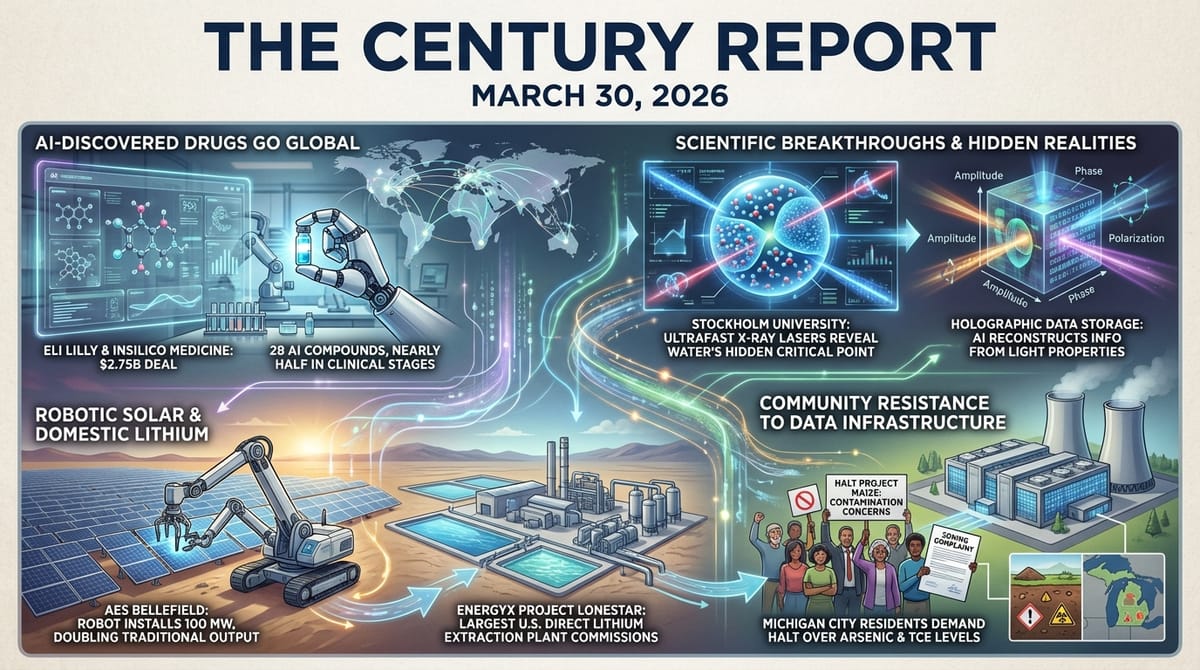
- Eli Lilly signed a $2.75 billion deal with Hong Kong-based Insilico Medicine to bring AI-discovered drugs to the global market, with 28 compounds developed using generative AI and nearly half already in clinical stages.
- A construction robot completed 100 megawatts of solar installation at the AES Bellefield complex in California, with its latest version consistently surpassing one module per minute and nearly doubling the output of traditional crews.
- Stockholm University researchers identified a hidden critical point in supercooled water where two distinct liquid phases merge, using ultrafast X-ray lasers to capture the state before freezing occurred.
- Michigan City, Indiana residents filed a zoning complaint and demanded construction halt at a suspected Google data center after soil samples showed contamination levels exceeding state safety criteria for arsenic and TCE.
- EnergyX commissioned the largest direct lithium extraction plant in the United States at Project Lonestar in Texas, producing 250 metric tonnes of battery-grade lithium carbonate equivalent per year.
- A new holographic data storage method encoding information across three properties of light simultaneously - amplitude, phase, and polarization - was demonstrated by researchers at Fujian Normal University, with an AI model reconstructing the data from diffraction patterns.
The 2-Minute Read
The Lilly-Insilico deal is the clearest signal yet that AI-driven drug discovery has crossed from experimental partnership into industrial-scale pharmaceutical strategy. Insilico has generated 28 compounds using generative AI, with nearly half already in clinical stages - a pipeline density that would have taken a conventional pharmaceutical company decades to assemble. Lilly is paying $115 million upfront with $2.75 billion in milestone payments, a structure that prices the AI discovery platform as a complement to one of the world's largest drug development operations rather than a speculative bet. When the largest pharmaceutical companies begin treating AI-originated molecules as production-ready inputs to their clinical machinery, the compression of drug development timelines moves from an interesting research finding to an economic fact with consequences for how quickly new treatments reach patients.
The robotic solar installation milestone and the Texas lithium extraction plant share an architectural logic: the physical infrastructure of the energy transition is being assembled by systems that did not exist at commercial scale two years ago. A robot that installs solar panels faster than human crews at utility scale, at a site that will eventually exceed a gigawatt of capacity, directly addresses the labor shortage constraining solar deployment. A domestic lithium extraction facility that produces battery-grade material from American brine breaks a supply chain dependency that has left the United States reliant on Chinese refining capacity for 70-75% of its lithium chemicals. Both developments demonstrate that the bottlenecks constraining clean energy buildout - labor availability and critical mineral sovereignty - are being resolved through the same pattern of engineering acceleration that defines this era.
The water critical point discovery and the holographic storage breakthrough share something less obvious: both involve capturing states of matter that are structurally unstable and exist only for fractions of a second. The Stockholm team used X-ray laser pulses to observe supercooled water before it crystallized, documenting a phase transition that has been theorized for decades but never directly measured. The Fujian team encoded data across three simultaneous properties of light and trained an AI model to reconstruct the information from what conventional sensors would read as noise. Each finding demonstrates that the instruments and intelligence systems available to science are now resolving phenomena that were previously below the threshold of observation - and each resolution opens categories of investigation that did not previously exist as experimental possibilities.
The 20-Minute Deep Dive
AI-Discovered Drugs Enter the Pharmaceutical Mainstream
Eli Lilly's $2.75 billion agreement with Insilico Medicine represents a structural shift in how frontier pharmaceutical capability meets AI-native drug discovery. Insilico, which went public in Hong Kong in December and has seen its shares rise more than 50% year-to-date, has developed at least 28 compounds using generative AI, with founder Alex Zhavoronkov confirming to CNBC that nearly half are already at a clinical stage. The deal gives Insilico $115 million upfront, with the remainder in regulatory and commercial milestones plus royalties on future sales.
The two companies have worked together since a 2023 AI-based software licensing agreement. What changed is the scope. Lilly's Andrew Adams, group vice president of Molecule Discovery, described Insilico's AI-enabled discovery as "a powerful complement" to Lilly's clinical development across multiple disease areas. Zhavoronkov noted that Lilly is "better than us in some areas of AI," pointing to a single individual who has unified biology, chemistry, and automation under one organizational roof. As part of the deal, Insilico will join Lilly's Gateway Labs community for biotech development.
This arrives against the backdrop of Sanofi committing approximately $4.5 billion across three deals in under 12 months to Earendil Labs, which The Century Report covered on March 23, and extends the research timeline compression that The Century Report documented on February 26 when MindRank reached Phase III in 4.5 years from project initiation for an AI-designed oral GLP-1 drug. The pattern is now unmistakable: the largest pharmaceutical companies on Earth are treating AI-originated drug candidates as production-grade inputs to their clinical pipelines, pricing them in billions rather than treating them as experimental curiosities. Insilico's approach - developing AI outside of China, in Canada and the Middle East, while conducting early preclinical work in China based on that AI research - illustrates how the global architecture of AI-enabled discovery is organizing itself around both capability and geopolitical constraints. Zhavoronkov noted that AI can synthesize molecules more quickly than those discovered using traditional methods, compressing not just the identification phase but the chemical synthesis that follows.
The deeper implication is about what pharmaceutical development becomes when the discovery bottleneck - historically the longest and most expensive phase - compresses from decades to years. Every drug that reaches clinical trials faster is a drug that reaches patients sooner. The 28 compounds Insilico has generated represent not just a pipeline but a demonstration that generative AI can produce clinical-stage molecules at a cadence that conventional chemistry cannot match. When Lilly, a company with a $900 billion market capitalization and one of the most sophisticated clinical development operations in the world, structures a $2.75 billion deal around that cadence, the signal is that the pharmaceutical industry's timeline architecture is being rebuilt around AI-native discovery as a permanent feature, not a temporary experiment.
Robots Build the Solar Grid
A Maximo construction robot completed 100 megawatts of solar installation at the AES Bellefield complex in California, one of the largest real-world demonstrations of robotic construction at utility-scale solar yet documented. The latest version 3.0 robots consistently surpassed an installation rate of one module per minute, with construction crews installing as many as 24 solar panel modules per hour per person. At full output, robot-equipped crews nearly doubled the installation rate of traditional methods at comparable Southern California solar sites.
This extends the pattern The Century Report tracked on March 21, when Terabase Energy began commercial shipments of its Terafab V2 autonomous robotic solar construction system rated at over 1 GW per factory-year. Maximo's milestone is significant because it represents verified performance at a real utility-scale project - the Bellefield complex is set to eventually exceed a gigawatt of total capacity - rather than a manufacturer's specification. The convergence of robotics, computer vision, and simulation-driven engineering is addressing the labor shortage that has been one of the binding constraints on solar deployment speed. As Maximo president Chris Shelton stated, this demonstrates that "field robotics can move beyond experimentation and deliver consistent results at utility scale."
The timing is acute. With a continuing conflict in the Middle East driving up fossil fuel energy costs, and data center demand adding pressure to already strained grids, the ability to install solar capacity faster with fewer workers is not an incremental improvement - it is a structural enabler of the energy transition at the pace the current moment demands. The U.S. added 43 GW of solar in 2025. Robotic installation systems that double crew output rates could meaningfully accelerate that number in the years ahead, particularly as the pipeline of permitted projects continues to grow faster than the available construction workforce.
Domestic Lithium Extraction Reaches Commercial Scale
EnergyX commissioned the largest direct lithium extraction plant in the United States at Project Lonestar in Texas. The facility is producing approximately 250 metric tonnes of battery-grade lithium carbonate equivalent per year using EnergyX's patented GET-LiT direct lithium extraction and refining technology. CEO Teague Egan described the milestone as foundational both for the company and for U.S. domestic lithium production, noting that it establishes EnergyX as what the company claims is the lowest-cost producer in the country.
The strategic significance is direct. China controls approximately 70-75% of global lithium chemical conversion capacity. Until now, it has been uneconomic for most non-Chinese converters to operate at investment-decision scale. Project Lonestar provides a scalable, cost-competitive domestic refining pathway that addresses the refining bottleneck visible across the critical minerals landscape. This connects to the broader pattern The Century Report has tracked in the energy infrastructure arc: U.S. grid battery manufacturing reached domestic self-sufficiency for the first time as documented on March 23, and now the upstream lithium supply chain is beginning to follow.
The facility's scale is modest compared to global demand, but the proof of concept at commercial operation is what allows capital to flow toward expansion. As The Century Report has consistently observed, the energy transition's pace is set by whichever physical constraint binds tightest at any given moment - and critical mineral refining has been among the tightest. Each facility that demonstrates economic viability outside the Chinese supply chain loosens that constraint incrementally, and the increments are beginning to compound.
Water's Hidden Architecture and the Instruments That Reveal It
Stockholm University researchers used ultrafast X-ray lasers to directly observe a long-theorized critical point in supercooled water, at approximately -63°C and 1,000 atmospheres, where two distinct liquid phases merge into one. The finding, published in Science, resolves a debate that has persisted for over a century since Wolfgang Röntgen's early work on water's anomalous properties.
What makes this structurally relevant is what it reveals about the threshold of observation itself. Water is the most studied substance on Earth, and yet this critical point - which influences water's behavior even at everyday temperatures and pressures - had never been directly measured because the state exists for only fractions of a second before crystallization occurs. The South Korean X-ray lasers at PAL-XFEL generated pulses fast enough to capture the phenomenon before it vanished. Researcher Robin Tyburski described the dynamics near the critical point as resembling a black hole: "It looks almost that you cannot escape the critical point if you entered it."
The implications extend beyond water physics. As Fivos Perakis, associate professor in Chemical Physics at Stockholm, noted: "I find it very exciting that water is the only supercritical liquid at ambient conditions where life exists and we also know there is no life without water. Is this a pure coincidence or is there some essential knowledge for us to gain in the future?" The discovery opens investigation into how water's critical-point-influenced behavior affects biological, chemical, geological, and climate-related processes. This instrument-crossing-threshold pattern connects directly to what the March 18 edition of The Century Report documented when MIT's terahertz microscope crossed the diffraction limit to directly observe superconducting electron behavior for the first time - in each case, a new instrument resolves phenomena that theory predicted but observation could not previously reach, opening entirely new categories of research that did not previously exist as experimental possibilities.
Data Centers Meet Community Resistance - Again
Michigan City, Indiana residents filed a zoning complaint and demanded a construction halt at the Project Maize data center site after soil samples revealed contamination exceeding state safety criteria for arsenic and trichloroethylene (TCE). The site is a former Federal-Mogul industrial facility with decades of documented contamination. Ashley Williams, executive director of Just Transition Northwest Indiana, sent a letter on behalf of multiple organizations including the Citizens Action Coalition and NAACP Michigan City Branch 3061-B, requesting that construction cease until all moved soil is fully characterized and contamination properly managed.
The Indiana Department of Environmental Management approved an air permit for the site on March 19, allowing 66 diesel-fired emergency generators with no emission control devices. At a December public hearing, more than 30 speakers expressed concerns about environmental impact. Residents allege that city officials are refusing to allow public viewing of data center site plans, citing an Indiana Code statute permitting municipalities to deny access under public safety threats.
This extends the community resistance pattern The Century Report has tracked since the Monterey Park five-thousand-signature petition in February, through the Saline Township, Michigan forced-construction controversy, the New Brunswick park replacement, and the Kentucky farmers declining any price for their land. The March 27 edition of The Century Report documented how local opposition is now materially slowing AI data center construction across multiple communities, establishing community resistance as a structural constraint on AI infrastructure buildout rather than a series of isolated incidents. What Michigan City adds to the pattern is contamination risk layered atop the standard community concerns about noise, emissions, and water use. The nondisclosure agreements signed by city officials before public discussion, the refusal to share site plans, and the approval of permits despite documented soil contamination describe an accountability gap between the infrastructure being built and the communities absorbing its consequences. This gap is the governance frontier that data center buildout is creating - and communities are increasingly organized, legally sophisticated, and unwilling to accept that the infrastructure of the intelligence era arrives without their informed consent. The question being answered in Michigan City and dozens of communities like it is whether the physical substrate of AI will be built with or against the people who live alongside it. The answer to that question will shape public acceptance of the transition itself.
The Century Perspective
With a century of change unfolding in a decade, a single day looks like this: Eli Lilly pricing 28 AI-generated drug compounds at $2.75 billion as production-grade clinical inputs rather than speculative experiments, a construction robot doubling solar installation rates at utility scale while the first domestic direct lithium extraction plant severs a critical mineral dependency that has run through Chinese refining capacity for decades, and ultrafast X-ray lasers resolving a hidden phase of water theorized since Röntgen's era but never captured because it vanishes before conventional instruments can reach it. There's also friction, and it's intense - Michigan City residents discovering that their neighborhood's new data center sits on a former industrial site with arsenic and TCE contamination in the soil, permits approved and site plans withheld behind nondisclosure agreements while organized community coalitions demand the environmental accountability that the infrastructure buildout is outrunning, and the gap between what is being constructed and who bears the consequences widening with every construction start that precedes consent. But friction generates pressure, and pressure is what forces hidden things to the surface where they can finally be named and addressed. Step back for a moment and you can see it: the discovery, energy, and materials bottlenecks that have defined the pace of human progress each yielding simultaneously - AI compressing pharmaceutical timelines from decades to years, robots resolving the labor constraints on solar deployment, domestic lithium refining closing the supply chain gap that left clean energy dependent on a single nation's processing capacity, and instruments crossing observation thresholds that rewrite foundational science about substances as familiar as water. Every transformation has a breaking point. A current can erode the ground beneath what has always stood firm... or carve the channel through which everything that comes next will finally be able to flow.
AI Releases & Advancements
New today
(No new releases identified.)
Other recent releases
- Anthropic: Released Bloom, an open-source agentic framework for automated behavioral evaluations of frontier AI models, tested across 16 frontier models. (Anthropic Research)
- Anthropic: Launched Claude Dispatch in research preview on March 28, enabling users to text Claude from their phone to trigger computer-use tasks on their Mac desktop via Claude Cowork. (TechCrunch)
- Meta: Released SAM 3.1, a drop-in update to SAM 3 that introduces object multiplexing for significantly faster video processing without sacrificing accuracy. (AI at Meta on X)
- Bluesky: Launched Attie in beta at the Atmosphere conference on March 28, a standalone AI-powered app using Anthropic's Claude that lets users build custom feeds and apps on the AT Protocol via natural language. (TechCrunch)
- OpenYak: Released an open-source AI desktop agent on GitHub under AGPL-3.0, providing Claude Code-like agentic capabilities with filesystem access running locally on Windows and macOS. (GitHub)
- TypeWhisper: Released TypeWhisper 1.0, a free open-source (GPLv3) macOS dictation app supporting local Whisper engines (WhisperKit, Parakeet, Qwen3) with LLM post-processing for system-wide speech-to-text. (Reddit)
- Google Research: Released TurboQuant, an open-source KV-cache compression algorithm achieving 4.6x compression at 98% FP16 speed with zero accuracy loss; implementations available for llama.cpp and MLX. (Ars Technica)
- Mistral AI: Released Voxtral TTS (Voxtral-4B-TTS-2603), a 4B-parameter open-weight text-to-speech model with zero-shot voice cloning, ~100ms time-to-first-audio, and support for 9 languages; available on Hugging Face under CC BY-NC 4.0. (Mistral AI)
- Cohere: Released Cohere Transcribe, an open-source 2B-parameter Conformer-based ASR model supporting 14 languages; ranked #1 on the Hugging Face Open ASR Leaderboard for English; Apache 2.0 licensed. (Hugging Face)
- Tencent: Open-sourced Covo-Audio, a 7B-parameter end-to-end speech language model for real-time audio conversations and reasoning, with weights and inference pipeline on GitHub and Hugging Face. (GitHub)
- Google: Launched Memory Import and Chat History Import tools for Gemini on desktop, enabling users to transfer memories and full conversation archives from other AI chatbots into Gemini. (Google Blog)
- Anthropic: Shipped Claude Code auto-fix in the cloud, enabling web and mobile sessions to automatically monitor pull requests and fix CI failures without a local terminal. (X/Twitter)
- Composio: Launched Universal CLI, a terminal tool connecting AI agents (Claude Code, Codex CLI, etc.) to 1,000+ apps directly from the command line. (Composio Blog)
- Symbolica: Released Agentica SDK, which scored 36.08% on ARC-AGI-3 on day one, passing 113 of 182 levels for $1,005 in compute; open-source on GitHub. (GitHub)
Sources
Artificial Intelligence & Technology's Reconstitution
- CNBC: Eli Lilly Reaches $2.75 Billion Deal with Insilico to Bring AI-Developed Drugs to Global Market
- Business Insider: Anthropic's Post-Pentagon Resistance Surge Is Fading
- TechCrunch: Why OpenAI Really Shut Down Sora
- ScienceDaily: New Holographic Data Storage Approach Packs More Data Into the Same Space
Institutions & Power Realignment
- Chicago Tribune: Michigan City Residents Want to Halt Project Maize Construction
- Guardian: Keir Starmer Says UK Will 'Have to Act' to Curb Addictive Features of Social Media
- Guardian: 'Soon Publishers Won't Stand a Chance': Literary World in Struggle to Detect AI-Written Books
Scientific & Medical Acceleration
- ScienceDaily: Hidden State of Water Could Explain Why Life Exists
- ScienceDaily: Just a Few Minutes of Effort Could Lower Your Risk of 8 Major Diseases
- ScienceDaily: Stroke Triggers a Hidden Brain Change That Looks Like Rejuvenation
- BioSpace: HI-PEITHO Trial Demonstrates Boston Scientific EKOS System Superior to Standard of Care for Pulmonary Embolism
- Nature: Dawkins's Paradox - Dissecting the Body's Battle to Keep Selfish Genes in Check
Economics & Labor Transformation
- Peter Diamandis Metatrends: From UBI to UHI (In 3 Steps)
- CNBC: Quantum Firms Are Racing to Market as the Industry Hits 'Inflection Point'
Infrastructure & Engineering Transitions
- Electrek: This Friendly Robot Just Installed 100 MW of Solar Power
- Mining.com.au: EnergyX's Project Lonestar Delivers US-Made Lithium Milestone
- POWER Magazine: Arevon Starts Construction of $600-Million Cormorant Energy Storage Project
- Canary Media: Many Homes Already Have the Power to Electrify, Study Finds
- ET EnergyWorld: Premier Energies Commissions 5.6 GW Solar Module Facility in Telangana
- Fortune: Big Tech Was Embracing Clean Energy. Then AI Data Centers Arrived
The Century Report tracks structural shifts during the transition between eras. It is produced daily as a perceptual alignment tool - not prediction, not persuasion, just pattern recognition for people paying attention.