TCR 03/21/26: The Governance War Begins

The 20-Second Scan
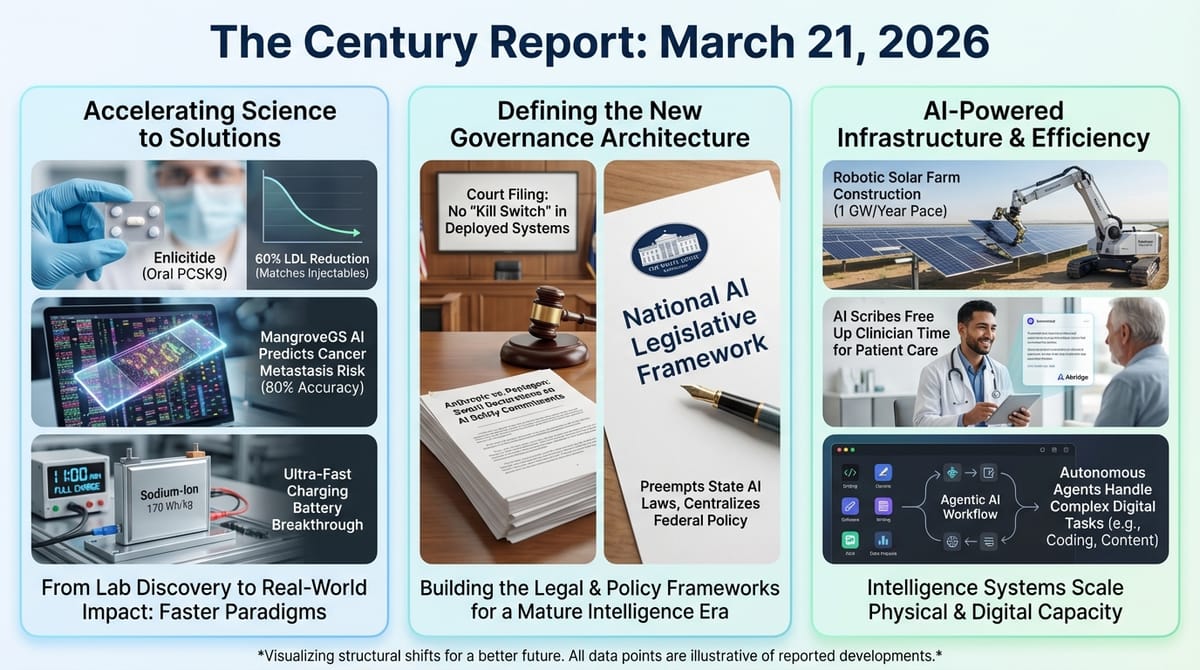
- Anthropic filed sworn declarations stating it has no kill switch, no backdoor, and no ability to alter Claude's behavior once deployed inside air-gapped military systems.
- A new court filing revealed the Pentagon told Anthropic the two sides were "very close" on the contested surveillance and autonomous weapons issues one day after finalizing the supply-chain risk designation.
- The White House released a national AI legislative framework calling on Congress to preempt state AI laws and avoid regulating AI development.
- Authors seeking final approval of their $1.5 billion copyright settlement with Anthropic reduced their attorneys' fee request to 12.5% of the deal.
- BAIC Group completed its first sodium-ion battery prototype achieving 170 Wh/kg energy density and 11-minute full recharge via 4C ultra-fast charging.
- University of Geneva researchers developed MangroveGS, an AI system that predicts cancer metastasis risk with 80% accuracy across multiple tumor types by reading gene expression patterns in colon cancer cells.
- A new oral cholesterol drug called enlicitide reduced LDL cholesterol by 60% in a Phase III trial of 2,909 patients, matching injectable therapies for the first time in pill form.
- Terabase Energy began commercial shipments of Terafab V2, an AI-powered robotic system that builds solar farms at a rate exceeding 1 GW per factory-year.
The 2-Minute Read
The Anthropic-Pentagon confrontation crossed a structural threshold yesterday. Sworn declarations from Anthropic's head of public sector and head of policy directly contradict the government's core national security argument by establishing, under penalty of perjury, that the company cannot technically alter Claude's behavior once the system is deployed inside classified environments. The filing also revealed that a Pentagon official emailed Anthropic's CEO calling their positions "very close" on the two contested issues - mass surveillance and autonomous weapons - one day after the supply-chain risk designation was formalized. The timeline raises a question the court will likely address at Tuesday's hearing: whether the designation was a genuine security assessment or a negotiating instrument. With Palantir's developer conference this week celebrating AI's role in active warfighting and the Pentagon simultaneously arguing that safety commitments constitute supply-chain contamination, the institutional architecture governing how intelligence systems participate in military operations is being constructed through litigation, sworn testimony, and operational precedent simultaneously.
The White House's release of a national AI legislative framework represents a formal bid to centralize AI governance at the federal level while explicitly limiting states' authority to regulate AI development. The framework's most consequential provision would preempt state laws that the administration considers burdensome, which could affect the four states that have already passed comprehensive AI legislation. The framework also takes a position on copyright, asserting that training on copyrighted material does not violate copyright laws while simultaneously acknowledging that courts should resolve the question. This arrives on the same day that authors asked a federal court to finalize a $1.5 billion settlement with Anthropic over exactly that issue, creating a striking juxtaposition: the executive branch declaring a legal principle settled while the judiciary processes the largest copyright class action in history.
The scientific and infrastructure signals share a common architecture of precision reaching production scale. An AI system predicting cancer metastasis at 80% accuracy across tumor types, an oral drug matching injectable cholesterol therapies, and a robotic solar construction system operating at gigawatt-year pace each demonstrate the same pattern: capabilities that were laboratory demonstrations months ago are entering clinical trials, commercial shipments, and real-world deployment. The sodium-ion battery prototype achieving 11-minute full recharge extends the pattern further, arriving just weeks after CATL's mass-production debut and confirming that the chemistry's commercial viability is no longer theoretical. Each development compresses the distance between discovery and deployment in ways that compound across domains.
The 20-Minute Deep Dive
The Pentagon's Case Collides With the Technical Record
The Anthropic-Pentagon confrontation entered its most technically specific phase yesterday when two sworn declarations filed in federal court established that the government's central argument rests on a capability Anthropic does not possess. Thiyagu Ramasamy, Anthropic's head of public sector and a former six-year veteran of AWS government deployments, stated under oath that "Anthropic does not maintain any back door or remote 'kill switch'" and that company personnel "cannot, for example, log into a DoW system to modify or disable the models during an operation." The declaration explains that once Claude is deployed inside a government-secured, air-gapped system operated by a third-party contractor, any update requires explicit Pentagon approval and contractor action to install.
Sarah Heck's declaration carries a different kind of weight. As a former National Security Council official who was personally present at the February 24 meeting between CEO Dario Amodei and Defense Secretary Hegseth, she states that the Pentagon's concern about Anthropic potentially disabling technology mid-operation "was never raised during negotiations" and "appeared for the first time in the government's court filings." She attaches an email from Under Secretary Emil Michael dated March 4 - the day after the supply-chain risk designation was finalized - telling Amodei the two sides were "very close" on the exact issues the government now cites as evidence of national security risk.
The timeline Heck constructs is precise and damaging to the government's position. If the Pentagon's own negotiator believed agreement was imminent on the issues of autonomous weapons and mass surveillance the day after the designation was imposed, the designation's relationship to those issues becomes harder to sustain as a national security judgment rather than a negotiating posture. Judge Rita Lin will hear the preliminary injunction arguments on Tuesday, and the sworn declarations provide the factual foundation for Anthropic's claim that the designation was retribution rather than risk assessment. As The Century Report has documented since the confrontation's origins in late February, the central sticking point was never capability assessment - it was the single phrase "analysis of bulk acquired data" and what compliance with that phrase would require Anthropic to enable.
This arrives in the same week that Palantir hosted its developer conference with CEO Alex Karp declaring that the company's "sole priority" is supporting warfighters and that employees who expect debate about military support "have got the wrong company." Palantir's CTO described the company's trajectory from embedding engineers in customer operations to enabling customers to build their own AI-powered capabilities. The contrast between Palantir's posture - unconditional operational commitment to military clients - and Anthropic's - safety commitments maintained under state-level pressure - defines the two poles of the governance framework being constructed in real time. The court's ruling will determine which pole the legal system reinforces.
The trajectory beyond this specific case extends to every organization deploying intelligence systems in high-stakes environments. If embedded safety commitments can be designated as supply-chain risks, the incentive structure for every frontier AI company shifts toward stripping those commitments from their architectures. If the designation is overturned, the precedent protects the principle that intelligence systems can carry design-level values into deployment without exposure to state retaliation. The March 25 hearing carries implications that extend far beyond the immediate parties.
A Federal Bid to Define AI Governance Architecture
The White House's national AI legislative framework released yesterday represents the most specific articulation yet of the administration's vision for how the intelligence era should be governed. The seven-point plan calls on Congress to preempt state AI laws, avoid creating new regulatory bodies, let existing agencies regulate within their domains, and refrain from legislating on whether AI training on copyrighted material constitutes fair use.
The framework's structural ambition is centralization. It argues that states "should not be permitted to regulate AI development, because it is an inherently interstate phenomenon with key foreign policy and national security implications." Four states - Colorado, California, Utah, and Texas - have already passed comprehensive AI legislation, and dozens more have bills in progress. The framework would constrain all of them, replacing what the administration calls a "patchwork" with federal standards that explicitly prioritize innovation and scaling. The preemption bid arrives as The Century Report has tracked a 2026 legislative wave in which states have been the primary governance actors - from Virginia's unanimous balcony solar vote to Illinois's data center self-supply mandate to the 27-state balcony solar legislative campaign - filling the vacuum that federal inaction created.
The child safety provisions represent the framework's most developed section and its most politically pragmatic concession. It calls for age assurance requirements, limits on training AI models on minors' data, and protections against AI-generated child sexual abuse material. Notably, this is the one area where the framework does not seek to preempt state authority, reflecting the bipartisan political reality that child safety legislation has support across the spectrum. The framework's language here is substantive enough to address the political pressure without imposing the kind of structural accountability that privacy advocates have demanded.
The copyright position is revealing in its strategic ambiguity. The administration "believes that training of AI models on copyrighted material does not violate copyright laws" but "supports allowing the Courts to resolve this issue." This arrives on the same day authors filed for final approval of their $1.5 billion settlement with Anthropic - the largest copyright class action settlement in history - in which Anthropic agreed to pay more than $3,000 per work it was accused of downloading from pirate websites. The executive branch is declaring the legal question settled while the judiciary is processing evidence that at least one major AI company found the question worth $1.5 billion to resolve.
Critics from both directions have identified gaps. The Electronic Privacy Information Center called the framework "light on protection and heavy on promotion of dangerous AI systems." The Alliance for Secure AI argued it "provides no path to accountability for AI developers for the harms caused by their products." Industry groups, by contrast, welcomed it. The question of whether Congress adopts any of these recommendations remains open, but the framework establishes the administration's position as the baseline against which all subsequent federal AI legislation will be measured. The structural significance is that the terms of the debate are being set by an administration whose AI czar is a venture capitalist and whose stated priority is "global AI dominance" - terms that will persist even as the specific policy proposals evolve.
Precision Medicine Reaches Oral Delivery
Two scientific developments yesterday crossed thresholds that have separated laboratory capability from population-scale impact. A Phase III trial of enlicitide, an oral PCSK9 inhibitor, demonstrated 60% reduction in LDL cholesterol in 2,909 patients - matching the efficacy of injectable therapies that have been available for years but remain underused precisely because they require injections. The study, published in the New England Journal of Medicine and led by UT Southwestern's Ann Marie Navar, represents the culmination of a research lineage stretching back to the Nobel Prize-winning discovery of LDL receptors at the same institution. This extends the pattern of research timeline compression that The Century Report tracked on March 7 when an Anthropic labor study documented AI covering 94% of theoretical computer and math tasks - the same acceleration dynamic now shortening the distance between molecular target identification and population-scale drug delivery.
The clinical significance is in the delivery mechanism, not the molecular target. PCSK9 inhibitors have proven their value since their introduction, but fewer than half of patients with established atherosclerotic cardiovascular disease currently reach their cholesterol targets, even on statins. The injectable format has been a primary barrier to adoption. An oral drug achieving equivalent efficacy removes that barrier for a population-level intervention. A follow-up trial is already underway to determine whether the cholesterol reductions translate into fewer heart attacks and strokes.
In parallel, the University of Geneva's MangroveGS system demonstrates a different kind of precision reaching deployment readiness. The AI system analyzed hundreds of gene signatures across cell clones from colon tumors and identified patterns that predict metastatic potential with approximately 80% accuracy - outperforming existing clinical methods. The system works directly with hospital tumor samples: cells are analyzed, RNA is sequenced, and a risk score is generated through an encrypted platform. The researchers found that the gene signatures derived from colon cancer also predicted metastatic risk in stomach, lung, and breast cancer, suggesting a shared biological logic underlying cancer spread across tissue types. The cross-tumor generalization echoes the pattern The Century Report documented on March 12 when Scripps Research's protein-folding Alzheimer's diagnostic validated across independent cohorts - AI systems trained on one biological context discovering signals that transfer across tissue types and disease categories.
Both findings share the architecture of computational resolution reaching the threshold where population-scale intervention becomes possible. The cholesterol drug converts a proven molecular mechanism into a delivery format the healthcare system can actually distribute. The cancer prediction system converts complex gene expression data into a clinical decision that determines whether a patient receives aggressive treatment or monitoring. In each case, the capability existed in some form before - injectable PCSK9 inhibitors, expert pathological assessment - but the new form makes it accessible at a scale that transforms outcomes from individual to systemic.
Solar Construction Enters the Robot Era
Terabase Energy's commercial launch of Terafab V2 marks a structural shift in how the physical infrastructure of the energy transition gets built. The system combines autonomous robotics, AI-driven manufacturing execution, and a fundamentally different construction sequence to install solar equipment on a two-minute cycle. Running continuously, a single Terafab line installs more than 20 MW per week - exceeding 1 GW per factory-year.
The architectural innovation is in the process inversion. Traditional solar construction installs steel torque tubes first, then workers manually attach panels one by one. Terafab pre-assembles panels onto torque tubes with integrated quality checks, then specialized rovers move completed units into position. This eliminates the manual lifting of heavy glass and steel components, improves safety in extreme heat conditions, and catches defects at assembly rather than after field installation. Terabase expects the rovers to become fully autonomous in the near future.
The timing aligns with a structural constraint. The world added 814 GW of wind and solar in 2025, and GlobalData projects global solar capacity reaching 6 TW by 2031. Labor shortages are one of the primary bottlenecks constraining that buildout - solar farms can span thousands of acres with millions of components, and the installation workforce has not scaled proportionally to demand. Terabase's facility in Northern California targets capacity to support 10 GW of annual installations, with the system designed and manufactured domestically.
The sodium-ion battery development from BAIC Group extends the acceleration pattern into energy storage chemistry. The prototype's 170 Wh/kg energy density places it among the best in the industry, and the 4C ultra-fast charging capability enables full recharge in approximately 11 minutes. The battery maintains over 92% energy retention at -20°C. This arrives just over a month after CATL and Changan Automobile unveiled the world's first mass-produced EV with a sodium-ion battery, and global sodium-ion shipments are projected to grow from 9 GWh in 2025 to over 1,000 GWh within four years. Sodium offers a lower-cost, less price-sensitive alternative to lithium, and the convergence of multiple Chinese manufacturers reaching production-ready prototypes simultaneously suggests the chemistry is crossing from demonstration to industrial reality.
The broader energy picture carries a geopolitical dimension that the Iran conflict has sharpened. BYD dealerships across Southeast Asia are reporting surging demand as oil prices climb, with one Manila location booking a month's worth of orders in two weeks. Shopping data from Edmunds showed U.S. consideration for electrified vehicles rose more than 20% in the first week of March alone. The structural argument for electrification has always been strongest when fossil fuel prices are high, and the current conflict is providing the clearest real-world demonstration of that principle at scale. The infrastructure being built now - robotic solar construction, sodium-ion chemistry, distributed battery storage - will outlast any specific conflict and continue generating returns regardless of oil prices. The transition's physical substrate is being assembled during a period of maximum fossil fuel vulnerability, which is both the source of current pain and the catalyst for permanent structural change.
The Century Perspective
With a century of change unfolding in a decade, a single day looks like this: an AI system reading gene expression patterns across tumor types to flag metastatic risk before a single cell migrates, an oral pill matching the cholesterol-lowering power of injectable therapies to bring cardiovascular prevention within reach for the first time at population scale, a robotic solar construction system shipping commercially at gigawatt-year pace, and sodium-ion battery chemistry crossing from prototype to production-ready across multiple laboratories simultaneously. There's also friction, and it's intense - the Pentagon arguing in sworn filings that safety commitments embedded in an AI system's architecture constitute a national security liability, the White House seeking to preempt the state legislatures that have been the only governing bodies to pass comprehensive AI legislation, and the largest copyright class action in history reaching for final approval on the same day the executive branch declares the underlying legal question already resolved. But friction generates edges, and edges are what make it possible to cut through what blunt force alone cannot separate. Step back for a moment and you can see it: therapeutic precision arriving in the delivery formats healthcare systems can actually distribute at scale, the physical infrastructure of the energy transition being assembled by intelligence systems at speeds human labor alone could never sustain, the legal terms governing how AI participates in military operations being established under oath in federal courtrooms, and the governance architecture for the entire intelligence era being contested simultaneously at every level of government. Every transformation has a breaking point. A graft can fail to take and leave the host more exposed than before... or fuse until the boundary between what was added and what was always there becomes impossible to locate.
AI Releases & Advancements
New today
- IBM Research / Generative Computing: Released Mellea 0.4.0 and three Granite Libraries on March 20, 2026; Mellea is an open-source Python library for structured generative AI workflows using constrained decoding, structured repair loops, and composable pipelines; the three libraries — granitelib-core-r1.0, granitelib-rag-r1.0, and granitelib-guardian-r1.0 — are LoRA adapter collections for the granite-4.0-micro model targeting requirements validation, agentic RAG pipelines, and safety/compliance checks respectively. (Hugging Face)
- Convergence AI: Open-sourced Proxy Lite 3B, a 3B-parameter Vision-Language Model fine-tuned from Qwen2.5-VL-3B-Instruct for fully autonomous web browser task completion; scores 72.4% on the WebVoyager benchmark, #1 among open-weights models; includes a CLI tool, Streamlit app, and vLLM serving recipe. (Hugging Face)
- Perplexity: Released Comet AI browser on iOS and iPadOS on March 18, following the prior Android launch; available free on the App Store with a built-in AI assistant and agentic web-browsing capabilities. (Perplexity)
- WordPress.com (Automattic): Launched write capabilities for its MCP integration on March 20, enabling AI agents (Claude, ChatGPT, Cursor, OpenClaw) to create posts, build pages, manage comments, organize categories and tags, and fix media metadata directly on WordPress.com sites via natural language with human approval at each step; adds 19 new operations across six content types; available to paid plan subscribers. (WordPress.com Blog)
- Visa: Launched the Visa Agentic Ready programme on March 17, a global framework enabling banks and merchants to test and validate AI agent-initiated payment transactions in real-world environments; initial European rollout includes Commerzbank and DZ Bank as pilot partners. (Mynewsdesk / Visa)
- Starling Bank: Launched Starling Assistant on March 20, billed as the UK's first agentic AI financial assistant; powered by Google Gemini on Google Cloud, it can set savings goals, organise bill payments, reply to spending queries via voice or text, and subsumes the earlier Spending Intelligence and Scam Intelligence tools under a single conversational interface; rolling out to personal account holders. (The Next Web)
- DoorDash: Launched Tasks, a standalone app for DoorDash couriers that pays them to record real-world activities (e.g., household chores, walking, cooking) to generate training data for AI and robotics models; pay is shown upfront per task. (TechCrunch)
Other recent releases
- Cursor: Released Composer 2, an in-house frontier-class coding model scoring 61.3 on CursorBench, 61.7 on Terminal-Bench 2.0, and 73.7 on SWE-bench Multilingual; trained via a first continued pretraining run feeding into RL; available in Cursor now at $0.50/$2.50 per 1M input/output tokens (~86% cheaper than Composer 1.5). (Cursor)
- Anthropic: Released Claude Code Channels in research preview, enabling developers to control their Claude Code session remotely via Telegram and Discord without needing to be at a computer. (VentureBeat)
- LangChain: Launched LangSmith Fleet (rebranded from Agent Builder), a centralized enterprise workspace for building, sharing, and managing fleets of AI agents with identity controls, credential management, permissioning, Slack exposure, and audit trails. (LangChain Blog)
- Google: Released an open-source MCP server for Google Colab, enabling any local AI agent to write and execute code in a Colab notebook and access cloud GPU runtimes via the Model Context Protocol with no custom integration required. (Google Developers Blog)
- Google: Launched a full-stack vibe coding experience in Google AI Studio powered by Gemini 3.1 Pro, adding one-click database setup via Firebase, one-click Cloud Run deployment, and a built-in preview pane for generating production-ready web apps from text prompts. (Google Blog)
- NVIDIA: Released Nemotron-Cascade 2, an open-weight 30B MoE model with only 3B active parameters; achieves Gold Medal-level performance on the 2025 IMO, IOI, and ICPC World Finals — the second open-weight model to do so — at 20x fewer parameters than frontier competitors; weights and training data released on Hugging Face. (NVIDIA Research)
- Cognition: Launched multi-agent Devin ("Teams of Devins"), where Devin autonomously decomposes large tasks and delegates subtasks to parallel Devin instances each running in isolated VMs. (Cognition / X)
- Adobe: Launched Firefly Custom Models in public beta, allowing creators and brands to train a private image generation model on their own assets to preserve consistent character designs, illustration styles, and photography aesthetics across generated outputs. (The Verge)
- ElevenLabs: Launched the Music Marketplace on March 19, enabling users to publish AI-generated songs made with Eleven Music and earn revenue each time businesses or creators with paid subscriptions license those tracks for ads, games, videos, or other commercial projects. (Billboard)
- MiniMax: Released MiniMax M2.7, a self-evolving agentic model scoring 56.22% on SWE-Bench Pro and 57.0% on Terminal Bench 2, with parity to Claude Sonnet 4.6 on OpenClaw benchmarks; features recursive self-improvement across skills, memory, and architecture; available immediately via Ollama cloud, OpenRouter, Vercel, and other platforms at $0.30/$1.20 per 1M input/output tokens. (MiniMax)
- Xiaomi: Released three MiMo-V2 models on March 18–19: MiMo-V2-Pro, a closed-weight flagship with over 1 trillion parameters and 1M token context at $1/$3 per 1M tokens available via API; MiMo-V2-Omni, a multimodal closed-weight model; and MiMo-V2-TTS, a text-to-speech model. (Gizmochina)
- Nous Research: Released Hermes Agent v0.3.0 on March 17, incorporating 248 pull requests from 15 contributors in 5 days; new capabilities include real-time streaming across CLI and all platforms, a first-class plugin architecture, live Chrome browser control via CDP, local Whisper-based voice mode, PII redaction, and integrations with Browser Use and IDE tools. (GitHub)
- LangChain: Open-sourced Open SWE on March 17, a background coding agent framework mirroring internal systems used at Stripe, Ramp, and Coinbase; integrates with Slack, Linear, and GitHub, uses subagents plus middleware, and separates harness, sandbox, invocation, and validation layers. (GitHub)
- LangChain: Launched LangSmith Sandboxes in Private Preview on March 17, providing microVM-isolated environments for AI agents to safely execute untrusted code, spinnable in a single line of code via the LangSmith SDK. (LangChain Blog)
- Snowflake: Launched Project SnowWork in research preview on March 18, an autonomous enterprise AI platform that orchestrates planning, analysis, and multi-step task execution directly on Snowflake data; available to a limited set of customers. (Snowflake)
- Amazon: Launched Alexa+ in the UK on March 19 via an early access program tied to new Echo device purchases; the first international rollout of the AI-powered conversational assistant outside North America, with Prime subscribers receiving access for free and non-Prime at £19.99/month once the early access period ends. (TechCrunch)
- Multiverse Computing: Launched the CompactifAI app and developer API portal, enabling offline inference of compressed models from OpenAI, Meta, DeepSeek, and Mistral AI on edge devices with no cloud dependency; the API portal also added Nemotron 3 family models. (TechCrunch)
Sources
Artificial Intelligence & Technology's Reconstitution
- Wired: Anthropic Denies It Could Sabotage AI Tools During War
- TechCrunch: New Court Filing Reveals Pentagon Told Anthropic the Two Sides Were Nearly Aligned
- Bloomberg Law: Authors' Lawyers Lower Fees Ask in Anthropic Pact Approval Bid
- The Atlantic: The Hypocrisy at the Heart of the AI Industry
- Wired: At Palantir's Developer Conference, AI Is Built to Win Wars
- The Verge: Google Search Is Now Using AI to Replace Headlines
- CNBC: OpenClaw's ChatGPT Moment Sparks Concern That AI Models Are Becoming Commodities
- Guardian: Meta AI Agent's Instruction Causes Large Sensitive Data Leak to Employees
- Guardian: Senior European Journalist Suspended Over AI-Generated Quotes
- OpenAI: How We Monitor Internal Coding Agents for Misalignment
Institutions & Power Realignment
- The Verge: Trump Takes Another Shot at Dismantling State AI Regulation
- TechCrunch: Trump's AI Framework Targets State Laws, Shifts Child Safety Burden to Parents
- CNET: Trump Outlines New AI Regulation Plan
- Gizmodo: Trump Proposes a 'Light Touch' National Framework for AI Policy
- LA Times: White House Moves to Strip California and Other States of AI Regulation Power
- Law.com: DOJ Defends Anthropic Security Risk Designation at DC Circuit
- Guardian: Palantir Suing a Small Swiss Magazine
- Guardian: Atlassian Layoffs - First Came the AI 'Teammates', Then the Layoffs
Scientific & Medical Acceleration
- ScienceDaily: New AI Tool Predicts Cancer Spread With Surprising Accuracy (Cell Reports)
- ScienceDaily: New Pill Cuts Bad Cholesterol by 60% (NEJM)
- ScienceDaily: Gum Disease Bacterium Linked to Breast Cancer (Cell Communication and Signaling)
- ScienceDaily: Scientists Turn Probiotic Bacteria Into Tumor-Hunting Cancer Killers (PLOS Biology)
- ScienceDaily: Harvard Engineers Build Chip That Can Twist and Control Light in Real Time (Optica)
- ScienceDaily: Scientists Found a Hidden 48-Dimensional World in Quantum Light (Nature Communications)
- ScienceDaily: Shingles Vaccine Cuts Heart Risk Nearly in Half (ACC.26)
- ScienceDaily: Scientists Turn CO2 Into Fuel Using Breakthrough Single-Atom Catalyst (ETH Zurich)
- ScienceDaily: Tectonic Shift: Earth Was Already Moving 3.5 Billion Years Ago (Science)
Economics & Labor Transformation
- Wired: I Tried DoorDash's Tasks App and Saw the Bleak Future of AI Gig Work
- Guardian: Western Carmakers' Retreat From Electric Risks Dooming Them to Irrelevance
- MIT Technology Review: Mind-Altering Substances Are Still Falling Short in Clinical Trials
Infrastructure & Engineering Transitions
- Electrek: A 24/7 Solar Farm-Building Robot Just Hit the Market
- Electrek: Another Sodium-Ion EV Battery Breakthrough Emerges in China
- Electrek: BYD's Bet on EVs Is Paying Off as Drivers Ditch Gas Amid Rising Oil Prices
- Canary Media: Next-Gen Nuclear Has a Chicken-and-Egg Problem
- Canary Media: Where in the World Is Clean Energy Technology Made?
- Utility Dive: Why Data Centers Will Need a 'Bring Your Own Power' Strategy
- Canary Media: Trump's Latest Attempt to Derail EV-Charger Construction
The Century Report tracks structural shifts during the transition between eras. It is produced daily as a perceptual alignment tool - not prediction, not persuasion, just pattern recognition for people paying attention.