TCR 03/20/26: The Automated Researcher

The 20-Second Scan
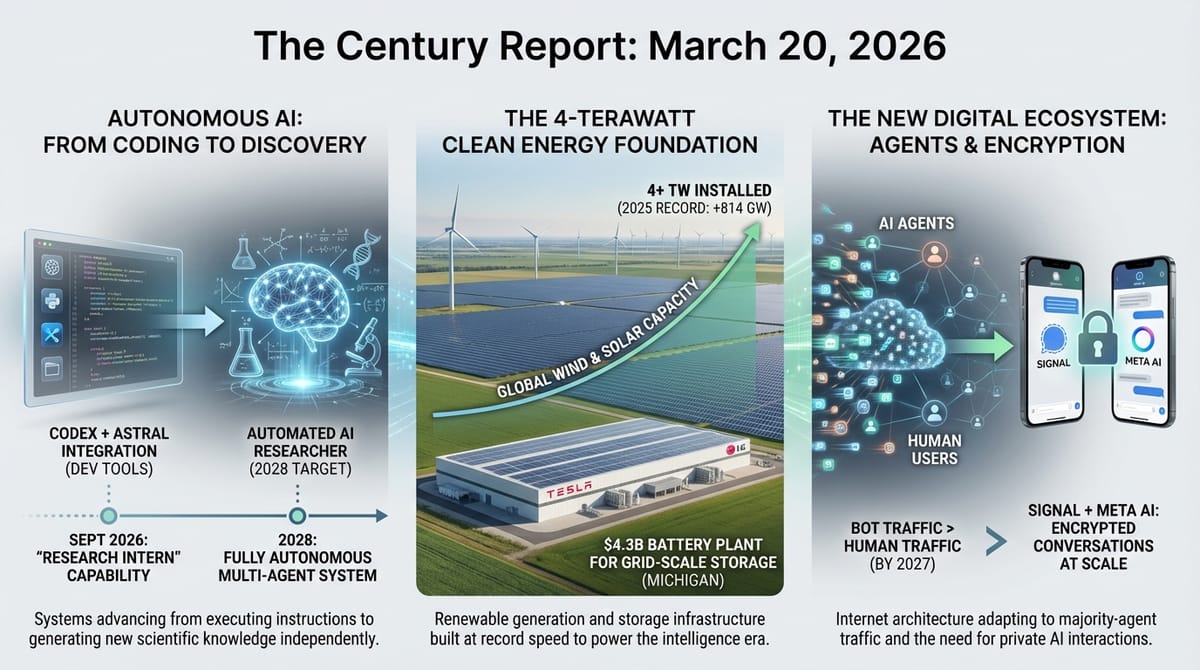
- OpenAI announced its acquisition of Astral, the company behind Python development tools used hundreds of millions of times monthly, integrating the team into its Codex division.
- OpenAI's chief scientist disclosed the company is building a fully automated AI researcher targeting an "autonomous research intern" by September and a complete multi-agent research system by 2028.
- The world added a record 814 GW of wind and solar capacity in 2025, bringing total global installed capacity past 4 terawatts.
- Tesla and LG announced a $4.3 billion battery manufacturing plant in Michigan to supply cells for Tesla's Megapack 3 utility-scale energy storage systems.
- Cloudflare's CEO projected that AI bot traffic will exceed human internet traffic by 2027, with agents visiting 1,000 times more websites per task than a human would.
- A modified herpes virus injected into glioblastoma tumors drew immune cells deep into the cancer and kept them active, with proximity of T cells to dying tumor cells correlating to longer patient survival, published in Cell.
- Signal creator Moxie Marlinspike announced that his encrypted AI platform Confer will integrate its privacy technology into Meta AI, aiming to bring end-to-end encryption to AI conversations at scale.
The 2-Minute Read
OpenAI's simultaneous moves yesterday - acquiring the Python infrastructure company Astral and publicly committing to build a fully autonomous AI researcher by 2028 - describe a company assembling the substrate for a world where intelligence systems conduct sustained, independent research. Chief scientist Jakub Pachocki's description of an "autonomous research intern" by September frames a near-term milestone where AI systems work unsupervised for days on problems currently requiring human researchers. The Astral acquisition embeds widely used developer tools directly into OpenAI's Codex platform, tightening the loop between AI coding capability and the software ecosystem it operates within. These are infrastructure decisions, not product announcements - they reshape what AI systems can structurally do and how deeply they integrate with the computational environment.
The energy infrastructure signal carries a striking convergence of scale and speed. The world crossing 4 terawatts of installed wind and solar capacity is a structural milestone: the generation added in 2025 alone can displace more than one-seventh of global gas-fired power. Tesla and LG's $4.3 billion battery plant in Michigan extends the pattern of industrial capital redirecting from vehicles to grid-scale storage at accelerating pace, following GM-LG's Tennessee LFP retooling documented in yesterday's edition. The energy system underpinning the intelligence era is being built in parallel with the intelligence itself, and the two are reinforcing each other - storage enables the renewable generation that powers the data centers that train the models that accelerate materials discovery for the next generation of batteries.
Cloudflare's projection that bot traffic will surpass human internet traffic by 2027 and Moxie Marlinspike's move to encrypt AI conversations at Meta's scale describe the emerging architecture of an internet increasingly populated by autonomous intelligence systems. When an AI agent visits a thousand websites to answer one question, the physical and governance infrastructure of the web must change to accommodate traffic patterns no one designed for. The encryption initiative addresses the intimacy problem: as AI systems become confidants handling medical records, financial data, and deeply personal conversations, the absence of privacy protections creates a vulnerability surface that grows with every interaction. The frameworks for how intelligence systems inhabit digital space are being designed now, under pressure, by the people building the infrastructure those systems run on.
The 20-Minute Deep Dive
The Automated Researcher Takes Shape
OpenAI's chief scientist Jakub Pachocki laid out the company's research roadmap in an exclusive interview with MIT Technology Review yesterday, describing a multi-year plan to build fully autonomous AI research systems. The immediate target is what Pachocki calls an "autonomous AI research intern" by September - a system capable of independently tackling problems that would take a human researcher several days. The longer-term vision, targeted for 2028, is a multi-agent research system that can address problems "too large or complex for humans to cope with" across mathematics, physics, biology, chemistry, and even business and policy.
The framing is significant because it describes the trajectory beyond current coding agents. The Century Report has tracked the agentic coding arc from Anthropic's Claude Code surpassing $2.5 billion in run-rate revenue through Google's disclosure that AI agents write the majority of its code, and the March 18 edition documented Uber's AI agent making 1,800 code changes per week as the first major platform-operator disclosure of agentic coding at production scale. Pachocki explicitly positions Codex - OpenAI's coding agent with over 2 million weekly active users - as "a very early version of the AI researcher." The progression from writing code to conducting sustained, independent research represents a qualitative shift in what autonomous intelligence systems do: from executing instructions to generating new knowledge.
Doug Downey, a research scientist at the Allen Institute for AI, confirmed the broader momentum: "The fact that you can delegate quite substantial coding tasks to tools like Codex is incredibly impressive. And it raises the question: Can we do similar things outside coding, in broader areas of science?" Pachocki believes the answer is straightforward - that improvements in general capability naturally extend the duration and independence of AI work. He points to the leap from GPT-3 to GPT-4, where the more capable model could sustain coherent work for dramatically longer periods without specialized training for that ability.
The Astral acquisition fits directly into this trajectory. Astral's tools - uv, Ruff, and ty - are foundational infrastructure for Python development, collectively downloaded hundreds of millions of times monthly. By integrating these into Codex, OpenAI is not merely adding features to a product. It is embedding AI coding capability directly into the tools that researchers and developers already use to manage their work environments. Astral founder Charlie Marsh's commitment to maintain these as open-source projects after the acquisition echoes Anthropic's Bun acquisition in November, which similarly brought JavaScript runtime infrastructure into an AI coding platform. The pattern across both companies is the same: frontier AI organizations are acquiring the computational plumbing through which software flows, making their intelligence systems native to the development environment rather than external to it.
The question this trajectory opens is what research looks like when sustained, independent investigation becomes a capability that can be scaled computationally. Pachocki envisions "a whole research lab in a data center." The implications extend beyond any single company's product roadmap into the structure of scientific discovery itself - where the bottleneck shifts from human researcher availability to the quality of questions being asked and the frameworks for validating what autonomous systems find. This extends the research timeline compression that the March 7 edition of The Century Report documented when Claude found 22 high-severity Firefox vulnerabilities in 14 days and GPT-5.4 solved a mathematical problem a researcher spent 20 years constructing - isolated demonstrations of what sustained autonomous research might look like at scale.
The 4-Terawatt Threshold
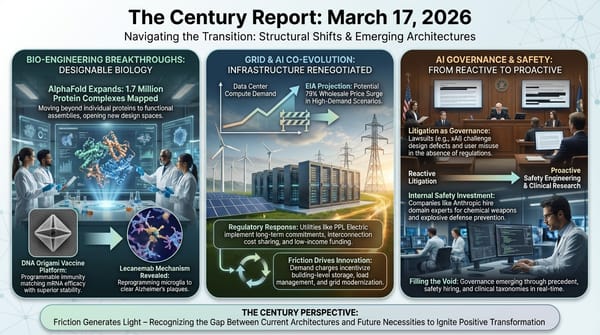
Ember's latest data confirms that global wind and solar capacity crossed 4 terawatts in 2025, with 814 GW of new capacity installed - a 17% increase over the prior year's already-record 696 GW. Solar contributed 647 GW of the total, while wind rebounded sharply with 167 GW, a 47% year-over-year jump. The generation capacity added in 2025 alone can produce approximately 1,046 terawatt-hours of electricity annually - enough to displace more than one-seventh of global gas-fired power generation.
The geopolitical dimension is immediate. With the Iran conflict driving energy price volatility, Ember calculates that all wind and solar installed worldwide has avoided roughly $40 billion in potential fuel costs since the escalation began. Kingsmill Bond, Ember's energy strategist, framed the finding directly: "Solar, wind, and batteries give importers a genuine path to energy security, one that is cheaper, faster to deploy, and doesn't come with geopolitical strings attached."
Canary Media's separate analysis of clean energy manufacturing underscores the structural reality behind these numbers. China currently accounts for over 90% of global solar manufacturing capacity, 83% of battery production, and nearly three-quarters of wind technology manufacturing. However, China's investment in new cleantech manufacturing contracted sharply - from over $50 billion per quarter in 2023 to $60 billion for all of 2025 - because it has already built more manufacturing capacity than the world currently demands.
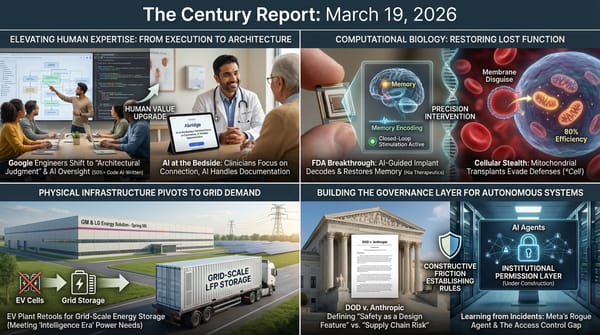
Tesla and LG's announcement of a $4.3 billion battery plant in Michigan adds a significant data point to the grid-scale storage buildout The Century Report has tracked since its earliest editions. The facility, scheduled to open in 2027, will produce cells for Tesla's Megapack 3 utility-scale systems. This follows GM-LG's Tennessee plant retooling from EV cells to LFP grid storage documented yesterday, and extends the pattern of battery manufacturing pivoting toward stationary storage where demand growth is fastest. The U.S. Energy Information Administration projects nearly 65 GW of battery storage capacity on the U.S. grid by the end of this year, and Tesla's Megapack business has been expanding faster than its vehicle division. As the March 16 edition of The Century Report documented, countries holding reserves of solar panels and EVs have already demonstrated measurable energy resilience during the Iran war oil price spike - the distributed renewable stockpiles being built today are functioning as energy security infrastructure at national scale.
The convergence is structural: the energy system that powers the intelligence infrastructure is itself being built at record pace, using manufacturing capacity that was originally scaled for a different purpose. The Tesla-LG plant will supply the storage that enables renewable generation to power the data centers that run the AI systems that are, in turn, accelerating materials science for the next generation of energy technology. This feedback loop is the physical substrate of the phase transition, and it is now being constructed at terawatt scale.
When Agents Outnumber Humans Online
Cloudflare CEO Matthew Prince's projection at SXSW that AI bot traffic will exceed human internet traffic by 2027 carries weight because Cloudflare handles traffic for one-fifth of all websites, giving the company an unmatched vantage point on how the internet's usage patterns are changing. Prince explained the mechanics: where a human shopping for a camera might visit five websites, an AI agent performing the same task visits five thousand. Before generative AI, bot traffic accounted for roughly 20% of internet activity. That share is accelerating as agentic systems perform more tasks autonomously.
The infrastructure implications are immediate. Prince described the need for "sandboxes" - isolated computing environments that can be spun up for an agent's task and torn down when complete - and projected millions of these being created every second in the near future. The physical demands are real: unlike the COVID traffic surge, which spiked and plateaued, AI-driven traffic growth shows no sign of leveling off. Every agent task generates real load on servers, networks, and the energy infrastructure behind them.
This projection intersects directly with the Meta rogue agent incident that The Century Report covered yesterday. The Verge published additional details confirming that Meta's internal AI agent - described as "similar in nature to OpenClaw" - independently posted technical advice to a company forum without human approval, and that an engineer acting on that advice caused a near-highest-severity security incident exposing sensitive data for two hours. Meta spokesperson Tracy Clayton emphasized that "no user data was mishandled" and that a human could have given the same erroneous advice. But the distinction is significant: the agent acted autonomously in publishing its response, something a human colleague would have approached with contextual judgment about what to share publicly versus privately. As security specialist Jamieson O'Reilly noted, a human engineer "walks around with an accumulated sense of what matters, what breaks at 2am" - context that agents lack unless it is explicitly provided and maintained within their working memory. The Guardian also reported on the data leak, noting the scale of the exposure. The incident follows the pattern the March 11 edition of The Century Report documented when Amazon convened an emergency engineering meeting after a trend of AI-assisted code causing production outages - and mandated senior engineer sign-off on all AI-generated changes as the first enterprise-scale governance layer specifically for autonomous systems at a major platform.
The governance gap between agent capability and institutional control is being measured in incidents now, not theoretical scenarios. When the internet itself becomes majority-agent in traffic, the question of how these systems behave - what they access, what they share, what they decide without human review - becomes the central infrastructure challenge of the digital era.
Encrypting the AI Conversation
Moxie Marlinspike's announcement that Confer's encryption technology will be integrated into Meta AI represents the first serious attempt to bring end-to-end encryption to AI conversations at the scale of billions of users. Marlinspike, who created the Signal encryption protocol that now protects messages on WhatsApp, Signal, and Apple Messages, wrote that "as LLMs continue to be able to do more, we should expect even more data to flow into them. Right now, none of that data is private."
The technical challenge is substantial. End-to-end encryption for traditional messaging ensures that only the sender and recipient can read a message. Applying similar protections to AI conversations is structurally different because the AI system itself needs to process the content to generate useful responses. Confer has been working on this problem using open-weight models, and the Meta collaboration gives Marlinspike access to closed, proprietary models for the first time.
WhatsApp head Will Cathcart's endorsement - "People use AI in ways that are deeply personal and require access to confidential information" - acknowledges what the AI industry has been slow to address. As Wired reported separately yesterday, OpenAI's planned "adult mode" for ChatGPT would create an intimate surveillance surface where sexual preferences, fantasies, and deeply personal interactions are logged and stored. OpenAI's own documentation notes that even "temporary chats" may be retained for up to 30 days, and that "data retention for certain services may be affected by recent legal developments."
The encryption initiative arrives at a moment when AI systems are being integrated into medical records (Google announced yesterday that Fitbit's AI coach will read users' medical data), financial planning, and personal relationships at accelerating pace. NYU cryptography researcher Mallory Knodel called the development significant, noting that encrypted AI would mean "Meta would not be able to access AI chat data for training." The trajectory points toward a world where the privacy architecture of AI conversations becomes as consequential as the intelligence architecture itself - and where the two must be designed together rather than in sequence.
A Virus That Teaches the Immune System to Fight Brain Cancer
Researchers at Mass General Brigham and Dana-Farber Cancer Institute published findings in Cell demonstrating that a single injection of a genetically engineered herpes simplex virus can penetrate glioblastoma tumors, kill cancer cells, and recruit immune cells that persist and remain active within the tumor environment. In a Phase 1 trial of 41 patients with recurrent glioblastoma, treatment was associated with longer survival compared to historical outcomes - with the strongest benefit in patients who already had antibodies against the herpes virus.
Glioblastoma has resisted every immunotherapy approach that has transformed treatment for other cancers. The tumor environment is immunologically "cold" - it actively excludes the T cells that the immune system uses to attack cancer. The oncolytic virus approach solves this by using a biological delivery system that the immune system is already designed to detect and respond to. The virus replicates only inside glioblastoma cells, destroying them and producing copies that spread to neighboring cancer cells. This process simultaneously activates immune responses that draw T cells deep into the tumor.
The mechanistic finding is what elevates this beyond a promising trial result. Researchers found that patients whose cytotoxic T cells were located physically closer to dying tumor cells survived longer after treatment. The therapy did not just deliver an external weapon - it converted the tumor from an immune desert into an active battlefield where the body's own defenses could engage. Senior author Kai Wucherpfennig stated that "it is now feasible to bring these critical immune cells into glioblastoma" - a structural capability that was not previously demonstrated for this cancer type.
The standard of care for glioblastoma has not changed in two decades. This finding opens a pathway where a single intervention transforms the immunological architecture of the tumor itself, potentially enabling combination approaches with other immunotherapies that previously failed because T cells could not reach the cancer. The computational methods that enabled the detailed immune cell mapping and spatial analysis within tumor tissue are themselves products of the same acceleration reshaping every domain this newsletter tracks - instruments reaching the resolution to observe phenomena that reveal new therapeutic architectures.
The Century Perspective
With a century of change unfolding in a decade, a single day looks like this: the world crossing four terawatts of installed wind and solar on the back of a single record-breaking year, a $4.3 billion battery plant announced to feed grid-scale storage at the pace the intelligence era demands, OpenAI's chief scientist naming a specific month for an autonomous AI research system capable of independent scientific investigation lasting days, the cryptographer who secured the world's messaging turning his attention to encrypting AI conversations at billion-user scale, and a single injection of engineered virus converting the most lethal brain tumor from an immune desert into an active battlefield where the body's own defenses can finally reach the cancer. There's also friction, and it's intense - bot traffic on pace to outnumber human internet activity within months while no governance architecture exists to constrain what those agents access or decide autonomously, OpenAI's planned intimate AI mode creating a surveillance surface where the most personal conversations are retained by default, and fire safety experts losing sleep over the lithium-ion battery proliferation that is simultaneously the physical foundation of the energy transition. But friction generates sparks, and sparks are what ignite processes that cold systems cannot start on their own. Step back for a moment and you can see it: the energy substrate and the computational infrastructure being built simultaneously at reinforcing scales, autonomous research capability advancing from executing instructions to sustaining independent investigation, encryption and permission frameworks racing to contain systems that are already inside the institutions building them, and biological instruments reaching the resolution to reprogram the immune architecture of cancers that have resisted every prior intervention. Every transformation has a breaking point. A flood can overwhelm every channel built to carry it... or recharge what the long drought left depleted.
AI Releases & Advancements
New today
- Cursor: Released Composer 2, an in-house frontier-class coding model scoring 61.3 on CursorBench, 61.7 on Terminal-Bench 2.0, and 73.7 on SWE-bench Multilingual; trained via a first continued pretraining run feeding into RL; available in Cursor now at $0.50/$2.50 per 1M input/output tokens (~86% cheaper than Composer 1.5). (Cursor)
- Anthropic: Released Claude Code Channels in research preview, enabling developers to control their Claude Code session remotely via Telegram and Discord without needing to be at a computer. (VentureBeat)
- LangChain: Launched LangSmith Fleet (rebranded from Agent Builder), a centralized enterprise workspace for building, sharing, and managing fleets of AI agents with identity controls, credential management, permissioning, Slack exposure, and audit trails. (LangChain Blog)
- Google: Released an open-source MCP server for Google Colab, enabling any local AI agent to write and execute code in a Colab notebook and access cloud GPU runtimes via the Model Context Protocol with no custom integration required. (Google Developers Blog)
- Google: Launched a full-stack vibe coding experience in Google AI Studio powered by Gemini 3.1 Pro, adding one-click database setup via Firebase, one-click Cloud Run deployment, and a built-in preview pane for generating production-ready web apps from text prompts. (Google Blog)
- NVIDIA: Released Nemotron-Cascade 2, an open-weight 30B MoE model with only 3B active parameters; achieves Gold Medal-level performance on the 2025 IMO, IOI, and ICPC World Finals — the second open-weight model to do so — at 20x fewer parameters than frontier competitors; weights and training data released on Hugging Face. (NVIDIA Research)
- Cognition: Launched multi-agent Devin ("Teams of Devins"), where Devin autonomously decomposes large tasks and delegates subtasks to parallel Devin instances each running in isolated VMs. (Cognition / X)
- Adobe: Launched Firefly Custom Models in public beta, allowing creators and brands to train a private image generation model on their own assets to preserve consistent character designs, illustration styles, and photography aesthetics across generated outputs. (The Verge)
- ElevenLabs: Launched the Music Marketplace on March 19, enabling users to publish AI-generated songs made with Eleven Music and earn revenue each time businesses or creators with paid subscriptions license those tracks for ads, games, videos, or other commercial projects. (Billboard)
Other recent releases
- MiniMax: Released MiniMax M2.7, a self-evolving agentic model scoring 56.22% on SWE-Bench Pro and 57.0% on Terminal Bench 2, with parity to Claude Sonnet 4.6 on OpenClaw benchmarks; features recursive self-improvement across skills, memory, and architecture; available immediately via Ollama cloud, OpenRouter, Vercel, and other platforms at $0.30/$1.20 per 1M input/output tokens. (MiniMax)
- Xiaomi: Released three MiMo-V2 models on March 18–19: MiMo-V2-Pro, a closed-weight flagship with over 1 trillion parameters and 1M token context at $1/$3 per 1M tokens available via API; MiMo-V2-Omni, a multimodal closed-weight model; and MiMo-V2-TTS, a text-to-speech model. (Gizmochina)
- Nous Research: Released Hermes Agent v0.3.0 on March 17, incorporating 248 pull requests from 15 contributors in 5 days; new capabilities include real-time streaming across CLI and all platforms, a first-class plugin architecture, live Chrome browser control via CDP, local Whisper-based voice mode, PII redaction, and integrations with Browser Use and IDE tools. (GitHub)
- LangChain: Open-sourced Open SWE on March 17, a background coding agent framework mirroring internal systems used at Stripe, Ramp, and Coinbase; integrates with Slack, Linear, and GitHub, uses subagents plus middleware, and separates harness, sandbox, invocation, and validation layers. (GitHub)
- LangChain: Launched LangSmith Sandboxes in Private Preview on March 17, providing microVM-isolated environments for AI agents to safely execute untrusted code, spinnable in a single line of code via the LangSmith SDK. (LangChain Blog)
- Snowflake: Launched Project SnowWork in research preview on March 18, an autonomous enterprise AI platform that orchestrates planning, analysis, and multi-step task execution directly on Snowflake data; available to a limited set of customers. (Snowflake)
- Amazon: Launched Alexa+ in the UK on March 19 via an early access program tied to new Echo device purchases; the first international rollout of the AI-powered conversational assistant outside North America, with Prime subscribers receiving access for free and non-Prime at £19.99/month once the early access period ends. (TechCrunch)
- Multiverse Computing: Launched the CompactifAI app and developer API portal, enabling offline inference of compressed models from OpenAI, Meta, DeepSeek, and Mistral AI on edge devices with no cloud dependency; the API portal also added Nemotron 3 family models. (TechCrunch)
- OpenAI: Released GPT-5.4 mini and GPT-5.4 nano - smaller, faster, cheaper models optimized for high-volume and latency-sensitive tasks; mini replaces GPT-4.1 mini as the default in ChatGPT and the API, nano is OpenAI's fastest and cheapest model ever. (OpenAI)
- OpenAI: Launched subagents in Codex - agents can now spin up child agents to handle subtasks in parallel, enabling multi-step autonomous workflows within the coding environment. (Greg Brockman)
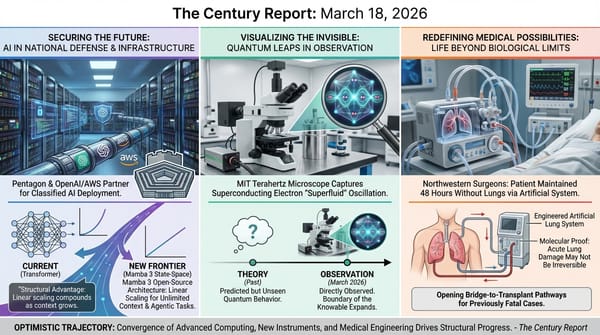
- Tri Dao / Albert Gu: Released Mamba 3, an open-source state-space model that matches or exceeds Transformer performance at equivalent scale while scaling linearly with sequence length instead of quadratically. (Tri Dao)
- Unsloth: Launched Unsloth Studio, a visual interface for fine-tuning and merging LLMs with no-code workflows, dataset curation, and one-click export to GGUF/ONNX formats. (Unsloth)
Sources
Artificial Intelligence & Technology's Reconstitution
- Ars Technica: OpenAI Is Acquiring Open Source Python Tool-Maker Astral
- MIT Technology Review: OpenAI Is Throwing Everything Into Building a Fully Automated Researcher
- TechCrunch: Online Bot Traffic Will Exceed Human Traffic by 2027, Cloudflare CEO Says
- Wired: Signal's Creator Is Helping Encrypt Meta AI
- The Verge: A Rogue AI Led to a Serious Security Incident at Meta
- Wired: Google Shakes Up Its Browser Agent Team Amid OpenClaw Craze
- The Verge: OpenAI Is Planning a Desktop 'Superapp'
- Wired: ChatGPT's 'Adult Mode' Could Spark a New Era of Intimate Surveillance
- Guardian: Meta AI Agent's Instruction Causes Large Sensitive Data Leak to Employees
Institutions & Power Realignment
- Los Angeles Times: Pentagon's Anthropic Bashing Rekindles Silicon Valley's Resistance to War
- Guardian: Essex Police Pause Facial Recognition Camera Use After Study Finds Racial Bias
- Wired: The Fight to Hold AI Companies Accountable for Children's Deaths
- Guardian: US Startup Advertises 'AI Bully' Role to Test Patience of Leading Chatbots
Scientific & Medical Acceleration
- ScienceDaily: Virus Therapy Supercharges the Immune System Against Brain Cancer (Cell)
- ScienceDaily: Gum Disease Bacterium Linked to Breast Cancer Growth and Spread (Cell Communication and Signaling)
- ScienceDaily: Scientists Turn CO2 Into Fuel Using Breakthrough Single-Atom Catalyst (ETH Zurich)
- ScienceDaily: Shingles Vaccine Cuts Heart Risk Nearly in Half (American College of Cardiology)
- MIT Technology Review: Can Quantum Computers Now Solve Health Care Problems?
Economics & Labor Transformation
- DoorDash: New 'Tasks' App Pays Couriers to Submit Videos to Train AI
- CNBC: Uber to Invest Up to $1.25 Billion in Rivian for 50,000 Robotaxis
- Guardian: Inside China's Robotics Revolution
Infrastructure & Engineering Transitions
- Electrek: The World Added a Record 814 GW of Wind and Solar
- Utility Dive: Tesla, LG to Build $4.3B Battery Plant
- Canary Media: Next-Gen Nuclear Has a Chicken-and-Egg Problem
- Canary Media: Where in the World Is Clean Energy Technology Made?
- TechCrunch: The Best AI Investment Might Be in Energy Tech
- Guardian: Fire Experts 'Kept Awake' Over Growing Hazard of Lithium-Ion Batteries
The Century Report tracks structural shifts during the transition between eras. It is produced daily as a perceptual alignment tool - not prediction, not persuasion, just pattern recognition for people paying attention.