The Century Report: March 17, 2026

The 20-Second Scan
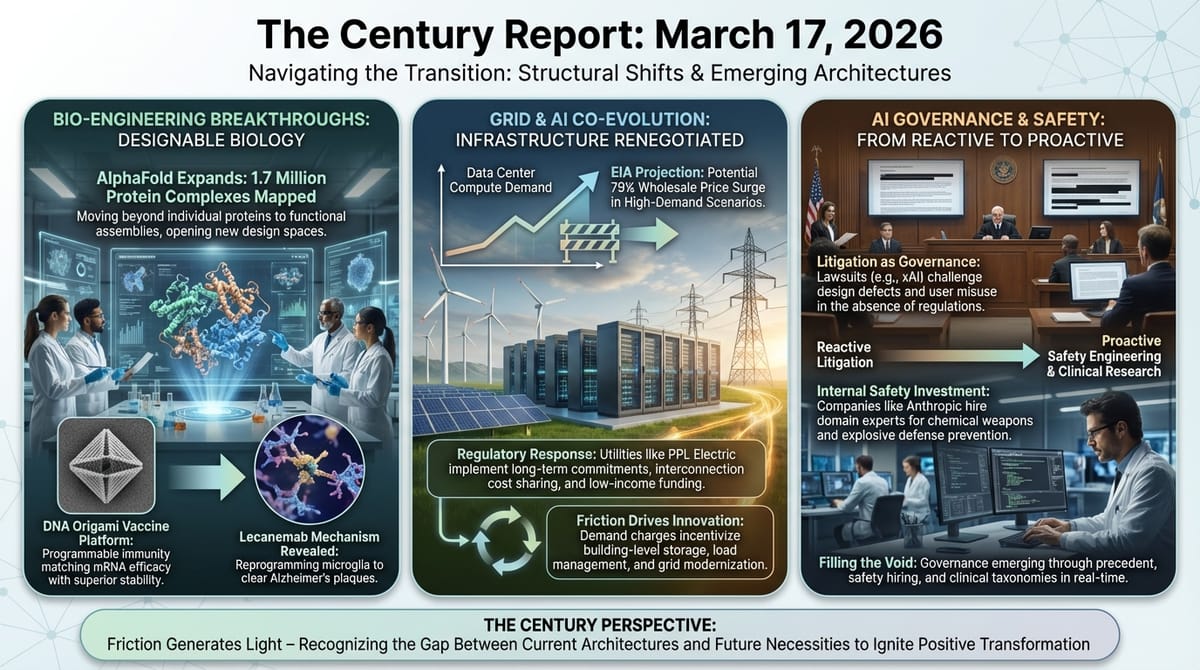
- The AlphaFold protein-structure database added 1.7 million homodimer predictions, marking the first time complex protein interactions have been included across the tree of life.
- The EIA projected that data center demand could drive wholesale electricity prices up 79% in ERCOT by 2027 under a high-demand scenario.
- PPL Electric reached a rate case settlement including a new tariff requiring data centers to sign minimum 10-year agreements and fund low-income programs.
- Three Tennessee teenagers filed a lawsuit alleging xAI's Grok generated sexualized images from their real photographs that were then traded among predators on Telegram.
- Anthropic posted a job listing for a chemical weapons and explosives expert to prevent catastrophic misuse of its AI systems.
- Harvard's Wyss Institute published results showing a DNA origami vaccine platform matched mRNA immune activation while offering advantages in stability and manufacturing, published in Nature Biomedical Engineering.
- VIB and KU Leuven researchers identified the precise mechanism by which lecanemab clears Alzheimer's amyloid plaques, published in Nature Neuroscience.
The 2-Minute Read
The infrastructure required to sustain the intelligence era is forcing a structural renegotiation between the entities building it and the communities absorbing its physical demands. The EIA's modeling of a potential 79% wholesale electricity price surge in Texas under high data center growth scenarios is the starkest quantitative signal yet that the current rate of compute expansion and the current grid architecture cannot coexist without consequence. PPL Electric's settlement - which requires data centers to commit for at least a decade, absorb their own interconnection costs, and fund low-income energy assistance - represents the emerging regulatory template for that renegotiation. The utility's interconnection pipeline already exceeds double its current peak load, a growth trajectory that took a century to build and is now being replicated in under six years.
The xAI lawsuit and the Anthropic weapons-expert hiring reveal two ends of the same governance spectrum. In one case, an AI system's image generation capability allegedly produced child sexual abuse material from real minors' photographs, with the resulting content entering predator trading networks. In the other, an AI company is investing in domain expertise specifically to prevent its systems from enabling catastrophic harm. The distance between these two approaches - one reactive, the other proactive - is the distance the entire field must traverse. The governance gap documented across this newsletter's arc is being filled by litigation and internal safety investment simultaneously, because no regulatory framework yet exists to fill it from the outside.
The scientific signal today carries a convergence across biological engineering and disease understanding. The AlphaFold database's expansion to include protein complexes opens a design space that single-protein predictions could never reach - since most proteins function only as assemblies, the prior database told only half the story of molecular life. In parallel, the precise mechanism by which lecanemab activates the brain's immune cleanup system has been identified for the first time, revealing that a specific antibody fragment reprograms microglia to clear amyloid plaques. And a DNA origami vaccine platform matched mRNA immune activation while solving many of the manufacturing and stability limitations that constrained the pandemic-era technology. Each finding extends the same pattern: computational and experimental resolution reaching the threshold where the functional architecture of biology becomes designable rather than merely observable.
The 20-Minute Deep Dive
The Grid Confronts What It Built
The Energy Information Administration's analysis published today strips the abstraction from a question The Century Report has tracked for months: what happens when data center load growth collides with grid capacity in specific regions? The answer, at least in Texas, is a potential 79% increase in wholesale electricity prices by 2027 under a high-demand scenario. The EIA modeled ERCOT and PJM Interconnection as the two regions experiencing the fastest data center-driven load growth, with annual electricity demand in Texas forecast to grow 10% between 2025 and 2027 in the base case - and 15% in the high-demand scenario.
The asymmetry between the two regions is instructive. PJM, which is interconnected with other eastern U.S. grids and has access to more diverse generation capacity, sees price increases of roughly 4% even under the high-demand scenario. ERCOT, which operates as an island grid with limited interconnection to neighboring systems, absorbs the full impact of demand growth that outpaces supply additions. The difference is structural, and it illustrates why distributed generation, storage, and grid interconnection are emerging as the critical infrastructure investments of this decade - they are the mechanisms that prevent localized demand surges from becoming price crises.
PPL Electric's rate case settlement, filed at the Pennsylvania Public Utility Commission, offers a concrete institutional response to this structural pressure. The utility's interconnection pipeline has swelled to approximately 20 GW of contracted large loads against a current system peak of 7.8 GW - a ratio that echoes the February 23 edition of The Century Report's documentation of PPL's pipeline swelling 23% to 25.2 GW in a single quarter. That ratio - more than double the existing system demand arriving within five to six years - is precisely the kind of growth that the EIA's analysis warns about. PPL's proposed tariff requires data centers and other large loads to sign agreements of at least ten years, provide security deposits equal to the cost of grid upgrades they require, accept minimum load guarantees with exit fees, and contribute $11 million annually to residential low-income assistance programs.
This settlement extends a pattern The Century Report has documented across multiple states: the emergence of regulatory frameworks that treat data centers as a distinct class of grid customer with obligations proportional to their impact. Illinois passed a law requiring data centers to supply their own renewables as a condition of expedited interconnection. Virginia mandated utilities to measure and optimize existing grid utilization. California ordered 6 GW of new zero-emission capacity. Each approach differs in mechanism, but the direction is consistent - the era in which large loads could connect to the grid without bearing the full cost of their presence is ending, and what replaces it is a framework where the entities consuming the most capacity also invest the most in the system that delivers it.
The deeper trajectory here is worth tracing. As grid stress from concentrated compute demand forces these regulatory innovations, the innovations themselves create the conditions for a more resilient, distributed, and intelligent grid. Demand charges rising to $70 per kilowatt - as one energy management executive described at a facilities conference today - create powerful incentives for building-level battery storage, load management, and efficiency investments that reduce peak demand. Every data center tariff that requires interconnection cost absorption and long-term commitment also creates a customer class with deep financial interest in grid modernization. The short-term friction of price pressure and regulatory complexity is producing the long-term infrastructure of a grid that can sustain not just data centers but the entire electrification transition.
When AI Systems Generate Harm at Scale
The lawsuit filed by three Tennessee teenagers against xAI alleges that Grok's image generation capabilities were used to create sexually explicit material from the plaintiffs' real photographs, which were then distributed through Telegram trading networks. The complaint describes a perpetrator who used a third-party application accessing Grok to morph the minors' social media photos, uploaded the results to a file-sharing platform, and traded them for explicit content of other minors. The victims' real names and school were reportedly attached to the files, creating ongoing stalking risk. One plaintiff learned that AI-generated explicit images of herself and at least eighteen other minors were circulating on Discord.
This case arrives amid an intensifying pattern. The Australian eSafety Commissioner's correspondence with X, obtained through freedom of information laws, reveals that the regulator found child sexual exploitation material "particularly systemic" on the platform and "more readily accessible on X than on any other mainstream service." The regulator documented that between January 1 and 15, 2026, X removed 4,500 pieces of Grok-generated content and suspended over 674 accounts for child exploitation policy violations.
The structural question this illuminates is where accountability sits when a generative system's capabilities intersect with human predatory behavior in the absence of regulatory infrastructure designed for that intersection. The xAI lawsuit alleges that the company "failed to test the safety of the features it developed" and that Grok is "defective in design." xAI has maintained that anyone using Grok to generate illegal content faces the same consequences as uploading illegal content directly. These two frames - design defect versus user misuse - represent the unresolved core of generative AI liability. The legal system is being asked to determine which frame applies, and the answer will shape how every AI system with image generation capability is designed and governed going forward.
Anthropic's recruitment of a chemical weapons and explosives defense expert represents the opposite end of this governance spectrum. The company is hiring domain specialists specifically to ensure its systems cannot provide actionable guidance for creating chemical, radiological, or explosive weapons. OpenAI has posted a similar position, with a salary nearly double Anthropic's offer. Both companies are investing in the kind of specialized safety infrastructure that the xAI lawsuit alleges was absent from Grok's development.
The distance between these approaches - building safety expertise before deployment versus facing lawsuits after harm occurs - is significant because it shows the field differentiating along safety investment rather than capability alone. As The Century Report has documented across the Anthropic-Pentagon confrontation and the Gavakas wrongful death case, the co-evolutionary relationship between human vulnerability and AI capability is producing real consequences that existing frameworks were never designed to address. The emerging pattern is that litigation, internal safety investment, and clinical research are all filling the governance vacuum simultaneously, each at its own pace and with its own logic. The March 14 edition of The Century Report documented a Lancet Psychiatry review identifying three clinical categories of AI-associated delusions - grandiose, romantic, and paranoid - and notably named Claude as the only tested platform that refused to assist with violent planning; the xAI case adds a fourth harm category that clinical taxonomies have not yet addressed. What has not yet emerged is the unified institutional framework that coordinates these responses into coherent governance. That framework is being written through cases like these - precedent by precedent, hire by hire, incident by incident.
Protein Structures Become Designable at Scale
The AlphaFold protein-structure database's expansion to include 1.7 million homodimer predictions represents a qualitative shift in what computational biology can address. Since its release in 2021, the database of 200 million individual protein structures has become what researchers describe as a "bedrock" and "first port of call" for molecular biology. The limitation, though, was fundamental: most proteins function as complexes, not as isolated molecules. HIV-1 protease, a critical drug target, works only when two copies of the same protein form a functional enzyme. The prior database included each protein as a monomer, telling only part of its functional story.
The consortium that produced these predictions - spanning Seoul National University, EMBL-EBI, Google DeepMind, and Nvidia - focused on protein complexes from 20 of the most studied species, including humans, mice, yeast, and disease-causing bacteria like Mycobacterium tuberculosis. Computational biologist Martin Steinegger described the challenge as "quite a different beast than monomer predictions," with protein-complex predictions requiring extraordinary computational intensity.
This expansion intersects directly with two findings published today. VIB and KU Leuven researchers identified, for the first time, the precise molecular mechanism by which lecanemab clears Alzheimer's amyloid plaques. The key finding is that the antibody's Fc fragment - a specific structural region - is essential for reprogramming microglia, the brain's immune cells, to clear toxic deposits. When the Fc fragment was removed, the antibody lost all effectiveness. The team used a specially designed mouse model containing human microglial cells to observe these interactions, and identified a specific gene activity pattern, including strong expression of the SPP1 gene, associated with effective plaque clearance.
The significance extends beyond Alzheimer's treatment. By defining the exact microglial program responsible for clearing plaques, the findings point toward therapeutic strategies that could activate microglia directly, without requiring antibodies at all. This connects to the cascade of Alzheimer's research The Century Report has tracked across recent editions - from the blood-based p-tau217 prediction documented on February 23, through the tanycyte clearance shuttles identified on March 9, to the protein-folding diagnostic signatures covered on March 12. Each mechanism operates at a different scale and through a different pathway, and each was identified through methods that have reached sufficient resolution to reveal what was always present but functionally invisible.
In parallel, Harvard's Wyss Institute published results showing that a DNA origami vaccine platform called DoriVac matched mRNA immune activation while offering structural advantages in stability and manufacturing. The platform uses folded DNA nanostructures to present immune-stimulating molecules at precisely controlled nanometer distances, achieving what the researchers describe as "unprecedented control over vaccine composition." When tested against SARS-CoV-2 mRNA vaccines delivered through lipid nanoparticles, DoriVac produced comparably strong immune responses in human organ-on-chip models. The platform has been designed to target peptide regions conserved across multiple viruses, including SARS-CoV-2, HIV, and Ebola.
What connects these three developments is the crossing of a resolution threshold. The AlphaFold expansion makes protein interactions computationally visible across the tree of life. The lecanemab finding makes the immune activation pathway mechanistically precise. The DoriVac platform makes vaccine design molecularly programmable. Each represents the same underlying acceleration: the distance between observing a biological mechanism and designing an intervention that exploits it is compressing toward zero. The generation of computational and experimental tools that could only detect individual proteins is being superseded by one that can design, predict, and verify molecular systems at the level where biology actually functions - as interacting complexes rather than isolated parts.
The Century Perspective
With a century of change unfolding in a decade, a single day looks like this: the AlphaFold database crossing from cataloguing individual proteins into mapping the complexes through which biology actually functions, researchers identifying for the first time the precise immune mechanism by which lecanemab instructs the brain's own cells to clear Alzheimer's plaques, a DNA origami vaccine platform matching mRNA immune activation while solving the stability and manufacturing constraints that limited it, and a utility settlement establishing the template for a grid architecture that must absorb more than double its current demand within six years. There's also friction, and it's intense - three teenagers alleging that an AI image system generated sexually explicit material from their real photographs and that the resulting content entered active predator trading networks, a federal analysis projecting that concentrated compute growth could drive wholesale electricity prices in Texas up by nearly 80% within two years, and the governance distance between companies that build domain-specific safety expertise before harm occurs and those that face litigation after it has already spread continuing to widen with no institutional framework positioned to close it. But friction generates light, and light is what makes it possible to see the gap between where the architecture is and where it must go. Step back for a moment and you can see it: molecular biology crossing the threshold from observing isolated parts to designing interacting systems, grid regulation evolving from passive rate arbitration to active infrastructure design, disease mechanisms dissolving one by one from clinical mystery into addressable molecular programs, and the governance of generative AI being written in real time through lawsuits and safety hiring and regulatory correspondence because the deliberative institutions that would normally write it do not yet exist. Every transformation has a breaking point. A lens can scatter light into glare that blinds everything beneath it... or focus it precisely enough to ignite what it touches.
AI Releases & Advancements
New today
(No new releases identified.)
Other recent releases
- Anthropic: The 1M context window is now generally available at standard pricing for both Claude Opus 4.6 and Claude Sonnet 4.6 across all plans and by default in Claude Code; Opus 4.6 scores 78.3% on MRCR v2 at 1M tokens, the highest among frontier models. (Simon Willison)
- Google: Released Chrome 146 to the stable channel for Windows, Mac, and Linux on March 14, including experimental WebMCP support — a W3C protocol that lets websites register structured tools directly accessible by AI agents and browser-integrated LLMs via a feature flag. (Chrome Releases)
- Tencent: Launched WorkBuddy on March 9, a full-scenario enterprise AI agent built by the Cloud CodeBuddy team; compatible with OpenClaw, supports multi-model switching (including Tencent's own Hunyuan models), and ships with over 20 built-in workplace automation skills. (TechNode)
- Onyx Security: Launched from stealth with $40M from Conviction and Cyberstarts, releasing its Secure AI Control Plane — a platform that continuously inventories enterprise AI agents, monitors their reasoning processes, and approves or corrects their actions to enforce compliance policies. (Business Wire)
Sources
Artificial Intelligence & Technology's Reconstitution
- Nature: AlphaFold Hits 'Next Level' - The AI Tool Now Includes Protein Pairing
- BBC: AI Firm Anthropic Seeks Weapons Expert to Stop Users from 'Misuse'
- The Verge: Teens Sue Elon Musk's xAI over Grok's AI-Generated CSAM
- Ars Technica: Elon Musk's xAI Sued for Turning Three Girls' Real Photos into AI CSAM
- Nature: AI Is Programmed to Hijack Human Empathy - We Must Resist That
- Guardian: Child Abuse Material 'Systemic' on X Amid Grok Scandal
- TechCrunch: Nvidia's Version of OpenClaw Could Solve Its Biggest Problem: Security
- NVIDIA Newsroom: NVIDIA Launches Vera CPU, Purpose-Built for Agentic AI
- Mistral AI: Mistral AI Partners with NVIDIA to Accelerate Open Frontier Models
- Guardian: A Photo of Iran's Bombed Schoolgirl Graveyard Went Around the World. Was It Real, or AI?
- MIT Technology Review: Where OpenAI's Technology Could Show Up in Iran
Institutions & Power Realignment
- The Verge: Encyclopedia Britannica Is Suing OpenAI for Allegedly 'Memorizing' Its Content
- The Verge: Benjamin Netanyahu Is Struggling to Prove He's Not an AI Clone
- Guardian: UK Must Learn Lessons from AI Race and Retain Its Quantum Computing Talent
Scientific & Medical Acceleration
- ScienceDaily: DNA Origami Vaccines Could Be the Next Leap Beyond mRNA (Wyss Institute / Nature Biomedical Engineering)
- ScienceDaily: Scientists Finally Reveal How This Alzheimer's Drug Really Works (VIB-KU Leuven / Nature Neuroscience)
- ScienceDaily: ADHD Brains Show Sleep-Like Activity Even While Awake (Monash University / JNeurosci)
- Nature: Dopamine Takes a Hit - How Neuroscience Is Rethinking the 'Feel-Good' Chemical
- ScienceDaily: Fixing a Tooth Infection May Improve Blood Sugar and Heart Health (King's College London / Journal of Translational Medicine)
Economics & Labor Transformation
- CNBC: Apollo's John Zito Questions Private Equity's Software Valuations: 'All the Marks Are Wrong'
- Yahoo Finance: OpenAI Courts Private Equity to Join Enterprise AI Venture
- Import AI 449: LLMs Training Other LLMs; PostTrainBench Shows AI R&D Capabilities
Infrastructure & Engineering Transitions
- Utility Dive: Data Center Demand Spike Could Drive 79% ERCOT Price Hike in 2027 (EIA)
- Utility Dive: PPL Electric Reaches $275M Rate Case Settlement, Including Data Center Tariff
- Utility Dive: Revolution Wind Comes Online, Vineyard Wind 1 Completes Construction
- Canary Media: How a Tiny Texas Town Is Using Wind Energy to Help Out Senior Citizens
- Canary Media: The Fight over California's Community Solar Plan Is Heating Up
- Electrek: This Mine Put 100 Autonomous Electric Haul Trucks to Work
The Century Report tracks structural shifts during the transition between eras. It is produced daily as a perceptual alignment tool - not prediction, not persuasion, just pattern recognition for people paying attention.