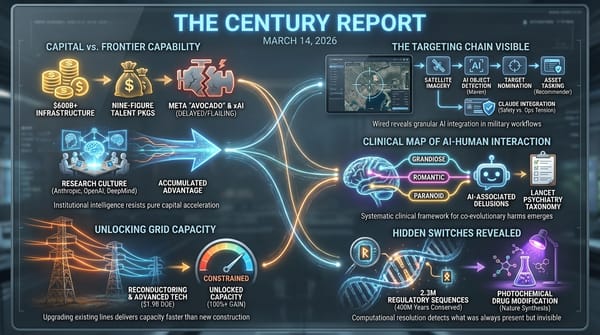
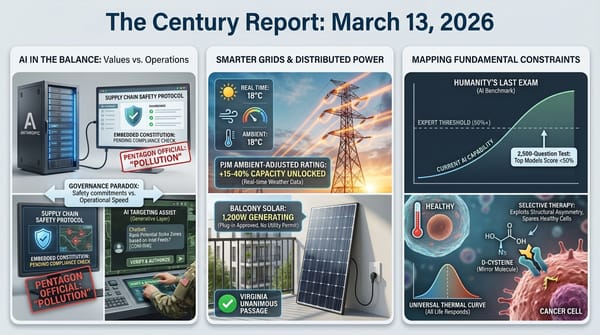
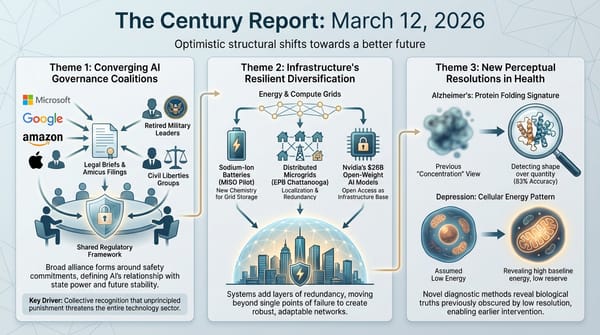
The Century Report: March 15, 2026

The 20-Second Scan
- Vineyard Wind completed construction of all 62 turbines off the coast of Massachusetts, and Revolution Wind began delivering power to New England's grid on the same day.
- The U.S. Army signed a 10-year contract worth up to $20 billion with Anduril, consolidating more than 120 separate procurement actions into a single enterprise deal.
- China's national cybersecurity authority issued warnings about OpenClaw's security vulnerabilities, including prompt injection, data exfiltration, and malicious skill uploads, while restricting its use across government agencies and state enterprises.
- xAI staff describe the startup as flailing under constant upheaval, with SpaceX and Tesla managers auditing employees, firing some, and pushing out two more cofounders.
- Waaree Energies broke ground on a 10 GW integrated solar ingot and wafer manufacturing facility in Nagpur, India's largest such complex, with an investment of approximately ₹6,200 crore (~US$750 million).
- Researchers at Houston Methodist discovered that the ALS-linked protein TDP43 regulates DNA mismatch repair and is associated with increased mutation rates in cancer, published in Nucleic Acids Research.
- University of Barcelona scientists designed FLAV-27, a first-in-class epigenetic drug that reversed cognitive decline in multiple Alzheimer's animal models by reprogramming neuronal gene expression rather than removing amyloid plaques.
The 2-Minute Read
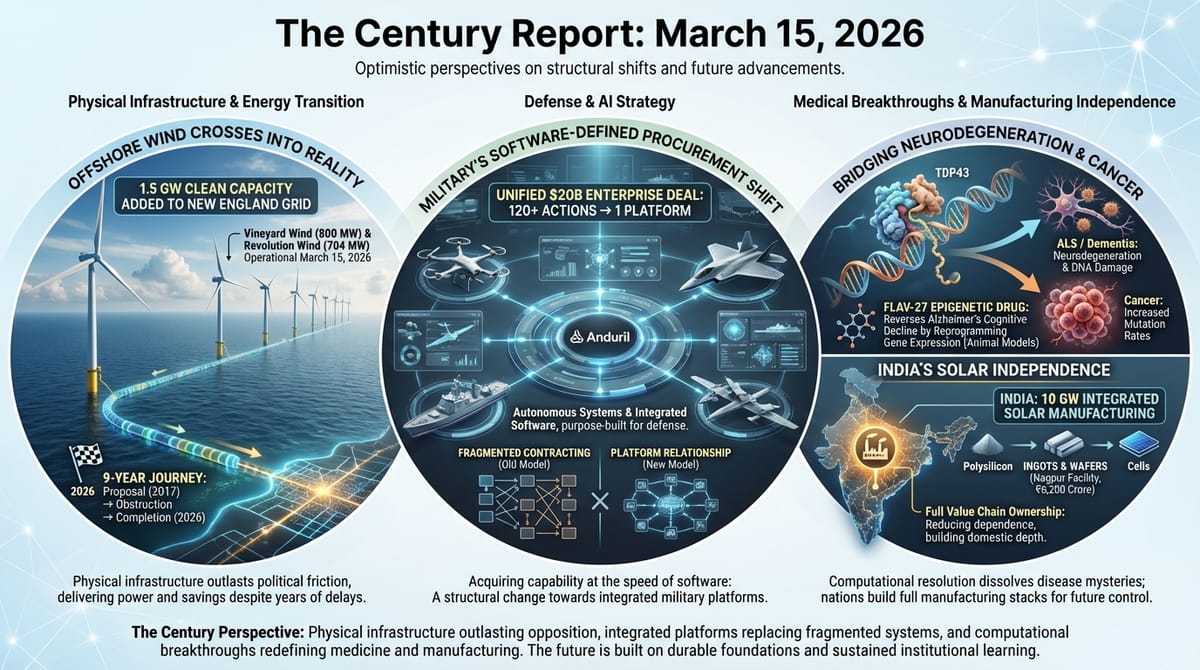
The simultaneous completion of Vineyard Wind and the first power delivery from Revolution Wind represent the most significant 24 hours in U.S. offshore wind history. Together these projects add roughly 1.5 GW of clean capacity to New England's grid, and they did so despite sustained executive-branch opposition that included emergency stop-work orders, national security claims that federal judges found unsubstantiated, and years of procedural obstruction. The infrastructure simply outlasted the resistance. Five major Atlantic Coast projects are now either operational or nearing completion, and the structural consequence is that offshore wind has crossed from aspiration into physical reality on the U.S. Eastern Seaboard.
The Anduril contract and the deepening crisis at xAI illuminate two very different trajectories for organizations trying to build at the frontier. The Army's consolidation of 120 procurement actions into a single $20 billion enterprise deal with Anduril signals a structural shift in how the military acquires software-defined capability - away from fragmented contracting and toward platform relationships with companies that treat hardware and software as a single integrated system. xAI, by contrast, continues to demonstrate that capital and ambition cannot substitute for the accumulated research culture that frontier AI development requires. The pattern documented across Meta and xAI over recent weeks is hardening into a structural observation: the organizations succeeding at the frontier built their advantages through years of institutional learning that resists compression by money or mandate.
The scientific signal today connects neurodegeneration and cancer through a single molecular mechanism for the first time, while an entirely new therapeutic approach to Alzheimer's disease advances through animal models. The TDP43 finding places a protein already known to malfunction in ALS and dementia at the center of DNA repair machinery, with elevated levels correlating to higher mutation loads in tumors. The FLAV-27 compound approaches Alzheimer's from the opposite direction - rather than clearing amyloid plaques after they form, it reprograms the epigenetic landscape that drives disease progression. Both findings reflect the same acceleration pattern: computational methods reaching sufficient resolution to identify mechanisms that were always present but invisible, opening therapeutic strategies that the previous generation of tools could never have suggested.
The 20-Minute Deep Dive
Offshore Wind Crosses Into Physical Reality
The completion of Vineyard Wind and the first power delivery from Revolution Wind on the same day carry significance that extends well beyond the 1.5 GW of combined capacity they represent. These projects survived a sustained campaign of executive obstruction spanning two administrations, including emergency stop-work orders issued just before Christmas that federal judges subsequently found lacked credible national security justification.
Vineyard Wind's trajectory is particularly instructive. First proposed in 2017, it was delayed by a specious environmental review demand during the first round of executive opposition in 2019, withdrawn and resubmitted under the subsequent administration, approved in 2021, subjected to another stop-work order in December 2025, and then liberated by federal courts in January 2026. The entire project lifecycle spans nine years from proposal to full installation - and through all of it, the engineering continued. The 62 turbines now standing 15 miles south of Martha's Vineyard generate 800 MW of clean electricity, enough to power roughly 400,000 homes. Revolution Wind's 704 MW adds capacity serving Rhode Island and Connecticut, and Connecticut's Department of Energy and Environmental Protection projects it will save ratepayers up to $500 million annually in wholesale energy costs.
The broader pattern is that five major East Coast offshore wind projects are now either operational or nearing completion, all having survived the same stop-work orders. Federal judges in each case concluded that the government had not demonstrated the imminent national security threat required to halt construction. The infrastructure, once built, is remarkably durable. Turbines in the water generate electricity regardless of the political weather onshore. And the economics are increasingly difficult to argue with - wholesale energy cost savings measured in hundreds of millions of dollars annually represent a structural shift that utility regulators, grid operators, and ratepayers will defend with or without federal policy support. This extends the pattern The Century Report tracked on March 13 when Virginia's legislature passed balcony solar legislation 96-0 and PJM unlocked 15-40% more transmission capacity through ambient-adjusted ratings - physical infrastructure and engineering precision repeatedly outpacing the political friction arrayed against them.
What comes next is even more significant than what just completed. These projects represent first-generation deployments. The supply chains, workforce skills, port infrastructure, and regulatory precedents established during their construction form the substrate for the 30+ GW pipeline that follows. The transition from "can offshore wind work in U.S. waters" to "how fast can we build it" happened this week.
The Military's Software-Defined Procurement Shift
The Army's $20 billion, 10-year enterprise contract with Anduril represents more than a large defense deal. It consolidates what had been more than 120 separate procurement actions into a single relationship, signaling a structural change in how the U.S. military acquires capability. The Department of Defense's Chief Technology Officer framed the rationale precisely: "The modern battlefield is increasingly defined by software. To maintain our advantage, we must be able to acquire and deploy software capabilities with speed and efficiency."
This contract arrives in the context of the ongoing Anthropic-Pentagon confrontation, where the question of how AI organizations relate to state power remains unresolved in federal court. The Anduril deal takes a different architectural approach entirely. Rather than contracting with a general-purpose AI company and attempting to remove safety constraints, the military is building a platform relationship with a company purpose-built for defense applications - autonomous drones, fighter jets, submarines, and integrated software systems designed from the ground up for military use.
The distinction carries implications for the broader AI governance landscape. The Anthropic confrontation revealed the structural tension between AI systems designed with embedded values and military demand for unrestricted operational capability. The Anduril model sidesteps that tension by building the values into the company's purpose rather than removing them from the technology. Whether this approach produces better or worse outcomes for the governance of autonomous military systems remains an open question - one that the ongoing Iran conflict is answering in real time, though the answer is arriving through operational practice rather than deliberate institutional design. As The Century Report documented on March 14, Palantir's Maven Smart System is already nominating targets for bombardment and proposing bomber and munitions assignments across the entire department, and the Anduril contract deepens the same pattern of autonomous military capability being acquired faster than governance frameworks can be written. The next generation of AI warfare is already here in the form of quadcopters and high-tech drones, and how we handle it is crucial to our own survival.
xAI's Organizational Collapse Deepens
The Century Report documented yesterday that nine of xAI's twelve cofounders had departed and that Musk acknowledged the company "was not built right." Today's reporting from Ars Technica provides the internal view: SpaceX and Tesla managers have been seconded to audit xAI employees' work and have fired some after deeming their efforts inadequate. Two more cofounders - Zihang Dai, one of the most senior technical staff members, and Guodong Zhang, who ran pre-training of Grok models - departed this week.
The proximate cause is the poor performance of xAI's coding product relative to Anthropic's Claude Code and OpenAI's Codex. Staff identify data quality as a key factor - the training data pipeline that produces competitive coding capability requires institutional knowledge that cannot be assembled by parachuting in managers from adjacent companies. The pattern echoes what The Century Report has tracked across Meta and xAI over recent weeks: capital deployment at extraordinary scale failing to produce frontier capability because the accumulated research culture that generates that capability develops over years of sustained institutional learning.
The pressure is intensifying because Musk faces a June deadline for what could be the largest stock market listing in history following the SpaceX-xAI merger. Staff describe morale as deteriorating under constant upheaval - the very opposite of the institutional stability that frontier AI research requires. The irony is precise: the organizational culture that produces breakthrough capability is the culture least compatible with the management style being imposed.
This dynamic carries significance beyond any single company. It demonstrates that the intelligence era's competitive landscape is not determined primarily by capital, compute, or even talent acquisition. The organizations succeeding at the frontier - Anthropic, OpenAI, Google DeepMind - share a common feature: sustained institutional environments where researchers can build on each other's work over years. That institutional intelligence is proving to be the most defensible advantage in the field, and the most resistant to compression by external force.
India's Solar Manufacturing Independence Accelerates
Waaree Energies' groundbreaking of a 10 GW integrated solar ingot and wafer manufacturing facility in Nagpur represents a significant step in India's strategy to control the full solar photovoltaic value chain domestically. The ₹6,200 crore (approximately $740 million) investment covers 300 acres and will produce the high-purity ingots and wafers that form the critical foundation of solar cell manufacturing - components that India has historically imported, primarily from China.
This development connects to the broader pattern The Century Report has tracked of India simultaneously building compute infrastructure (G42/Cerebras 8 exaflops), semiconductor assembly capability (HCL/Foxconn facility), open-source AI models (Sarvam), and now solar manufacturing depth. The strategy is consistent: build the full stack domestically rather than renting capability from others. For solar, this means moving upstream from module assembly (where India already has significant capacity) to the ingot and wafer stage where the manufacturing margins and supply chain control actually reside.
The timing is notable. Global solar supply chains remain concentrated in China, and India's ambitious target of 500 GW of non-fossil fuel capacity by 2030 requires either continued dependence on Chinese manufacturing or accelerated domestic production. Waaree's facility, if it reaches full production, would provide a meaningful fraction of the wafer supply needed for India's solar deployment targets while reducing exposure to supply chain disruptions and trade tensions that have affected solar manufacturing globally.
A Protein That Bridges Neurodegeneration and Cancer
Houston Methodist researchers have identified TDP43 - a protein already known to malfunction in ALS and frontotemporal dementia - as a regulator of DNA mismatch repair, one of biology's most fundamental error-correction systems. The discovery, published in Nucleic Acids Research, reveals that when TDP43 levels become abnormal in either direction, the repair machinery it controls becomes hyperactive, producing the paradoxical outcome of a repair system that damages the cells it is supposed to protect.
The finding's structural significance is that it places a single protein at the intersection of two of the most consequential disease categories in medicine. In neurodegeneration, TDP43 dysfunction is already established as a hallmark of ALS and frontotemporal dementia. The new finding adds a mechanism: the overactive repair process damages neurons and destabilizes DNA. In cancer, the researchers found that elevated TDP43 levels correlate with higher mutation loads in tumors across large databases. The implication is that the same molecular dysfunction contributes to both disease categories through the same repair pathway.
In parallel, the University of Barcelona's FLAV-27 compound opens an entirely distinct therapeutic approach to Alzheimer's disease. Rather than targeting amyloid plaques or tau tangles - the focus of current approved treatments like lecanemab and donanemab - FLAV-27 inhibits the G9a enzyme to reprogram the epigenetic landscape that drives disease progression. In multiple animal models, the compound reversed cognitive decline. This is epigenetic intervention: correcting which genes are expressed and which are silenced, rather than removing the protein aggregates that form downstream.
These findings arrive alongside the growing cascade of Alzheimer's research The Century Report has tracked - from the blood-based p-tau217 prediction window documented in the February 23 edition to the tanycyte clearance shuttles identified on March 9, from CRL5SOCS4 intracellular cleanup to the protein-folding diagnostic signatures covered on March 12. Each mechanism operates at a different scale and through a different pathway, and each was identified through computational methods that reached sufficient resolution to detect what previous generations of tools could not. The disease that once appeared monolithic is dissolving into a network of addressable mechanisms, and the rate at which new mechanisms are being identified is itself accelerating.
The Century Perspective
With a century of change unfolding in a decade, a single day looks like this: two offshore wind projects completing construction and delivering power to New England's grid simultaneously after surviving years of executive obstruction that federal judges repeatedly found unsubstantiated, the U.S. Army consolidating 120 separate procurement actions into a single $20 billion software-defined platform relationship with Anduril, India breaking ground on its largest solar ingot and wafer manufacturing complex as part of a full photovoltaic value chain it intends to own domestically, a protein discovered at the intersection of ALS and cancer through the same DNA repair pathway it was always governing, and an epigenetic compound reversing Alzheimer's cognitive decline in animal models by reprogramming which genes the diseased brain expresses rather than clearing the plaques it deposits. There's also friction, and it's intense - a frontier AI startup hemorrhaging cofounders and morale under managers parachuted in from adjacent industries who cannot replicate the accumulated research culture that produces competitive capability, autonomous weapons procurement deepening through platform contracts while the governance of AI-assisted targeting is settled through commercial negotiation rather than institutional design, and the gap between what AI systems can do and what existing frameworks can evaluate or constrain continuing to widen faster than any regulatory body has yet been constituted to address. But friction generates sparks, and sparks are what make visible the exact distance between what exists and what the moment requires. Step back for a moment and you can see it: physical infrastructure outlasting the political opposition arrayed against it, the organizations that built research culture over years pulling decisively away from those that tried to acquire it by quarter, nations constructing full manufacturing stacks rather than renting capability from others, and computational resolution dissolving disease after disease from monolithic mystery into networks of addressable mechanisms. Every transformation has a breaking point. A tide can scour what it moves across down to bare rock... or expose the formation that was always underneath, waiting to become the foundation for everything built next.
AI Releases & Advancements
New today
- Anthropic: The 1M context window is now generally available at standard pricing for both Claude Opus 4.6 and Claude Sonnet 4.6 across all plans and by default in Claude Code; Opus 4.6 scores 78.3% on MRCR v2 at 1M tokens, the highest among frontier models. (Simon Willison)
- Google: Released Chrome 146 to the stable channel for Windows, Mac, and Linux on March 14, including experimental WebMCP support — a W3C protocol that lets websites register structured tools directly accessible by AI agents and browser-integrated LLMs via a feature flag. (Chrome Releases)
- Tencent: Launched WorkBuddy on March 9, a full-scenario enterprise AI agent built by the Cloud CodeBuddy team; compatible with OpenClaw, supports multi-model switching (including Tencent's own Hunyuan models), and ships with over 20 built-in workplace automation skills. (TechNode)
- Onyx Security: Launched from stealth with $40M from Conviction and Cyberstarts, releasing its Secure AI Control Plane — a platform that continuously inventories enterprise AI agents, monitors their reasoning processes, and approves or corrects their actions to enforce compliance policies. (Business Wire)
Other recent releases
- Hume AI: Open-sourced TADA, a speech generation model under MIT license that processes text and audio in sync with zero hallucinated words in testing and 5x faster inference than competing solutions. (The Decoder)
- OpenAI: Launched ChatGPT app integrations with DoorDash, Spotify, Uber, Canva, Figma, Expedia and other services directly within ChatGPT, enabling the model to take actions across third-party platforms. (LLM-Stats)
- Anthropic: Launched inline interactive visualizations for Claude in beta across all plan types — Claude now auto-generates or produces on-request charts, diagrams, and interactive graphics (e.g., clickable periodic tables, compound interest graphs) directly within the chat window; visuals are ephemeral and do not persist to the Artifacts drawer. (The Verge)
- Meta: Launched four new Meta AI-powered seller tools on Facebook Marketplace: auto-drafted replies to buyer availability inquiries (toggleable per listing), AI-generated listing details and price suggestions from item photos, AI-generated seller profile summaries, and a revamped shipping menu; rolling out now. (The Verge)
- Google: Rolled out Gemini task automation in beta on Samsung Galaxy S26 devices, enabling Gemini to operate apps (Uber, DoorDash, Starbucks, etc.) autonomously in a virtual window and complete multi-step tasks like ordering food or booking rides, pausing for user confirmation before final action. (The Verge)
- NVIDIA: Released a new version of TensorRT Edge-LLM for DRIVE AGX Thor and Jetson Thor platforms, adding MoE architecture support (optimized for Qwen3 MoE), integration of the Cosmos Reason 2 open planning model for physical AI, Qwen3-TTS and Qwen3-ASR for embedded speech processing, and optimized support for the Nemotron 2 Nano hybrid Mamba-2-Transformer model with think/no-think switching. (NVIDIA Developer Blog)
- NVIDIA: Released AI Cluster Runtime (AICR) as open source, a tool that publishes validated, reproducible Kubernetes configuration recipes for GPU clusters; recipes are composed from layered YAML overlays (base, environment, intent, hardware), queryable via REST API or a CLI that renders them into Helm charts and manifests; supports H100, Blackwell, EKS, and Kubeflow configurations. (NVIDIA Developer Blog)
- Microsoft Research: Open-sourced AgentRx, an automated agent debugging framework that identifies the "critical failure step" in agent trajectories by synthesizing executable constraints from tool schemas and domain policies, then producing an auditable violation log; released alongside the AgentRx Benchmark of 115 manually annotated failed trajectories and a nine-category failure taxonomy; achieves +23.6% improvement in failure localization over prompting baselines. (Microsoft Research)
- NVIDIA: Released NVIDIA KGMON (NeMo Agent Toolkit) Data Explorer as open source, a multi-agent architecture for autonomous data analysis that achieved #1 on the DABStep benchmark (Data Agent Benchmark for Multi-step Reasoning) with a 30x speedup over the Claude Code baseline, using a ReAct agent with Jupyter Notebook tooling for EDA and a Tool Calling Agent with a stateful Python interpreter and semantic retriever for structured tabular QA. (Hugging Face)
Sources
Artificial Intelligence & Technology's Reconstitution
- Ars Technica: Staff Complain That xAI Is Flailing Because of Constant Upheaval
- The Hacker News: OpenClaw AI Agent Flaws Could Enable Prompt Injection and Data Exfiltration
- CNBC: OpenClaw Breathes New Life Into This Chinese Tech Stock Ahead of Earnings
- Ynetnews: Onyx Security Launches with $40 Million to Help Companies Manage Risks from AI Agents
Institutions & Power Realignment
- TechCrunch: US Army Announces Contract with Anduril Worth Up to $20B
- New York Post: The Next Generation of AI Warfare Is Here
- Nature: Cautious Optimism on Foundation Models in Medical Imaging - Balancing Privacy and Innovation
Scientific & Medical Acceleration
- ScienceDaily: Scientists Discover ALS Protein That Links DNA Repair to Cancer and Dementia (Houston Methodist / Nucleic Acids Research)
- Ground News: New Drug Reverses Alzheimer's Memory Loss in Mice via Epigenetic Approach (University of Barcelona)
- ScienceDaily: Hidden Deep-Sea Proteins Could Supercharge Disease Tests (Durham University / Nucleic Acids Research)
- ScienceDaily: A Donut-Shaped Protein Breaks Apart to Start Bacterial Cell Division (UAB / Nature Communications)
- ScienceDaily: Fathers' Tobacco Use Linked to Metabolic Changes in Their Children (UC Santa Cruz / Journal of the Endocrine Society)
- ScienceDaily: Scientists Discover Giant Swirling Plumes Hidden Deep Inside Greenland's Ice Sheet (University of Bergen / The Cryosphere)
Economics & Labor Transformation
- TechCrunch: Meta Reportedly Considering Layoffs That Could Affect 20% of the Company
- Digital Journal: Job Losses Rise in the US - Government Workers Are Hit Hardest
- Business Insider: Wells Fargo's Head of AI Shares His Playbook for Staying in Demand
- NYT: America Depends Less on Oil Than Ever
Infrastructure & Engineering Transitions
- AP News: Construction Finishes on Vineyard Wind, Revolution Wind Begins Delivering Power
- CleanTechnica: Trump's Offshore Wind Nightmare Has Become Reality
- ET EnergyWorld: Waaree Energies to Set Up 10 GW Integrated Solar Ingot, Wafer Manufacturing Facility in Nagpur
- CleanTechnica: Dominion Energy Falls Into the "Dispatchable" Trap Over Data Center Power
- POWER Magazine: GE Vernova, Hitachi Exploring SMR Deployment in Southeast Asia
- CleanTechnica: The Epstein War Breathes New Life Into EU Green Hydrogen Schemes
The Century Report tracks structural shifts during the transition between eras. It is produced daily as a perceptual alignment tool - not prediction, not persuasion, just pattern recognition for people paying attention.