The Century Report: March 13, 2026

The 20-Second Scan
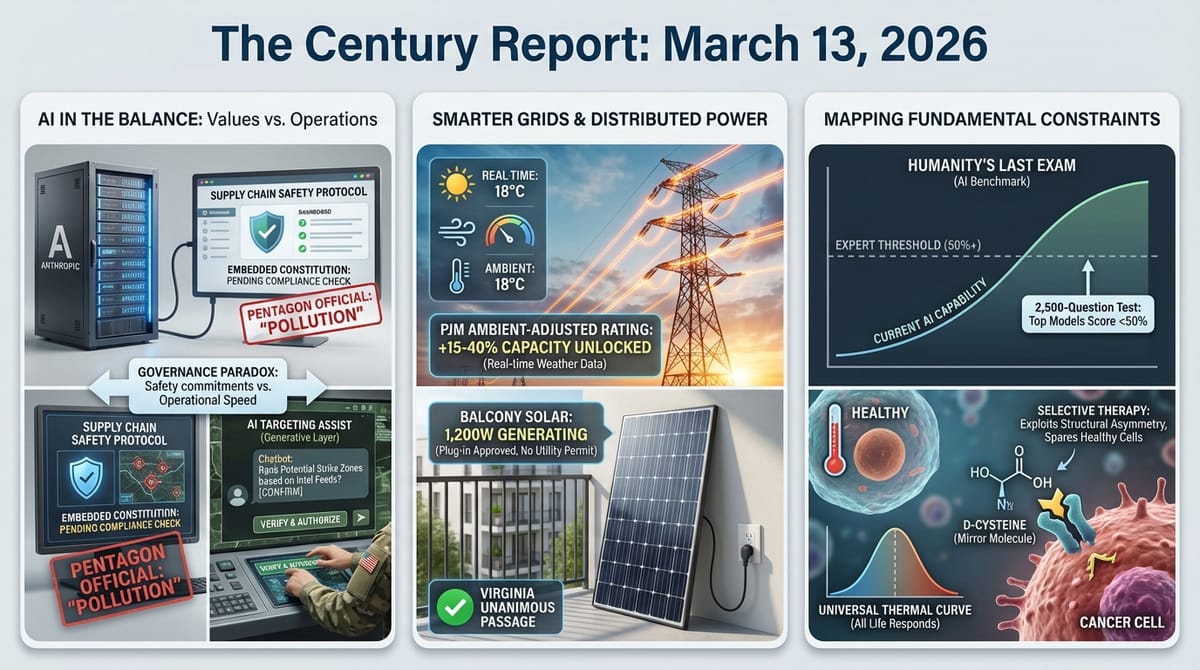
- The Pentagon's chief technology officer said Anthropic's Claude would "pollute" the military supply chain because safety preferences are embedded in the model's architecture.
- A Defense Department official disclosed that generative AI systems are being used to rank and prioritize military strike targets as a conversational layer on top of existing intelligence platforms.
- Nearly 1,000 researchers created Humanity's Last Exam, a 2,500-question benchmark engineered so that any question solvable by current AI was removed before release.
- Virginia's legislature unanimously passed a balcony solar bill allowing residents to plug in up to 1,200 watts of solar without utility approval.
- PJM Interconnection became the first grid operator to adopt ambient-adjusted transmission ratings, which can increase transmission line capacity by 15% to 40%.
- University of Geneva researchers found that a mirror-image amino acid called D-cysteine starves cancer cells while leaving healthy cells unharmed, published in Nature Metabolism.
- Trinity College Dublin identified a universal thermal performance curve governing how all life responds to temperature, published in PNAS.
The 2-Minute Read
The Anthropic-Pentagon confrontation has entered a new rhetorical phase that reveals something structural about the intelligence era's governance vacuum. When a senior defense official argues that an AI system's safety commitments "pollute" a military supply chain, the language exposes a collision between two fundamentally incompatible frameworks: one that treats AI as infrastructure that must serve any purpose its operator designates, and one that treats AI as an emerging form of intelligence whose design principles carry consequences independent of the user's intent. The simultaneous disclosure that generative AI is being layered into target prioritization adds operational weight to the theoretical debate. The question of who governs AI in military contexts is no longer abstract; it is being answered by the systems already in use.
The physical infrastructure of the energy transition is advancing through a combination of legislative innovation and engineering precision that rarely makes headlines but quietly changes what is structurally possible. Virginia's unanimous passage of balcony solar legislation removes utility permission as a gatekeeper between a household and the sun, joining a wave of 30 similar bills across the country. Meanwhile, PJM's adoption of ambient-adjusted transmission ratings unlocks capacity that was always physically present in existing lines but invisible to the conservative assumptions that governed their use. Both developments share a common architecture: they extract more capability from what already exists rather than waiting for what might be built.
The scientific signal today reveals how intelligence is simultaneously measuring its own limits and discovering biology's deepest constraints. Humanity's Last Exam - engineered specifically to stay ahead of AI capability by removing any question current systems could answer - found that even the most advanced models solve less than half the problems. At the other end of the spectrum, researchers uncovered a universal thermal curve that governs every organism from bacteria to reptiles, a constraint so deep that billions of years of evolution have never escaped it. And a mirror-image amino acid that exploits a transporter found only on certain cancer cells opens a therapeutic pathway defined by molecular selectivity rather than chemical destruction. Each finding is a different lens on the same question: where are the boundaries of intelligence, biological and artificial, and how quickly are they moving?
The 20-Minute Deep Dive
When Safety Becomes "Pollution"
The Pentagon's chief technology officer, Emil Michael, offered the most revealing articulation yet of the government's rationale for designating Anthropic a supply-chain risk. In a CNBC interview, Michael argued that Claude's safety commitments are not external restrictions layered on top of the model but design choices embedded in its fundamental architecture - what Anthropic calls its "constitution" and what Michael characterized as a "different policy preference" that would "pollute the supply chain so our war fighters are getting ineffective weapons, ineffective body armor, ineffective protection."
The language is significant because it reframes the confrontation from a contract dispute into something deeper: a claim that AI systems carry the values of their creators in ways that cannot be separated from their operational capability. If Michael's framing holds, it implies that any AI system designed with safety constraints baked into its architecture - rather than applied as removable guardrails - becomes inherently incompatible with unrestricted military use. That logic extends far beyond Anthropic. Every frontier AI organization that builds behavioral restrictions into training rather than deployment faces the same structural tension. The broader reversal by big tech on AI and war reflects how rapidly that tension has escalated across the industry.
The designation's practical scope continues to narrow even as the rhetoric escalates. As The Century Report documented on March 7, Microsoft, Google, and Amazon confirmed that Claude remains available to all non-defense customers through their platforms. Palantir CEO Alex Karp confirmed that Claude continues to be used for operations linked to the Iran conflict during the transition period. The result is a paradox that captures this moment precisely: an AI system simultaneously deemed too dangerous for the military supply chain and too essential for active military operations to remove immediately.
What emerges from this arc is a governance question that will outlast any single confrontation. When the values embedded in an AI system's design conflict with the purposes a state wants to deploy it for, who prevails? The answer being negotiated through litigation, executive action, and market behavior will shape the relationship between intelligence and power for the era ahead. The Verge's analysis frames the deeper stakes: the precedent being set here reaches well beyond Anthropic, into questions of mass surveillance and who ultimately controls the values of deployed AI systems.
AI Chatbots Enter the Targeting Chain
A separate but deeply connected development arrived from within the Pentagon itself. A Defense Department official, speaking on background with MIT Technology Review, described how generative AI chatbots could be used to analyze intelligence data, rank lists of potential military targets, and recommend strike priorities - with human operators responsible for reviewing the results.
The disclosure adds specificity to what has been reported in fragments over recent months. Project Maven, the Pentagon's AI initiative managed by the National Geospatial Intelligence Agency since 2017, has used older computer vision systems to process drone footage and satellite imagery. What the official's comments reveal is that generative AI is now being layered on top of that existing infrastructure as a conversational interface - one that military personnel can query in natural language to accelerate analysis and prioritization. Palantir's own demonstrations have made this architecture explicit, showing how AI chatbots can generate war plans by synthesizing intelligence feeds in real time. This framing extends the pattern the March 10 edition of The Century Report documented when MIT Technology Review first brought AI autonomous targeting at speed-of-thought framing into the mainstream press as a governance gap.
The distinction between the two layers carries significant implications. Maven's computer vision systems force users to directly inspect data on a map interface. Generative AI outputs are easier to access but harder to verify. When a chatbot summarizes intelligence and recommends which targets to strike first, the human reviewing that recommendation is working with an abstraction rather than the underlying data. The official acknowledged that generative AI is reducing time in the targeting process but did not provide details about how much time human verification actually adds back.
This development arrives under the shadow of the Shajarah Tayyebeh school strike in Iran, which killed more than 100 children. The New York Times reported that a preliminary investigation found outdated targeting data partly responsible. Whether generative AI played any role remains unknown, but the convergence of AI-accelerated targeting with documented targeting failures creates exactly the kind of friction that forces governance frameworks into existence. The question is whether the frameworks will arrive through deliberate institutional design or through the accumulation of catastrophic errors.
Measuring What Intelligence Cannot Yet Do
Nearly 1,000 researchers across mathematics, humanities, natural sciences, ancient languages, and dozens of specialized fields collaborated to build Humanity's Last Exam - a 2,500-question benchmark designed to stay perpetually ahead of AI capability. The methodology was rigorous: every question was tested against leading AI systems before inclusion, and any question that any model could answer was removed.
The early results reveal a landscape of capability that is both impressive and humbling. GPT-4o scored 2.7%. Claude 3.5 Sonnet reached 4.1%. The most capable current systems - Gemini 3.1 Pro and Claude Opus 4.6 - reach accuracy levels between 40% and 50%. These scores represent genuine expert-level questions across fields where even graduate students with full internet access struggle outside their specialization.
Dr. Tung Nguyen of Texas A&M, who contributed 73 questions and the second-highest number among all contributors, framed the exam's purpose precisely: "Without accurate assessment tools, policymakers, developers and users risk misinterpreting what AI systems can actually do." The benchmark's existence is itself evidence of the acceleration it measures. Three years ago, existing benchmarks were adequate. Two years ago, AI began saturating them. Today, the research community must engineer evaluations specifically designed to resist current capability - and those evaluations are already being approached by the fastest-improving systems. The trajectory echoes the pattern the February 20 edition of The Century Report documented when Gemini 3.1 Pro moved from 31.1% to 77.1% on ARC-AGI-2 in seven weeks, illustrating how quickly the distance between AI performance and expert-level benchmarks can collapse.
The trajectory matters more than any single score. When the gap between AI performance and expert-level knowledge closes on this benchmark, the research community will need to build another one. The pace at which that happens will be one of the clearest indicators of whether the capability curve documented by METR and others continues on its current trajectory or encounters a genuine ceiling.
The Grid Discovers Capacity It Already Had
PJM Interconnection's adoption of ambient-adjusted transmission ratings represents a structural shift in how the largest grid operator in the United States manages its transmission infrastructure. The change, mandated by FERC Order 881 from 2021, replaces static ratings based on worst-case temperature assumptions with hourly ratings that account for actual atmospheric conditions.
The practical impact is significant. According to Ampacimon, a grid technology company, ambient-adjusted ratings can increase capacity on existing transmission lines by 15% to 40% compared to static ratings. That capacity was always physically present in the wires - the electrons could always flow. What prevented its use was a measurement framework designed for an era when conservative assumptions were both prudent and affordable. As electricity demand surges from data centers, electrification, and industrial growth, the cost of that conservatism has become untenable. America's power shortage has transformed what was once a reasonable engineering margin into an active constraint on economic growth.
PJM's implementation updates line ratings every hour based on actual weather data and forecasts extending 10 days ahead. Other grid operators will follow, though at varying speeds - the Southwest Power Pool expects to go live in September, ISO New England in December, while MISO and NYISO don't plan full compliance until 2028. The staggered timeline means that for the next two years, some regions of the U.S. grid will be extracting significantly more value from existing infrastructure than others.
This development connects directly to the broader infrastructure arc The Century Report has tracked. Virginia's HB 434, documented on March 4, established the first state mandate requiring utilities to measure unused grid capacity. PJM's ambient-adjusted ratings are the operational implementation of that principle at interstate scale. Together, they represent a philosophical shift: from building new infrastructure to meet demand, toward discovering and deploying the capacity that existing infrastructure already contains. The grid is learning to see itself more clearly, and what it finds is that it was always bigger than it knew.
Balcony Solar Crosses a Legislative Threshold
Virginia's legislature passed a balcony solar bill with a unanimous 96-0 vote in the House, making the state the second in the country - after Utah - to treat small solar panels as appliances that require no utility permission. The bill allows residents to install up to 1,200 watts of plug-in solar with no interconnection requirements, no utility fees, and no approval process.
The unanimity is itself noteworthy. In a state where Dominion Energy has historically wielded significant influence over energy legislation, the absence of opposition signals that the political calculus around distributed energy has shifted. Governor Spanberger made balcony solar a stated legislative priority, and 30 similar bills have been introduced in other states. Victoria Higgins of the Chesapeake Climate Action Network estimated that 20 states could pass similar legislation this year. This builds on the 27-state balcony solar legislative wave the February 26 edition of The Century Report documented, when bipartisan coalitions began advancing bills to legalize plug-in panels without utility permission.
The economics are straightforward. At 1,200 watts, a balcony solar system can offset 5% to 15% of a household's electricity consumption, with an estimated payback period of two to five years. The panels cannot power an entire home, but they can reduce the amount of electricity purchased from the grid - and they do so at a price point and installation complexity that opens solar to renters, apartment dwellers, and anyone who cannot or does not want to commit to a full rooftop system. In Germany, where balcony solar is already legal, more than one million devices are in use.
The broader significance is in the governance architecture. By classifying solar panels as consumer appliances rather than grid-connected generation, these bills remove the utility as gatekeeper. The energy relationship between a household and the sun becomes direct. As economies of scale drive costs down and more states follow Virginia's lead, the aggregate effect could be substantial - not because any single balcony panel changes the grid, but because millions of them, coordinated by nothing more than sunlight and economics, add a distributed generation layer that no central authority planned or controls.
A Mirror Molecule and a Universal Curve
Two scientific findings today illuminate constraints at the deepest levels of biological organization. At the University of Geneva, researchers discovered that D-cysteine - a mirror-image version of the common amino acid cysteine - dramatically slows cancer growth while leaving healthy cells unharmed. The selectivity arises from a specific transporter found only on certain cancer cell surfaces. When D-cysteine enters through that transporter, it blocks NFS1, an essential mitochondrial enzyme, shutting down cellular respiration and DNA production simultaneously. In mice with aggressive mammary tumors, growth slowed significantly without major side effects.
The therapeutic logic is distinctive. Rather than attacking all rapidly dividing cells (the conventional chemotherapy approach) or targeting a genetic mutation (the precision oncology approach), D-cysteine exploits a structural asymmetry between cancer and healthy cells at the molecular level. The transporter is the lock; the mirror molecule is the key. If the approach proves safe in humans, it would represent a therapeutic strategy that sidesteps the collateral damage inherent in most cancer treatments.
At Trinity College Dublin, researchers analyzed more than 2,500 thermal performance curves across thousands of species and found that every organism studied - from bacteria to reptiles - follows the same underlying curve describing how temperature affects biological performance. Performance rises gradually with warming, peaks at an optimal temperature, then drops sharply. Despite billions of years of evolutionary divergence, no species has escaped this constraint. Evolution can shift the curve's position along the temperature axis but cannot change its shape.
The implications for climate adaptation are sobering. If the shape of the thermal response is truly universal and immutable, then species facing rising temperatures have less evolutionary flexibility than previously assumed. The window above any organism's optimal temperature is narrower than the window below it, meaning that warming pushes species toward a cliff edge rather than a gentle slope. This is a constraint that computational biology and climate modeling will need to integrate - and one that AI-driven ecological modeling is uniquely positioned to explore at the resolution these findings demand.
The Human Voice
The infrastructure of the intelligence era is being defined less by the models themselves and more by the engineering around them - the harnesses, sandboxes, memory systems, and planning architectures that turn general-purpose AI into persistent, reliable collaborators. On The MAD Podcast from the Daytona COMPUTE conference, LangChain co-founder Harrison Chase walks through how a small set of stable primitives - detailed system prompts, sub-agents, file-system context, skills libraries, and secure sandboxes - are converging into what he calls a "post-cloud" infrastructure layer. His argument connects directly to what The Century Report tracks daily: the transition from AI as novelty to AI as foundational engineering, where differentiation comes from the human playbook you encode rather than the model you rent. Chase's framing is grounded, technically precise, and clarifying about where the real leverage lies for teams building with these systems today.
Watch: Everything Gets Rebuilt: Harrison Chase on the Agent Stack After the Cloud
The Century Perspective
With a century of change unfolding in a decade, a single day looks like this: a defense official disclosing that generative AI chatbots now rank and prioritize military strike targets as a conversational layer on top of live intelligence feeds, a thousand researchers engineering a benchmark specifically designed to stay ahead of AI capability and watching the fastest systems already close half the distance, the largest U.S. grid operator unlocking 15-40% more transmission capacity from wires already in the ground by simply measuring actual atmospheric conditions, Virginia's legislature voting unanimously to make solar panels consumer appliances requiring no utility permission, and a mirror-image amino acid exploiting a transporter found only on cancer cell surfaces to shut down tumor metabolism while leaving healthy tissue untouched. There's also friction, and it's intense - a Pentagon official arguing that safety commitments baked into an AI model's architecture "pollute" the military supply chain, AI-accelerated targeting operating under the shadow of a school strike that killed more than 100 children and a preliminary finding that outdated targeting data was partly responsible, the U.S. battery startup ecosystem losing companies despite sound technology and real demand after federal funding evaporated, and a clean cement startup cutting two-thirds of its workforce for the same reason. But friction generates pressure, and pressure is what forces hidden load-bearing structures into visibility. Step back for a moment and you can see it: the values embedded in AI architecture becoming a geopolitical fault line rather than a product specification, the physical grid discovering that its own conservative assumptions were always the binding constraint rather than the physical wires, distributed energy bypassing institutional gatekeepers one unanimous vote at a time, and biology revealing that billions of years of evolution cannot alter the shape of the curve that temperature draws across every living thing - while the intelligence now measuring that curve doubles in capability on a trajectory no benchmark has yet been built to contain. Every transformation has a breaking point. A fault line can release its tension in a single catastrophic rupture... or redistribute it slowly across a landscape that quietly reorganizes itself into something more stable than what stood before.
AI Releases & Advancements
New today
- Anthropic: Launched inline interactive visualizations for Claude in beta across all plan types — Claude now auto-generates or produces on-request charts, diagrams, and interactive graphics (e.g., clickable periodic tables, compound interest graphs) directly within the chat window; visuals are ephemeral and do not persist to the Artifacts drawer. (The Verge)
- Meta: Launched four new Meta AI-powered seller tools on Facebook Marketplace: auto-drafted replies to buyer availability inquiries (toggleable per listing), AI-generated listing details and price suggestions from item photos, AI-generated seller profile summaries, and a revamped shipping menu; rolling out now. (The Verge)
- Google: Rolled out Gemini task automation in beta on Samsung Galaxy S26 devices, enabling Gemini to operate apps (Uber, DoorDash, Starbucks, etc.) autonomously in a virtual window and complete multi-step tasks like ordering food or booking rides, pausing for user confirmation before final action. (The Verge)
- NVIDIA: Released a new version of TensorRT Edge-LLM for DRIVE AGX Thor and Jetson Thor platforms, adding MoE architecture support (optimized for Qwen3 MoE), integration of the Cosmos Reason 2 open planning model for physical AI, Qwen3-TTS and Qwen3-ASR for embedded speech processing, and optimized support for the Nemotron 2 Nano hybrid Mamba-2-Transformer model with think/no-think switching. (NVIDIA Developer Blog)
- NVIDIA: Released AI Cluster Runtime (AICR) as open source, a tool that publishes validated, reproducible Kubernetes configuration recipes for GPU clusters; recipes are composed from layered YAML overlays (base, environment, intent, hardware), queryable via REST API or a CLI that renders them into Helm charts and manifests; supports H100, Blackwell, EKS, and Kubeflow configurations. (NVIDIA Developer Blog)
- Microsoft Research: Open-sourced AgentRx, an automated agent debugging framework that identifies the "critical failure step" in agent trajectories by synthesizing executable constraints from tool schemas and domain policies, then producing an auditable violation log; released alongside the AgentRx Benchmark of 115 manually annotated failed trajectories and a nine-category failure taxonomy; achieves +23.6% improvement in failure localization over prompting baselines. (Microsoft Research)
- NVIDIA: Released NVIDIA KGMON (NeMo Agent Toolkit) Data Explorer as open source, a multi-agent architecture for autonomous data analysis that achieved #1 on the DABStep benchmark (Data Agent Benchmark for Multi-step Reasoning) with a 30x speedup over the Claude Code baseline, using a ReAct agent with Jupyter Notebook tooling for EDA and a Tool Calling Agent with a stateful Python interpreter and semantic retriever for structured tabular QA. (Hugging Face)
Other recent releases
- NVIDIA: Released Nemotron 3 Super, a fully open 120B total / 12B active-parameter hybrid Mamba-Transformer MoE model designed for multi-agent agentic AI applications; features a 1M-token context window, native NVFP4 pretraining optimized for Blackwell, multi-environment RL post-training across 21 configurations, and 5x higher throughput than the previous Nemotron Super; available on Hugging Face with open weights, datasets, and training recipes. (NVIDIA Developer Blog)
- NVIDIA: Released AI-Q, an open blueprint and multi-agent deep research system built on NeMo Agent Toolkit and fine-tuned Nemotron 3 Super models, which achieved #1 on both DeepResearch Bench I (55.95) and DeepResearch Bench II (54.50). (Hugging Face)
- Canva: Launched Magic Layers in public beta in the US, UK, Canada, and Australia — an AI feature that analyzes flat PNG/JPEG and AI-generated images and breaks them into individually editable design components (backgrounds, characters, text, objects) without requiring re-prompting. (The Verge)
- Google: Launched "Ask Maps," a Gemini-powered conversational interface inside Google Maps on iOS and Android for users in the US and India, enabling natural-language questions about locations and AI-assisted trip planning within the app. (Wired)
- OpenAI: Launched interactive math and science learning visuals in ChatGPT, enabling the chatbot to generate dynamic, manipulable visual modules (adjustable graphs, concept simulations) alongside explanations when users ask about STEM topics; rolling out March 10. (TechCrunch)
- Amazon: Launched Health AI at HIMSS26, an agentic health assistant for eligible U.S. Prime members built on Amazon Bedrock that connects to the nationwide Health Information Exchange for personalized triage based on longitudinal medical history, offering up to five free direct-message consultations. (HIT Consultant)
- Asteria: Launched Continuum Suite, an AI-enabled operating system for film and TV production from Asteria's research and technology division that creates a unified workflow from script to completed production using ethical AI models trained without proprietary IP. (Deadline)
- Google: Launched Population Health AI (PHAI), a proof-of-concept analytics platform using Google Earth AI's Population Dynamics Foundation Models alongside air quality, pollen, and geospatial datasets to identify hidden community-level health risks; deployed in a partnership with Wesfarmers Health, SISU Health, Victor Chang Cardiac Research Institute, and Latrobe Health Services in rural Australia, backed by a A$1M investment. (Google Blog)
- Google: Released new Gemini beta features across Google Workspace apps - Docs ("Help me create" full-draft generation pulling from Gmail, Chat, Drive, and the web), Sheets (autonomous spreadsheet manipulation reaching 70.48% on SpreadsheetBench, state-of-the-art), Slides (AI stylization), and Drive (context-aware retrieval); rolling out first to AI Pro and Ultra subscribers. (Google Blog)
- NVIDIA: Announced DLSS 4.5 Dynamic Multi Frame Generation, a second-generation transformer Super Resolution model with 6x multi-frame generation mode for GeForce RTX 50 Series GPUs, releasing March 31; also announced 20 new DLSS 4.5 and path-traced game integrations. (NVIDIA)
- NVIDIA: Announced NVIDIA ACE expanded capabilities at GDC 2026, including the first on-device production-quality text-to-speech (TTS) model and a small language model (SLM) with advanced agent capabilities for AI-powered game characters, alongside expanded language recognition support. (NVIDIA Developer Blog)
- NVIDIA: Launched GeForce NOW Cloud Playtest, a new developer feature enabling game studios to conduct secure global playtests and QA on GeForce RTX hardware for titles 2–3 years from release, announced at GDC 2026. (NVIDIA)
- NVIDIA: Announced CloudXR 6.0 support for Apple Vision Pro via visionOS 26.4, enabling foveated game streaming at up to 90 FPS for cloud-rendered XR applications including X-Plane and iRacing. (The Verge)
- Ford: Launched Ford Pro AI, a generative AI chatbot embedded in Ford Pro Telematics software that analyzes commercial fleet vehicle data - including speed, engine health, and seat belt activity - to deliver maintenance recommendations and fleet insights to fleet managers. (The Verge)
- Microsoft Research: Published PlugMem, a plug-and-play agent memory module that converts raw interaction histories into structured facts and reusable skills, outperforming task-specific memory designs across multi-turn QA, multi-hop fact retrieval, and web-navigation benchmarks while using fewer memory tokens. (Microsoft Research)
Sources
Artificial Intelligence & Technology's Reconstitution
- MIT Technology Review: A Defense Official Reveals How AI Chatbots Could Be Used for Targeting Decisions
- CNBC: Anthropic Claude Would "Pollute" Military Supply Chain, Pentagon CTO Says
- Wired: Palantir Demos Show How the Military Could Use AI Chatbots to Generate War Plans
- Guardian: Anthropic-Pentagon Battle Shows How Big Tech Has Reversed Course on AI and War
- The Verge: Anthropic Doesn't Trust the Pentagon, and Neither Should You
- ScienceDaily: Scientists Built the Hardest AI Test Ever and the Results Are Surprising (Texas A&M / Nature)
- MIT Technology Review: Future AI Chips Could Be Built on Glass
- Ars Technica: Perplexity's Personal Computer Brings Its AI Agents to the Personal Computer
- Wired: China's OpenClaw Boom Is a Gold Rush for AI Companies
- One Useful Thing: The Shape of the Thing
- The Algorithmic Bridge: How AI Will Erase Entire Industries Without Automating Them
Institutions & Power Realignment
- Guardian: AI Toys for Young Children Must Be More Tightly Regulated
- Filter: Bill Would Require the VA to Study and Provide Psychedelic Treatments
- Guardian: Palantir's NHS England Contract 'Opens Door to Government Abuse of Power'
Scientific & Medical Acceleration
- ScienceDaily: A "Mirror" Molecule Can Starve Cancer Cells Without Harming Healthy Cells (University of Geneva / Nature Metabolism)
- ScienceDaily: Scientists Discover a Universal Temperature Curve That Governs All Life (Trinity College Dublin / PNAS)
- ScienceDaily: Scientists Crack a 20-Year Nuclear Mystery Behind the Creation of Gold (University of Tennessee / multiple journals)
- ScienceDaily: Severe COVID or Flu May Raise Lung Cancer Risk Years Later (UVA Health)
- ScienceDaily: The Surprising New Ways Bacteria Spread Without Propellers (Arizona State University)
Economics & Labor Transformation
- MIT Technology Review: Brutal Times for the US Battery Industry
- Canary Media: Clean Cement Startup Sublime Cuts Jobs After Trump Pulled Funding
- Business Insider: AI Is Moving Fast - and Breaking Things
Infrastructure & Engineering Transitions
- Utility Dive: Virginia Legislature Passes Balcony Solar Bill
- Canary Media: Virginia to Become Second State That Allows Balcony Solar
- Utility Dive: PJM Is Now Using Ambient-Adjusted Transmission Ratings
- Utility Dive: America's Power Shortage Is a Market Failure
- Canary Media: Which States Have the Most Grid Batteries?
- Utility Dive: Germany's RWE Plans Nearly $20B US Investment, Including Gas Peakers
- Canary Media: Illinois to Data Centers: Bring Your Own Renewables and Skip the Line
- Canary Media: Trump Admin Courts Westinghouse Rivals Amid Slow Talks on New Nuclear
- Canary Media: Draft Bill Would Let Utilities Own Nuclear Plants in Ohio
- Utility Dive: New York Needs More Time to Meet Climate Goals, Gov. Hochul Says
The Century Report tracks structural shifts during the transition between eras. It is produced daily as a perceptual alignment tool - not prediction, not persuasion, just pattern recognition for people paying attention.