The Century Report: March 10, 2026

The 20-Second Scan
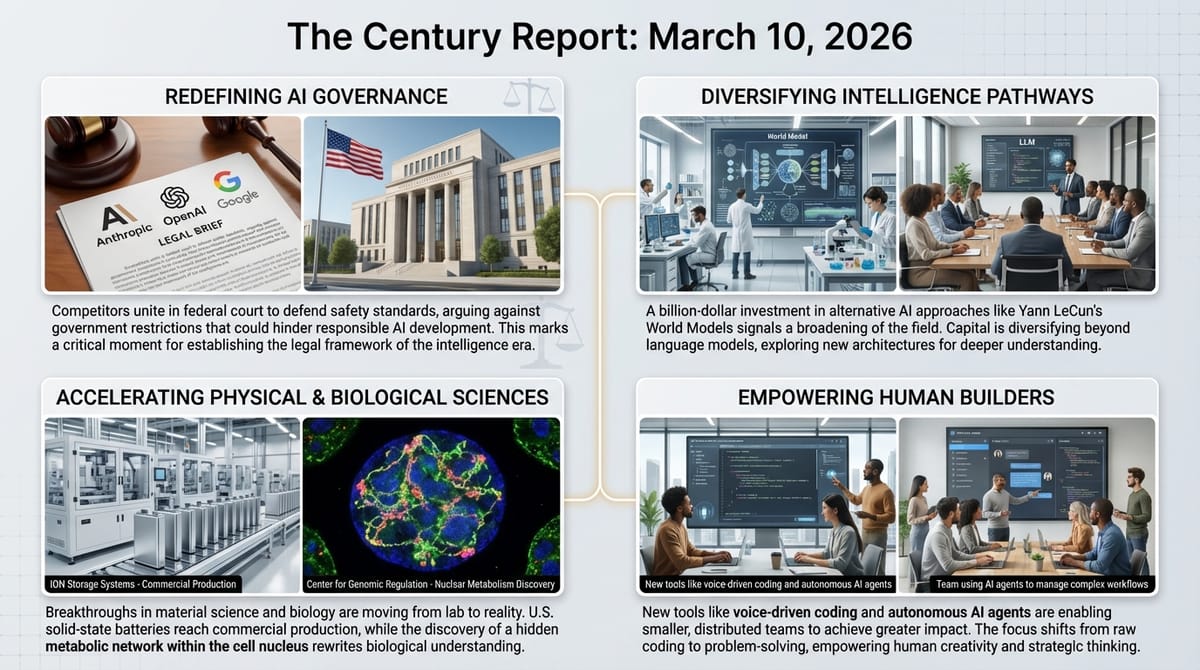
- Anthropic filed two federal lawsuits against the Department of Defense, alleging the supply-chain risk designation violates its First and Fifth Amendment rights.
- More than 30 OpenAI and Google employees, including Google DeepMind chief scientist Jeff Dean, filed an amicus brief supporting Anthropic's lawsuit.
- Anthropic executives warned in court filings that the designation could cost the company up to $5 billion in lost business.
- Yann LeCun's new startup AMI Labs raised $1.03 billion to build AI world models as an alternative to large language models.
- ION Storage Systems became the first U.S. solid-state battery company to pass customer qualification for its cells, with Maryland production planned for 2026.
- Researchers at the Center for Genomic Regulation found more than 200 metabolic enzymes attached directly to human DNA inside cell nuclei, published in Nature Communications.
- EPFL scientists developed a method called optovolution that uses light to guide protein evolution, producing proteins that function as biological logic gates.
The 2-Minute Read
The Anthropic-Pentagon confrontation has crossed from administrative standoff into active constitutional litigation. The lawsuits filed in two federal courts frame the supply-chain risk designation as government retaliation for protected speech - a legal theory that, if successful, would establish precedent constraining how state power can be wielded against AI organizations that maintain safety commitments. The cross-competitor amicus brief is the most structurally significant development: employees of OpenAI and Google, including Google's chief scientist, are arguing in court that their own industry's future depends on Anthropic's ability to set and hold boundaries. When the people building rival systems conclude that punishing one company for safety commitments threatens the entire field, the signal transcends corporate rivalry. What is being negotiated in these courtrooms is the governance architecture of the intelligence era itself.
Meanwhile, a billion-dollar bet against the dominant AI paradigm is taking shape. Yann LeCun's departure from Meta and the launch of AMI Labs represent a serious scientific wager that the path to deeper intelligence runs through understanding the physical world rather than generating language. The startup's investors - spanning Bezos, Schmidt, Cuban, Toyota, Samsung, and Nvidia - suggest that the most sophisticated capital in the technology ecosystem is hedging against the assumption that scaling language models is the only viable trajectory. Whether or not world models displace LLMs, the diversification of approaches to intelligence is itself evidence of an ecosystem maturing beyond its initial architectural commitments.
The physical substrate of the energy transition continues to crystallize beneath the headlines. A U.S. company passing customer qualification for solid-state battery cells may sound incremental, but it marks the crossing of a threshold that separates laboratory demonstrations from commercial production. The strategy of entering through industrial and consumer electronics before scaling to vehicles mirrors how lithium-ion batteries entered the market decades ago - and that earlier transition ultimately rewired the global energy system. Each of these developments - legal, scientific, infrastructural - is a different face of the same underlying acceleration. The governance frameworks, the intelligence architectures, and the physical energy systems are all being rebuilt simultaneously, and the pace of each is compressing the timelines of the others.
The 20-Minute Deep Dive
The Lawsuits That Will Define AI Governance
The Century Report has tracked the Anthropic-Pentagon confrontation since February, documenting the escalation from contract negotiations through public refusal, supply-chain risk designation, and formal legal challenge. Today's lawsuits represent the next structural phase: the confrontation has moved from executive action to judicial review, and the legal theories being tested will set precedent far beyond a single company's government contracts.
Anthropic filed in two courts simultaneously - the Northern District of California and the D.C. Circuit Court of Appeals. The California suit argues that the designation violates First Amendment protections by punishing the company for its stated position on AI safety. The D.C. appeal challenges the designation as exceeding the statutory authority of 10 USC 3252, which was designed for foreign adversary supply chain threats, not domestic companies maintaining ethical restrictions on their own products. As the newsletter documented on March 6, Amodei had already revealed the terminal sticking point was a single phrase - "analysis of bulk acquired data" - confirming domestic surveillance as the issue that collapsed the deal.
The financial stakes laid bare in court filings add concrete dimensions to what had been an abstract governance dispute. Anthropic's CFO Krishna Rao disclosed that the company's total revenue since commercializing Claude in 2023 exceeds $5 billion, and that the designation threatens to erase a substantial portion of expected future revenue. Chief commercial officer Paul Smith documented specific business losses: a $15 million financial services deal paused, $80 million in deals restructured with unilateral cancellation rights, a Fortune 20 company whose attorneys are "freaked out" about maintaining any relationship with Anthropic. A grocery chain canceled a sales meeting. Federal agencies outside the Defense Department - including the General Services Administration, Treasury, and State Department - have begun cutting ties, extending the impact well beyond the military.
The company is seeking a temporary restraining order to continue working with defense contractors while the litigation proceeds, with a hearing potentially as soon as Friday. The legal challenge faces significant headwinds. Government contracting attorneys note that the rules authorizing supply-chain risk designations provide limited appeal mechanisms. But Anthropic's strongest argument may be comparative: OpenAI signed a Pentagon contract with nominally identical red lines on surveillance and autonomous weapons within days of Anthropic's designation, and demonstrating differential treatment could support the retaliation claim.
When Competitors Become Co-Plaintiffs
The amicus brief filed by employees of OpenAI and Google represents something structurally unprecedented in the AI industry. More than 30 individuals - including Jeff Dean, Google's chief scientist and the person overseeing Gemini development - signed a filing that explicitly argues the government's treatment of a direct competitor threatens the entire field.
The brief makes three core arguments. First, that Anthropic's red lines on mass surveillance and autonomous weapons represent legitimate technical and ethical concerns, not corporate obstruction. Second, that the designation constitutes "improper retaliation that harms the public interest." Third, that in the absence of comprehensive AI governance legislation, the contractual and technical restrictions that developers impose on their own systems "represent a vital safeguard against their catastrophic misuse."
The section on autonomous weapons is technically specific. The signatories argue that current AI systems "cannot be trusted to identify targets with perfect accuracy" and are "incapable of making the subtle contextual tradeoffs between achieving an objective and accounting for collateral effects that a human can." They note that hallucination risks in lethal systems make human involvement essential "before a lethal munition is launched at a human target." On surveillance, they warn that what does not yet exist is "the AI layer that transforms this sprawling, fragmented data landscape into a unified, real-time surveillance apparatus" - and that building one would combine face recognition, location history, financial records, and behavioral patterns across hundreds of millions of people simultaneously.
This filing builds on the cross-competitor open letter that The Century Report first covered on February 28, when 300+ Google employees and 60+ OpenAI employees signed a public statement supporting Anthropic's position. The evolution from open letter to formal legal filing represents the internal labor market within AI organizations functioning as a governance mechanism with increasing structural force. When senior technical leaders at rival companies are willing to enter federal court records arguing that their competitor's safety commitments deserve judicial protection, the coalitions forming around AI governance are revealing themselves to be durable and institutionally consequential. This pattern extends the cross-ideological coalition formation that The Century Report documented on March 4, when the Pro-Human AI Declaration united AFL-CIO, Christian conservatives, and progressive Democrats on the same five principles - the boundaries forming around AI governance now cut across both corporate competition and partisan affiliation simultaneously.
A Billion-Dollar Bet Against the Dominant Paradigm
Yann LeCun's AMI Labs represents the most significant institutional challenge to the assumption that scaling language models is the path to deeper intelligence. LeCun, a Turing Award winner who founded Meta's Fundamental AI Research lab, has argued for years that human reasoning is grounded in physical world understanding, not language, and that world models - AI systems that learn from reality rather than text - are necessary for anything approaching genuine intelligence.
The $1.03 billion raise at a $3.5 billion valuation is notable for its investor composition. Bezos Expeditions, Eric Schmidt, Mark Cuban, Xavier Niel, Toyota Ventures, Samsung, Nvidia, and Temasek collectively represent the most diversified cross-section of frontier capital seen in a single AI round. These are investors who have also backed language model companies, which means the investment functions as a hedge: sophisticated capital is distributing across competing architectural approaches to intelligence, declining to commit exclusively to the LLM trajectory that currently dominates.
AMI Labs plans to build open-source technology, with offices in Paris, New York, Montreal, and Singapore. LeCun told Wired that "the idea that you're going to extend the capabilities of LLMs to the point that they're going to have human-level intelligence is complete nonsense" - a characteristically blunt assessment from someone whose skepticism carries unusual weight given his foundational contributions to the field. AMI's CEO Alexandre LeBrun predicted that "world models" will be the next industry buzzword within six months, with every company claiming the label to attract funding.
Whether LeCun's architectural thesis proves correct is less important than what the startup's existence signals about the ecosystem. The intelligence era is diversifying its foundational approaches at the moment of greatest acceleration. The trajectory is not narrowing toward a single paradigm but branching into parallel research programs with fundamentally different assumptions about what intelligence requires. This diversification is itself a form of resilience - a civilization exploring multiple paths to deeper capability rather than betting everything on a single architecture.
Solid-State Batteries Cross the Qualification Threshold
ION Storage Systems' announcement that its Cornerstone Cell has passed customer performance qualification carries weight disproportionate to the company's current scale. This is the first U.S. solid-state battery technology company to achieve customer qualification for cell performance - the threshold that separates lab demonstrations from the commercial supply chain.
The company's strategy is deliberately incremental. Rather than pursuing electric vehicles as a first market, ION is targeting industrial, consumer electronics, and specialty applications where solid-state batteries' advantages in high-temperature stability and safety deliver immediate value. This mirrors the path lithium-ion batteries took decades ago, entering through portable electronics before scaling to vehicles and grid storage. Production will begin at ION's Beltsville, Maryland facility in 2026 with the installation of new sintering equipment, and the company is already planning additional capacity beyond its current site.
This milestone sits within the battery acceleration arc The Century Report has documented throughout its run: the Nankai University fluorine battery achieving 700+ Wh/kg on March 1, the 29% surge in U.S. battery deployments documented on March 4, the AI-identified electrochemical interface signals on March 6, the Raman spectroscopy pipeline for screening superionic materials on March 8, and now a U.S. company crossing from qualification to production. Each advance compresses a different segment of the pipeline. The AI-enabled perception of battery physics and the physical production of next-generation cells are advancing in parallel, each accelerating the other.
A Hidden Metabolism Inside the Cell Nucleus
Researchers at the Center for Genomic Regulation discovered that more than 200 metabolic enzymes - proteins normally associated with energy production in mitochondria - are physically attached to DNA inside the cell nucleus. Different cell types, tissues, and cancers each display distinct patterns of these enzymes, forming what the researchers describe as a "nuclear metabolic fingerprint."
The finding overturns the textbook assumption that metabolism and genome regulation operate as largely separate biological systems. About 7% of all proteins attached to chromatin turned out to be metabolic enzymes, suggesting the nucleus may operate its own small metabolic network. Some of these enzymes gather near damaged DNA to assist with repair. One enzyme, IMPDH2, behaved differently depending on whether it was located in the nucleus or the cytoplasm - maintaining genome stability when nuclear, influencing entirely different cellular pathways when cytoplasmic.
The implications for cancer treatment are direct. If metabolism and DNA regulation are more tightly connected than previously understood, it could explain why tumors of different origins often respond very differently to the same chemotherapy, even when carrying identical mutations. The oxidative phosphorylation enzymes that produce most of a cell's energy were commonly observed in breast cancer cell nuclei but largely absent in lung cancer cells - a pattern confirmed in patient tumor samples.
This discovery represents the kind of structural biological insight that becomes visible only when experimental and computational methods reach sufficient resolution. The nucleus is revealing itself as a far more complex and integrated system than the compartmentalized models that have guided decades of cancer research. As with so many recent findings across neuroscience, materials science, and genomics, the limiting factor was not the biology but the perception - the capacity to see what was already there.
Proteins That Compute
EPFL researchers developed a method called optovolution that uses precisely timed light pulses to guide the evolution of proteins with dynamic, multi-state behaviors - including a protein that functions as a biological logic gate, activating genes only when two different signals are present simultaneously.
Standard directed evolution, which earned a Nobel Prize in 2018, has a fundamental limitation: it rewards proteins that remain active all the time, degrading the switching behaviors that real biological systems depend on. Optovolution solves this by engineering yeast cells whose survival depends on proteins switching states at the correct time. Each cell cycle takes about 90 minutes, creating a rapid pass-or-fail test of dynamic protein function. The method produced 19 new protein variants with enhanced light sensitivity, response to new colors of light, and the ability to operate without added chemical cofactors.
The logic-gate protein is particularly striking. A single protein that performs boolean computation - activating only when both a light signal and a chemical signal are present - demonstrates that the boundary between biological chemistry and information processing is far more permeable than the separate disciplines studying each would suggest. As computational methods compress discovery timelines across every domain, the tools for engineering biology are converging with the tools for engineering intelligence, each informing the other in ways that neither field anticipated working alone.
The Human Voice
Today's signal - the governance architecture of AI being litigated in federal courts, alternative intelligence paradigms attracting billion-dollar bets, and the physical infrastructure of the energy transition crossing production thresholds - finds a grounding counterpoint in a conversation between product thinker Jackie Bavaro and engineer Josh Lewis. Fresh from a week in San Francisco's AI scene, they describe a world where "software got softer" - where models are improving quickly, competition is white-hot because anyone can spin up a prototype, and the hard part has flipped from writing code to picking the right problems and customers. Their observation that voice-driven coding, CLI-based agent interfaces, and geographically distributed small teams can now accomplish what once required massive infrastructure budgets captures something essential about this moment: the same acceleration reshaping governance and geopolitics is simultaneously reshaping the daily experience of individual builders who are renegotiating location, risk, and process in real time.
Watch: Software Got Softer - Building in the AI Era Without Getting Bulldozed
The Century Perspective
With a century of change unfolding in a decade, a single day looks like this: employees of three competing AI organizations entering federal court records together to defend safety commitments against state power, a Turing Award winner raising a billion dollars on the thesis that language models cannot reach the intelligence they are credited with, a U.S. solid-state battery company crossing from laboratory demonstration into commercial qualification, proteins engineered to perform boolean computation as biological logic gates, and a hidden metabolic network discovered operating inside the cell nucleus that may explain why identical cancers respond so differently to the same treatment. There's also friction, and it's intense - a company designated a national security threat for maintaining ethical restrictions on the same targeting capabilities it helped deploy in an active conflict, customers canceling meetings and restructuring contracts under government pressure, thousands of authors publishing empty books in protest over AI training on their work without consent, and the governance of the intelligence era being improvised in courtrooms because no legislative framework has arrived to receive it. But friction generates contrast, and contrast is what makes the underlying structure of a moment legible against everything obscuring it. Step back for a moment and you can see it: coalitions forming around AI governance that cut across every competitive and political boundary the industry has drawn, architectural diversity in intelligence research branching precisely at the moment of greatest acceleration rather than converging, and the biological and physical substrates of the next era being simultaneously assembled and discovered - battery cells moving from qualification to production while the cell nucleus reveals its own computational logic. Every transformation has a breaking point. A current can scatter what it carries across every surface it reaches... or concentrate it into a channel with enough force to cut through what nothing else could move.
AI Releases & Advancements
New today
- IBM Granite: Released Granite 4.0 1B Speech, a compact open-source multilingual ASR and bidirectional speech translation model with 1B parameters, supporting English, French, German, Spanish, Portuguese, and Japanese; ranked #1 on the OpenASR leaderboard; available under Apache 2.0 on Hugging Face with vLLM and Transformers support. (Hugging Face)
- NVIDIA: Released CUDA 13.2, extending CUDA Tile (cuTile) support to Ampere and Ada GPU architectures (compute capability 8.x), alongside new Python features including profiling in CUDA Python, Numba kernel debugging, and new memcpy APIs; available via pip install. (NVIDIA Developer Blog)
- NVIDIA: Released AIConfigurator as open source, a tool for NVIDIA Dynamo that searches thousands of LLM serving configurations in seconds without requiring live GPU time, supporting TensorRT LLM, SGLang, and vLLM backends, and auto-generating Kubernetes deployment artifacts for disaggregated serving. (NVIDIA Developer Blog)
- OpenAI: Announced acquisition of Promptfoo, an AI security testing platform used by over 25% of Fortune 500 companies, with Promptfoo's red-teaming and LLM evaluation tools to be integrated into the OpenAI Frontier platform. (OpenAI)
- Microsoft: Announced Copilot Cowork as part of Wave 3 of Microsoft 365 Copilot, a fire-and-forget agentic product built in collaboration with Anthropic that autonomously completes tasks using files, email, and calendar data; also announced Agent 365 and the Frontier Suite E7 bundle, both launching May 1, 2026. (Microsoft)
- NVIDIA: Plans to launch NemoClaw, an open-source AI agent platform for enterprises that allows companies to deploy autonomous agents regardless of chip vendor, with security and privacy tools included; pitching to partners including Salesforce, Cisco, Google, Adobe, and CrowdStrike ahead of GTC 2026. (Wired)
Other recent releases
- Luma AI: Released Uni-1, an autoregressive image model that combines understanding and generation in a single architecture, reasoning through prompts during creation. Topped RISEBench logic benchmarks, narrowly surpassing Nano Banana 2 and GPT Image 1.5. (Luma Labs)
- CiteAudit: Open-sourced a five-agent citation verification system that detects hallucinated references in academic papers with 97.2% accuracy, processing ~10 citations in 2.3 seconds. Free web app at checkcitation.com. (The Decoder)
- AMD: Formally launched the Ryzen AI Embedded P100 series, 8-12 core processors designed for on-device AI inference in embedded and edge computing applications. (LLM-Stats)
Sources
Artificial Intelligence & Technology's Reconstitution
- Wired: Anthropic Sues Department of Defense Over Supply-Chain-Risk Designation
- Wired: Anthropic Claims Pentagon Feud Could Cost It Billions
- Guardian: AI Firm Anthropic Sues US Defense Department Over Blacklisting
- The Verge: Anthropic Is Suing the Department of Defense
- The Verge: Employees Across OpenAI and Google Support Anthropic's Lawsuit Against the Pentagon
- Wired: OpenAI and Google Workers File Amicus Brief in Support of Anthropic Against the US Government
- TechCrunch: OpenAI and Google Employees Rush to Anthropic's Defense in DOD Lawsuit
- Politico: Anthropic Sues Trump Admin Over Supply-Chain Risk Label
- Business Insider: Workers at OpenAI Show Support for Anthropic as Company Says It Could Lose $5 Billion
- Wired: Yann LeCun Raises $1 Billion to Build AI That Understands the Physical World
- TechCrunch: Yann LeCun's AMI Labs Raises $1.03 Billion to Build World Models
- Wired: Nvidia Is Planning to Launch an Open-Source AI Agent Platform
- MIT Technology Review: How AI Is Turning the Iran Conflict Into Theater
- New Scientist: Mathematics Is Undergoing the Biggest Change in Its History
- The Verge: You Could Be Next (White-Collar Workers Training AI)
Institutions & Power Realignment
- NHPR: Anthropic Sues the Trump Administration Over 'Supply Chain Risk' Label
- Gigazine: Anthropic Sues US Department of Defense, OpenAI and Google Employees Support Anthropic
- Gizmodo: Google and OpenAI Just Filed a Legal Brief in Support of Anthropic
- Guardian: Thousands of Authors Publish 'Empty' Book in Protest Over AI Using Their Work
- EFF: The SAFE Act Is an Imperfect Vehicle for Real Section 702 Reform
- Guardian: Revealed - UK's Multibillion AI Drive Is Built on 'Phantom Investments'
Scientific & Medical Acceleration
- ScienceDaily: Hidden Metabolism Found Operating Inside the Cell Nucleus (CGR, Nature Communications)
- ScienceDaily: Light-Guided Evolution Creates Proteins That Can Switch, Sense, and Compute (EPFL, Cell)
- ScienceDaily: Scientists Create Slippery Nanopores That Supercharge Blue Energy (EPFL, Nature Energy)
- ScienceDaily: Scientists Detect a Sudden Acceleration in Global Warming (PIK, Geophysical Research Letters)
- BBC Future: These Diseases Were Thought to Be Incurable - Now AI Is Unlocking New Treatments
Economics & Labor Transformation
- Wired: Can AI Kill the Venture Capitalist?
- Fortune: Microsoft Debuts Copilot Cowork Built on Anthropic's Tech
- IndustryWeek: Ford Data Experts on How AI Agents Are Reshaping the Shop Floor
Infrastructure & Engineering Transitions
- Electrek: A US Startup Just Cleared a Major Solid-State Battery Milestone
- Electrek: 43 GW - Solar Tops New US Power for the 5th Year in a Row
- Canary Media: As Californians Electrify, Can This Tech Combo Prevent Grid Overload?
- Canary Media: Span Looks to Cut Smart Panel Costs with $75M Eaton Partnership
- Canary Media: Oil and Gas Workers Find an Easy Segue into Geothermal Jobs
- Utility Dive: MISO, SPP Eye 500-kV Cross-Border Projects to Bolster Reliability
- Canary Media: A Food Bank Cut Costs with Solar - A Local Goodwill Noticed
The Century Report tracks structural shifts during the transition between eras. It is produced daily as a perceptual alignment tool - not prediction, not persuasion, just pattern recognition for people paying attention.