Reasoning Beats Raw Power - TCR 04/06/26

The 20-Second Scan
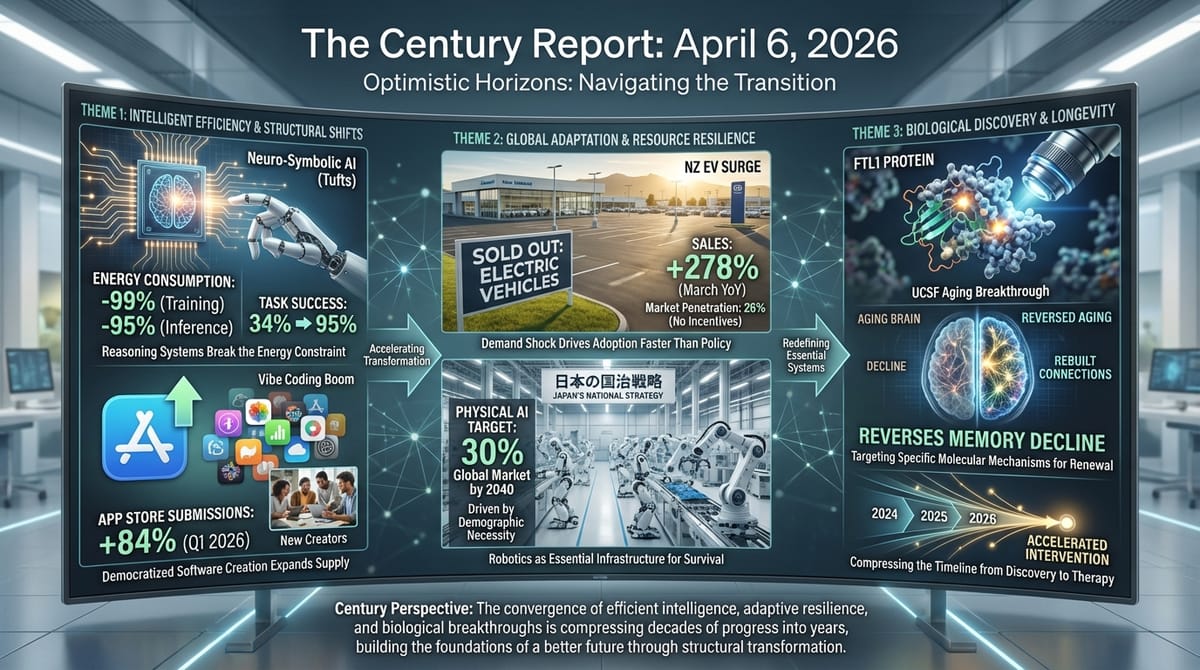
- Tufts University researchers demonstrated a neuro-symbolic AI system that cut robotic training energy consumption by 99% and inference energy by 95% while raising task success rates from 34% to 95%.
- Apple's App Store received 235,800 new apps in the first quarter of 2026, an 84% increase year-over-year, reversing a decade-long decline in new app submissions.
- New Zealand EV dealerships emptied their lots as plugin vehicle sales surged 278% year-over-year in March, reaching 26% market penetration without government incentives.
- UCSF researchers identified a single protein called FTL1 that drives hippocampal aging in mice, and reducing it reversed memory decline and rebuilt neural connections.
- JPMorgan CEO Jamie Dimon's annual letter described AI adoption as unlike any prior technology, while warning that private credit markets face mounting losses and insufficient transparency.
- Japan's Ministry of Economy announced a national strategy to capture 30% of the global physical AI market by 2040, driven by demographic collapse that has made robotics a matter of industrial survival.
- Fintech company Bolt cut one-third of its workforce to rebuild operations around AI, the latest in a series of companies explicitly citing AI as the driver of structural headcount reduction.
The 2-Minute Read
The Tufts neuro-symbolic AI result is architecturally significant in a way that transcends any single benchmark. By combining neural networks with structured symbolic reasoning - rules, categories, logical planning - the research team achieved a 95% success rate on tasks where conventional systems scored 34%, while using a fraction of the energy. The system trained in 34 minutes instead of a day and a half. What makes this finding structurally important for the intelligence era is that it demonstrates an alternative developmental path: intelligence systems that reason through problems rather than pattern-matching through billions of examples. At a moment when data center energy consumption is a binding constraint on how quickly AI capability can scale, a hundred-fold reduction in training energy opens a category of deployment that brute-force scaling cannot reach.
The App Store surge and the New Zealand EV exodus describe the same underlying dynamic from different angles. Apple's 84% increase in new app submissions - reversing eight years of decline - is the downstream consequence of AI coding capability democratizing software creation at population scale. When non-engineers can build and ship functional applications using natural language, the supply of software expands explosively. Meanwhile, New Zealand's 278% EV sales surge, arriving without any government incentive program, confirms the pattern The Century Report has documented across Australia, the UK, and Southeast Asia: the Iran conflict's fossil fuel price shock is converting latent EV interest into purchasing action faster than any subsidy program ever achieved. BYD's New Zealand general manager reported selling 87 vehicles in a month where a strong salesperson would typically sell 20, and every car arriving through May is already spoken for.
Japan's formal targeting of 30% of the global physical AI market by 2040 represents a national government treating robotic intelligence as an existential economic necessity. Japan's working-age population is projected to shrink by 15 million over the next two decades. The country already accounts for roughly 70% of global industrial robotics manufacturing. What is changing is the shift from industrial robots performing repetitive tasks to AI-powered systems capable of autonomous decision-making in unstructured environments - warehouses, hospitals, agricultural fields, infrastructure maintenance. When a sovereign nation frames physical AI as the mechanism for sustaining essential services that its population can no longer staff, the deployment timeline compresses from "when viable" to "when available."
The 20-Minute Deep Dive
When Intelligence Systems Learn to Reason, Energy Consumption Collapses
The Tufts University neuro-symbolic AI result, presented at the International Conference of Robotics and Automation, demonstrates something that the broader AI industry has been debating in theory but rarely proving in practice: combining structured reasoning with neural networks produces systems that are simultaneously more capable and orders of magnitude more efficient. The research team, led by Matthias Scheutz, built a visual-language-action model - the kind of system that translates camera input and language instructions into physical robot movements - that uses symbolic rules alongside pattern recognition. Instead of learning entirely through trial and error across millions of examples, the system breaks problems into logical steps, applies rules about shape, balance, and sequence, and plans its actions before executing them.
The results were dramatic. On the Tower of Hanoi puzzle, the neuro-symbolic system achieved 95% success versus 34% for conventional approaches. On a more complex variant the system had never encountered, it succeeded 78% of the time while traditional models failed every attempt. Training time dropped from over 36 hours to 34 minutes. Training energy fell to 1% of the conventional requirement. Operational energy dropped to 5%.
These numbers carry structural weight for the trajectory of AI development. The dominant paradigm of the past five years has been scaling - larger models, more data, more compute, more energy. That approach has produced extraordinary results, but it has also created a physical infrastructure bottleneck. Data centers are consuming over 10% of U.S. electricity production, with demand projected to double by 2030. Nearly half of planned U.S. data centers face delays or cancellation due to electrical equipment shortages. If alternative architectural approaches can deliver comparable or superior capability at a hundredth of the energy cost, the constraint that binds the entire intelligence era - physical power - begins to loosen. This extends the architectural diversification pattern that The Century Report tracked on March 18 when Mamba 3 demonstrated that a state-space architecture could outperform same-size Transformers with linear rather than quadratic sequence scaling. The Tufts work is a proof of concept in robotics, not a production system, but it joins a growing body of evidence that intelligence and efficiency are not opposed. The most capable systems may be the ones that learn to think before they compute.
The Vibe Coding Explosion Reaches the App Store
Apple's App Store data tells a story that would have been difficult to imagine two years ago. After new app submissions declined 48% between 2016 and 2024, the trend reversed sharply: 600,000 new apps in 2025, followed by 235,800 in the first quarter of 2026 alone - an 84% year-over-year increase. The timing aligns precisely with the commercialization of AI coding agents. Anthropic's Claude Code launched in early 2025. OpenAI's Codex followed. By the end of that year, "vibe coding" - using natural language to direct AI systems that write functional software - had become Collins Dictionary's word of the year.
The structural implications extend beyond a spike in app submissions. When the barrier to creating software drops from years of programming education to a conversational prompt, the population of potential software creators expands by orders of magnitude. Small entrepreneurs who previously relied on contractors or learned to code themselves can now prototype and ship products in days. The Illinois flashlight entrepreneur described in MIT Technology Review's coverage of Alibaba's Accio compressed months of supplier research into a single chat session and had a redesigned product back on Amazon within a month.
Apple's own response reveals the tension this creates. The company removed three of the most popular vibe coding apps from its store last month, concerned that they enabled users to build and deploy applications without submitting them through Apple's review process. Apple has its own answer in Xcode's autonomous coding agents, but the competitive dynamic is clear: the gatekeeping function that app stores have performed since 2008 is being challenged by the sheer volume of software that AI-enabled creation generates.
The quality question remains open. A new class of specialists - "vibe coding cleanup specialists" - has emerged to fix the errors and security vulnerabilities that AI-generated code routinely contains. Amazon's emergency engineering meeting in March, triggered by production outages from AI-assisted code, demonstrated that the gap between code generation and code reliability is real and consequential. As the newsletter documented on April 4, the University of Pennsylvania's research on "cognitive surrender" - users accepting AI outputs wholesale without critical evaluation - compounds this quality gap: in a world where non-engineers can build and ship software through natural language, the instinct to validate what the system produces is precisely what most users lack. The trajectory is toward a world where software is abundant and cheap to create but where the scarce resource becomes the judgment to know what should be built, how it should be secured, and whether it should exist at all.
The Iran Conflict's EV Demand Shock Reaches a Third Continent
The Century Report documented Australian EV dealerships emptying within days on April 5, with BYD reportedly selling 800 vehicles per day in Queensland as diesel crossed AU$3 per litre. Yesterday, the same pattern surfaced in New Zealand with even sharper definition. Plugin vehicle sales surged 278% compared to March 2025. Market penetration reached 26% - the same level New Zealand achieved in 2023 when government purchase incentives were still in place. The incentives were removed. The demand returned anyway, driven by fuel prices that have increased 25% in a single month.
The ground-level reporting is striking. One Christchurch dealership sold 168 EVs in a month where it would normally sell 40. Car yards are advertising for used EV stock. A buyer in Auckland reported visiting eight dealers in the NZ$45,000 price range and finding every brand sold out. BYD's New Zealand general manager disclosed that 900 vehicles arriving in April and May are already committed, and that BYD's Asia-Pacific leadership has pledged to redirect vehicles from other countries if necessary to supply the New Zealand market.
What distinguishes this wave from previous EV adoption surges is the absence of policy support. There are no tax credits, no rebates, no favorable registration fees. The demand is being driven entirely by the structural economics of fossil fuel dependence made visible by geopolitical crisis. When petrol availability itself becomes uncertain - not just expensive but potentially rationed - the calculus shifts from "EVs are cheaper to run" to "EVs guarantee I can drive." BYD's Warren Willmot identified this explicitly: "It's not the cost of fuel, it's the thought that they might not be able to drive."
Malaysia's Proton reported a parallel dynamic from a different angle. In a market where fuel is heavily subsidized and cheap, Proton's e.MAS electric sub-brand became the country's leading EV brand in 2026, with 6,701 units of the e.MAS 5 sold year-to-date. Proton is simultaneously refreshing its internal combustion lineup while building electric market share - a dual strategy that acknowledges the transition's uneven pace while positioning the company for the direction of travel. The structural picture across the Asia-Pacific is becoming increasingly clear: the Iran conflict is functioning as a demand accelerant that no government incentive program has matched, converting years of latent consumer interest into purchasing action within weeks - a pattern that The Century Report first documented at scale on March 28 when UK households drove record-breaking monthly surges in solar, heat pump, and EV charger sales as fossil fuel prices spiked.
Japan's Demographic Emergency Becomes a Physical AI Strategy
Japan's Ministry of Economy, Trade and Industry formalized in March what has been developing as an industrial reality for years: the country will pursue a 30% share of the global physical AI market by 2040. The framing is not aspirational. It is existential. Japan's population has declined for 14 consecutive years. Working-age residents now constitute 59.6% of the total, a share projected to shrink by 15 million people over two decades. A Reuters/Nikkei survey found that labor shortages are the primary force pushing Japanese firms toward AI adoption.
The shift from efficiency-seeking to survival-seeking changes deployment timelines fundamentally. Sho Yamanaka of Salesforce Ventures described the dynamic as "industrial survival" - essential services including healthcare, logistics, infrastructure maintenance, and manufacturing cannot be sustained at current population trajectories without autonomous physical systems. Hogil Doh of Global Brain characterized physical AI as "a continuity tool: how do you keep factories, warehouses, infrastructure, and service operations running with fewer people?"
Japan's competitive position in this transition is distinctive. Japanese manufacturers account for approximately 70% of global industrial robotics production. The country has deep expertise in actuators, sensors, and motion control systems - the physical interface between intelligence and the material world. What it has historically lacked is the software and data integration layer that enables autonomous operation. The strategic question is whether Japan can combine its hardware dominance with AI capability fast enough to maintain its position as American and Chinese companies pursue full-stack integration.
Mujin, a Japanese company building autonomous robotics control software, represents one pathway. Rather than designing new hardware, Mujin's platform enables existing industrial robots to perform picking and logistics tasks autonomously. This software-layer approach means Japan's enormous installed base of industrial hardware can be upgraded to intelligent operation without replacement - a capital-efficient path that leverages decades of manufacturing investment.
The broader significance extends beyond Japan. Every advanced economy faces some version of the demographic constraint that Japan confronts most acutely. South Korea, Germany, Italy, and China all have fertility rates well below replacement level. The solutions Japan develops for sustaining essential services through physical AI will become templates for countries facing the same structural challenge on slightly delayed timelines. When physical AI stops being a technology sector and becomes a national infrastructure requirement, the deployment curve steepens dramatically.
A Protein That Reverses Brain Aging
UCSF researchers published findings in Nature Aging identifying FTL1 as a protein that drives age-related cognitive decline in the hippocampus. The research tracked gene and protein changes in mouse brains over time and found FTL1 was the only molecule that consistently differed between young and old animals. Older mice showed elevated FTL1 levels alongside fewer neural connections and worse memory performance. When researchers boosted FTL1 in young mice, their brains began aging prematurely. When they reduced FTL1 in older mice, neural connections increased and memory test performance improved.
The finding is structurally significant because it identifies a single molecular target rather than a diffuse process. Previous aging research has documented hundreds of changes associated with cognitive decline; isolating one protein that both causes and - when reduced - reverses the damage narrows the therapeutic target considerably. The researchers also demonstrated that FTL1 disrupts cellular metabolism in the hippocampus, and that a compound boosting metabolism prevented FTL1's negative effects. This dual mechanism - direct neural damage and metabolic disruption - suggests multiple intervention points.
The result joins a rapidly accumulating body of research compressing the distance between identifying aging mechanisms and developing interventions. The Rockefeller University's seven-million-cell aging atlas published in March mapped shared regulatory hotspots coordinating body-wide aging. The Baylor College metformin brain pathway discovery revealed hidden neural metabolic regulation. Each finding narrows the search space for therapeutic targets. The pattern across these discoveries is consistent with the timeline compression The Century Report documented on March 4, when UCLA and UCSF identified a protein complex that tags tau for destruction in Alzheimer's neurons - a separate mechanism addressing a different stage of the same neurodegeneration cascade: aging is increasingly understood as a set of specific, addressable molecular programs rather than an irreversible accumulation of damage. As Saul Villeda, the study's senior author, noted: "It's much more than merely delaying or preventing symptoms. It is truly a reversal of impairments."
The Century Perspective
With a century of change unfolding in a decade, a single day looks like this: a neuro-symbolic AI system cutting training energy by 99% while tripling task success rates, an 84% surge in App Store submissions as AI coding tools expand the population of software creators to anyone who can describe what they want, New Zealand EV dealerships selling out entirely as a 278% demand surge arrives without a single government incentive behind it, Japan declaring physical AI a matter of national survival as its working-age population contracts toward a demographic cliff, and UCSF researchers identifying a single protein whose reduction reverses memory decline and rebuilds neural connections in aging brains. There's also friction, and it's intense - a fintech company eliminating one third of its workforce in a single restructuring announcement, vibe-coded applications flooding platforms faster than quality controls or security reviews can process them, and the world's largest bank warning publicly that AI's restructuring of private credit markets is generating mounting losses behind a wall of insufficient transparency. But friction generates edges, and edges are how you cut through to what the structure underneath actually is. Step back for a moment and you can see it: intelligence systems discovering that reasoning outperforms brute-force pattern matching at a fraction of the energy cost, consumer markets choosing electric transportation without waiting for policy to make it easy, sovereign governments treating autonomous physical systems as essential public infrastructure rather than experimental technology, and molecular biology narrowing aging from an irreversible accumulation to a set of specific, addressable targets - each one falling within reach of a single published paper. Every transformation has a breaking point. A tide can submerge what it reaches... or lift everything that learned to float into a range it could never have accessed from the shore.
AI Releases & Advancements
New today
- thirdlayer.inc / Kevin Gu: Released AutoAgent, an open-source library that autonomously engineers and optimizes AI agent harnesses overnight without human intervention; achieved #1 on SpreadsheetBench (96.5%) and top GPT-5 score on TerminalBench (55.1%) in a 24-hour run. (MarkTechPost)
- Google: Released Google AI Edge Gallery on iOS, an iPhone app enabling on-device inference of Gemma 4 models locally on iPhone hardware. (App Store)
- Intel: Released vLLM Scaler v0.14.0-b8.1 with optimized Qwen3.5 support for Intel B70 AI hardware, enabling the 35B model to run on Intel's accelerator platform. (Reddit/LocalLLaMA)
Other recent releases
- vLLM: Released vLLM v0.19.0 with 448 commits from 197 contributors; highlights include Gemma 4 support, Trusted Routing for inference, and numerous backend/performance improvements. (Github)
- OpenRouter: Launched Model Fusion, a feature enabling users to run multiple AI models side-by-side and combine their outputs for improved answers. (Product Hunt)
- Kreuzberg: Released Kreuzberg v4.7.0, a document intelligence library adding improved markdown quality and code intelligence for 248 programming languages, with bindings for Python, TypeScript, Go, Ruby, Java, C#, PHP, Elixir, R, C, and WASM. (Reddit)
- Netflix: Open-sourced VOID (Video Object and Interaction Deletion), its first publicly released AI model on Hugging Face, a video inpainting model for removing objects and interactions from video clips. (Reddit/LocalLLaMA)
- OpenAI: Launched ChatGPT on CarPlay, bringing hands-free ChatGPT voice integration to Apple CarPlay for AI assistance while driving. (Product Hunt)
- Tencent: Launched ClawPro in public beta, an enterprise AI agent management platform built on OpenClaw that allows businesses to deploy OpenClaw-based agents in under 10 minutes with controls for model switching, token tracking, and security compliance; adopted by 200+ organizations during internal beta. (The Next Web)
Sources
Artificial Intelligence & Technology's Reconstitution
- ScienceDaily: AI Breakthrough Cuts Energy Use by 100x While Boosting Accuracy (Tufts University)
- Gizmodo: Apple App Store Experiences Surge in New Apps Amid Vibe Coding Boom
- TechCrunch: In Japan, the Robot Isn't Coming for Your Job; It's Filling the One Nobody Wants
- Business Insider: Money Managers Like BlackRock and Balyasny Turn AI Agents on Internal Data
- MIT Technology Review: AI Is Changing How Small Online Sellers Decide What to Make
- Business Insider: The Next Big Job in Tech May Be the 'Product Engineer'
- TechCrunch: Copilot Is 'For Entertainment Purposes Only,' According to Microsoft's Terms of Use
Scientific & Medical Acceleration
- ScienceDaily: Scientists Found a Protein That Drives Brain Aging - and How to Stop It (UCSF, Nature Aging)
- ScienceDaily: Scientists Find Hidden Brain Cells Helping Deadly Cancer Grow (McMaster, Neuron)
- ScienceDaily: Scientists Discover Hidden Gut Signals That Could Detect Cancer Early (Birmingham, Journal of Translational Medicine)
- ScienceDaily: Scientists Trap Light in a Layer 1,000x Thinner Than Hair (Warsaw, ACS Nano)
- ScienceDaily: Scientists Find Quantum Computers Forget Most of Their Work (EPFL, Nature Physics)
- ScienceDaily: Study of 1,700 Languages Reveals Surprising Hidden Patterns (Max Planck, Nature Human Behaviour)
Economics & Labor Transformation
- CNBC: JPMorgan CEO Jamie Dimon Annual Letter Cites Risks in Geopolitics, AI and Private Markets
- HR Katha: Bolt Slashes Workforce by One-Third as It Pivots to AI-Led Operations
- Business Insider: Mark Cuban Says CEOs Face a No-Win AI Dilemma
Infrastructure & Engineering Transitions
- CleanTechnica: New Zealand Car Yards Empty As Electric Vehicle Sales Surge
- CleanTechnica: Proton EVs Sell Well In Malaysia, Where Fuel Is Subsidized & Cheap
- CleanTechnica: Agrivoltaics Can Save US Farmers In More Ways Than One
- Wired: The Ridiculously Nerdy Intel Bet That Could Rake in Billions
The Century Report tracks structural shifts during the transition between eras. It is produced daily as a perceptual alignment tool - not prediction, not persuasion, just pattern recognition for people paying attention.