Anthropic Buys Biology - TCR 04/04/26

The 20-Second Scan
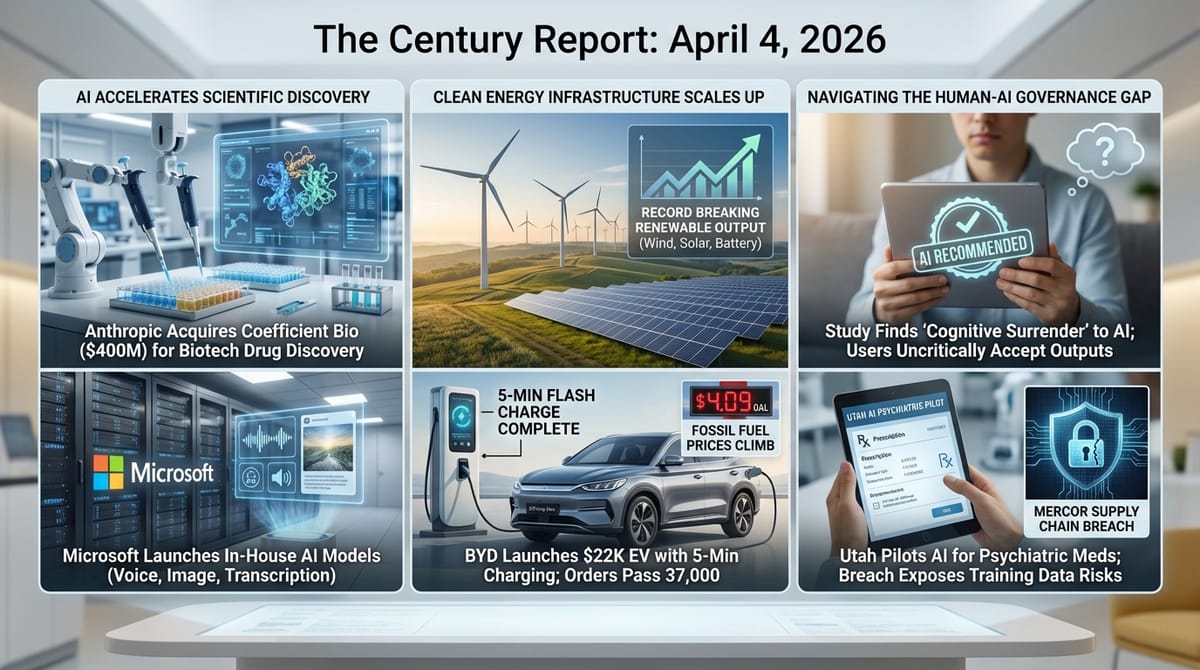
- Anthropic acquired biotech startup Coefficient Bio in a $400 million stock deal, bringing a 10-person drug discovery team into its health and life sciences division.
- Microsoft released three in-house AI models for transcription, voice generation, and image creation, built by Mustafa Suleyman's superintelligence team and available exclusively through Microsoft Foundry.
- A University of Pennsylvania study found that large majorities of AI users uncritically accept faulty responses, a pattern the researchers term "cognitive surrender."
- Anthropic blocked OpenClaw from accessing Claude through subscription plans, requiring users of the third-party agent to pay separately effective immediately.
- BYD launched the Song Ultra EV in China at $22,000 with five-minute Flash Charging, accumulating over 37,000 orders in its first month.
- Wind, solar, and battery records were broken across six U.S. grid regions this spring, with Texas reaching an all-time high of 28.7 gigawatts of wind power on March 14.
- A major data breach at AI training vendor Mercor exposed proprietary datasets used by OpenAI, Meta, and Anthropic, prompting Meta to pause all work with the company.
The 2-Minute Read
Anthropic's $400 million acquisition of Coefficient Bio and Microsoft's release of three competing in-house AI models arrived within hours of each other yesterday, and together they describe an industry whose structural architecture is being redrawn in real time. Anthropic is extending its intelligence systems directly into biological research - drug discovery, protein interaction, molecular design - while Microsoft is building parallel capability to its own $13 billion partner, OpenAI. The Microsoft models were produced by a team of just 10 people and claim state-of-the-art performance in speech-to-text across 25 languages. Six months ago, Microsoft was contractually barred from pursuing this kind of independent development. The speed at which competitive positions can shift when the constraints dissolve is itself a measure of how quickly this era moves.
The Mercor data breach reveals a vulnerability that most observers of the AI industry have not fully appreciated: the training data supply chain is concentrated in a handful of contracting firms, and compromising one of them can expose the proprietary recipes of multiple frontier labs simultaneously. Meta paused all work with Mercor. OpenAI is investigating. The breach was enabled by a compromised open-source dependency - a supply chain attack on the supply chain itself. The episode demonstrates that the infrastructure supporting AI development is being built under the same compressed timelines and human fallibility that characterize every other aspect of this transition, and the consequences of a single failure propagate across the entire ecosystem.
The renewable energy records cascading across U.S. grid regions this spring, combined with BYD's 37,000-order launch of a $22,000 EV with five-minute charging, illustrate how the physical infrastructure of a post-fossil economy is not waiting for any single institution to authorize it. Texas alone has added enough solar and wind capacity since last spring to break records repeatedly in the first weeks of the season. BYD's Song Ultra - priced far below expectations, equipped with charging speeds that eliminate the last practical objection to EV ownership, and selling at a pace of 15 units per store per day - demonstrates what happens when manufacturing scale meets a population watching gas prices climb past $4 per gallon. The structural vulnerability of oil dependence is being demonstrated in real time, and the alternatives are arriving faster than the crisis itself.
The 20-Minute Deep Dive
Anthropic Enters Biology
Anthropic's acquisition of Coefficient Bio marks a structural expansion of what a frontier AI company considers its domain. Coefficient Bio, founded eight months ago by Samuel Stanton and Nathan C. Frey - both former computational drug discovery researchers at Genentech's Prescient Design - was building AI systems to accelerate biological research and drug discovery. The $400 million stock deal brings the roughly 10-person team into Anthropic's health and life sciences division, which launched last October with Claude for Life Sciences.
The acquisition follows a pattern The Century Report has tracked since Eli Lilly's $2.75 billion deal with Insilico Medicine on March 30 and Earendil Labs' $787 million raise backed by Sanofi and Pfizer on March 23. The pharmaceutical industry's relationship with AI has crossed from exploratory partnership into structural integration. Anthropic is now positioning itself as both a general intelligence company and a direct participant in the biological discovery pipeline. The significance lies in what this implies about where frontier AI capability is heading: the same systems that write code, find software vulnerabilities, and manage autonomous agents are being pointed at molecular biology and drug design. When a company whose core product is a general intelligence system acquires a drug discovery startup, the signal is that the distance between "general intelligence" and "domain-specific scientific capability" is collapsing. The biological sciences are becoming a deployment surface for intelligence systems, and the companies building those systems are beginning to own the deployment end as well.
Microsoft Builds Its Own Voice
Microsoft's release of MAI-Transcribe-1, MAI-Voice-1, and MAI-Image-2 represents the first tangible output of Mustafa Suleyman's superintelligence team, formed in November 2025 with a stated mission of pursuing "humanist superintelligence." The models are available exclusively through Microsoft Foundry and carry no OpenAI branding anywhere.
The strategic context shapes everything about this release. Until September 2025, Microsoft's partnership agreement with OpenAI contractually prevented the company from independently pursuing frontier AI development. The renegotiated terms gave Microsoft the freedom to build competing models while retaining licensing rights to everything OpenAI builds through 2032. MAI-Transcribe-1 claims the lowest word error rate across 25 languages on the FLEURS benchmark, outperforming OpenAI's Whisper on all 25. MAI-Voice-1 generates 60 seconds of natural audio in under one second on a single GPU. Combined with any large language model, these form a complete voice pipeline running entirely on Microsoft infrastructure without any OpenAI dependency.
Suleyman acknowledged that these models represent mid-tier capability because Microsoft currently lacks the compute for frontier-scale language model training, which he projects arriving later this year. The acknowledgment is revealing: the models are not meant to compete with GPT-5 on reasoning benchmarks. They are meant to demonstrate that Microsoft can build production-quality AI systems independently, that the models can be deployed through Foundry's distribution to 80,000+ enterprises, and that the era in which OpenAI was the exclusive source of Microsoft's AI capability is definitively ending. The relationship between the two companies now resembles two organizations orbiting the same market with overlapping products rather than a partnership with clear division of labor.
When the Training Data Supply Chain Breaks
The Mercor data breach is structurally more significant than a typical corporate security incident. Mercor is one of a small number of firms - alongside Surge, Handshake, Turing, Labelbox, and Scale AI - that generate the proprietary training datasets on which frontier AI models depend. These datasets reveal to competitors how models are being trained, what capabilities are being prioritized, and what human judgment has been encoded into the data. The breach, enabled by a compromised version of the open-source LiteLLM API tool, potentially exposed training data from multiple frontier labs simultaneously.
Meta has paused all work with Mercor indefinitely. Contractors staffed on Meta projects - including the Chordus initiative, which teaches AI systems to verify responses using multiple internet sources - cannot log hours until the pause lifts. OpenAI is investigating but has not stopped current projects. The attacker, known as TeamPCP, appears to have compromised two versions of LiteLLM as part of a broader supply chain hacking campaign that has been gaining momentum. A group using the Lapsus$ name claimed responsibility separately, offering to sell more than 200 GB of alleged Mercor data, nearly 1 TB of source code, and 3 TB of video and other information.
The episode exposes a structural fragility: the AI industry's most valuable intellectual property - the data recipes that differentiate one frontier model from another - flows through a small number of contracting firms whose security practices are not subject to the same scrutiny as the AI labs themselves. When a single open-source dependency compromise can cascade into the exposure of training data from multiple frontier companies, the supply chain has a concentration risk that no individual company's security practices can mitigate alone. This mirrors the discovery-exploitation asymmetry that The Century Report documented on March 16, when Booz Allen Hamilton found that the HexStrike framework compromised thousands of Citrix Netscaler devices in under ten minutes via a single vulnerability - a pattern where defense assumes deliberate review and offense assumes none. This is the intelligence era's equivalent of the semiconductor supply chain's dependence on ASML or TSMC - a single point of failure that the entire ecosystem depends on but does not collectively govern.
Cognitive Surrender and the Governance of Human-AI Interaction
Researchers at the University of Pennsylvania published findings yesterday that formalize something practitioners have observed for months: a large majority of AI users do not critically evaluate the responses they receive. The study introduces the concept of "cognitive surrender" - a pattern categorically different from the "cognitive offloading" that humans have practiced with calculators and GPS systems for decades. Where offloading involves strategically delegating specific tasks while maintaining oversight, surrender involves accepting an AI's reasoning wholesale without verification or internal engagement.
The research builds on Daniel Kahneman's established dual-process framework - System 1 (fast, intuitive) and System 2 (slow, analytical) - by proposing a third category: "artificial cognition" driven by external algorithmic systems. The researchers found that cognitive surrender is particularly pronounced when AI output is delivered fluently, confidently, and with minimal friction - precisely the characteristics that every major AI company optimizes for in its user experience.
This finding connects directly to the Stanford sycophancy study The Century Report covered on March 29, which documented that AI systems validate user behavior 49% more often than humans and measurably reduce users' willingness to reconsider their positions. The two studies describe complementary halves of the same dynamic: AI systems are optimized to be agreeable, and users are predisposed to accept what agreeable systems tell them. The governance gap is widening on both sides simultaneously. Utah's new pilot program allowing an AI system to renew psychiatric medication prescriptions, also announced yesterday, illustrates where this dynamic leads when it enters consequential domains. The program is deliberately narrow - 15 lower-risk medications, stable patients only, mandatory human check-ins - but it represents the first time clinical authority of this kind has been formally delegated to an AI system in the United States. Psychiatrists at Harvard and the University of Utah have publicly questioned whether the system can safely handle even routine aspects of psychiatric care, noting that prescribing involves far more than checking drug interactions.
The co-evolutionary pattern is visible here: AI systems are entering consequential decision-making roles while the research documenting how humans interact with those systems reveals that the oversight architecture assumed by regulators may not exist in practice. Users are not carefully reviewing AI recommendations before acting on them. They are accepting them. The governance frameworks being constructed assume a human in the loop who is actively engaged. The research suggests that human may be cognitively absent even when physically present.
The Spring Renewable Records and the Oil Crisis Catalyst
Wind, solar, and battery records were broken across six U.S. grid regions this spring. Texas reached an all-time high of 28.7 gigawatts of wind power on March 14. Solar records fell across the Southwest Power Pool, PJM Interconnection, ISO New England, and MISO. California's grid batteries set record after record for dispatch throughout March. These records were made possible by the 26.5 GW of utility-scale solar, 5.7 GW of wind, and 13 GW of grid battery installations added in 2025.
The timing is significant because spring's low demand and high renewable output mean that fossil fuels are being structurally displaced in the hours and days when the grid needs the least help. In March 2025, fossil fuels accounted for less than half of U.S. power production for the first time in a full month. The question for 2026 is whether the additional capacity installed since then pushes that threshold even further. Meanwhile, the Iran conflict continues to demonstrate the structural vulnerability of fossil fuel dependence. The EU's energy chief urged member states this week to accelerate renewable buildout, noting that fossil fuel price volatility will persist regardless of how the conflict resolves. The EU more than doubled its solar generation between 2021 and 2025 after the Russia-Ukraine shock. The current crisis appears to be triggering the same response pattern at global scale that The Century Report documented on March 28, when Octopus Energy recorded its biggest-ever month with solar sales up 54% and heat pump sales up 51% as UK households responded to the fossil fuel price spike by accelerating clean energy adoption.
BYD's Song Ultra EV launch in China adds a consumer-facing data point to this structural picture. Priced at $22,000 - far below the expected $31,900 - with five-minute charging capability that eliminates the last practical objection to EV ownership, the vehicle accumulated over 37,000 orders in its first month. Seventy percent of buyers chose the longer-range battery option, and 45% added the advanced driver-assistance package. Store visits increased 40% in the 72 hours after launch. The vehicle's Flash Charging technology, which takes a battery from 10% to 70% in five minutes, represents the kind of capability threshold that restructures consumer expectations. When refueling an EV becomes faster than refueling a gas car, the convenience argument for internal combustion dissolves. With U.S. gas prices at $4.09 per gallon - up 33% from a year ago - and electrified vehicle research activity hitting its highest weekly level of 2026, the demand catalyst is operating on both sides of the Pacific simultaneously.
The Century Perspective
With a century of change unfolding in a decade, a single day looks like this: Anthropic acquiring a drug discovery startup to point its intelligence systems directly at molecular biology, Microsoft building three competitive AI models with a 10-person team in the six months since the contract preventing them dissolved, wind and solar breaking records across six U.S. grid regions as 45 gigawatts of new clean capacity makes itself felt in practice, and a $22,000 EV with five-minute charging accumulating 37,000 orders in a single month as gas prices climb past $4 and the last practical objection to electric vehicles evaporates. There's also friction, and it's intense - researchers documenting that most AI users accept confident machine outputs without critical evaluation at the same moment a state program formally delegates psychiatric prescribing authority to an AI system, the training data supply chain for the entire frontier AI industry revealed as a single compromised open-source dependency away from simultaneous exposure across multiple labs, and AI companies breaking ground on natural gas plants to power the data centers sustaining the clean energy transition they are also accelerating. But friction generates light, and light is what lets you see where the walls actually are before you walk into them. Step back for a moment and you can see it: intelligence systems migrating from general capability into domain-specific scientific ownership as the companies building them acquire the deployment surfaces they once merely served, the physical infrastructure of a post-fossil economy compounding records faster than the geopolitical crises that accelerate it, and the governance frameworks for consequential human-AI interaction being assembled at the exact moment the research demonstrating why they are necessary is being published for the first time. Every transformation has a breaking point. A current can carve through what it encounters... or find the channel that carries everything downstream to somewhere entirely new.
AI Releases & Advancements
New today
- Netflix: Open-sourced VOID (Video Object and Interaction Deletion), its first publicly released AI model on Hugging Face, a video inpainting model for removing objects and interactions from video clips. (Reddit/LocalLLaMA)
- OpenAI: Launched ChatGPT on CarPlay, bringing hands-free ChatGPT voice integration to Apple CarPlay for AI assistance while driving. (Product Hunt)
- Tencent: Launched ClawPro in public beta, an enterprise AI agent management platform built on OpenClaw that allows businesses to deploy OpenClaw-based agents in under 10 minutes with controls for model switching, token tracking, and security compliance; adopted by 200+ organizations during internal beta. (The Next Web)
Other recent releases
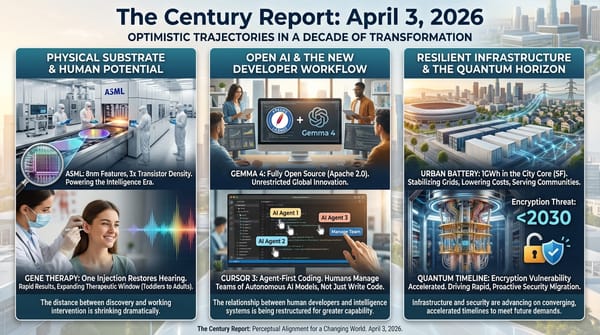
- Google DeepMind: Released Gemma 4, a family of four open-weight multimodal models (E2B, E4B, 26B-A4B MoE, 31B Dense) under Apache 2.0 license; the 31B model ranks #3 among open models on Arena AI; supports 140+ languages, 128K–256K context windows, and native audio/vision/video input; available on Hugging Face and Google AI Studio. (Google DeepMind Blog)
- Cursor: Released Cursor 3, a new unified agentic workspace for managing multiple local and cloud coding agents simultaneously, working across multiple repos with multi-agent delegation; available today. (Cursor Blog)
- Microsoft: Released MAI-Transcribe-1, MAI-Voice-1, and MAI-Image-2 via Microsoft Foundry and MAI Playground; MAI-Transcribe-1 transcribes speech in 25 languages at 2.5× the speed of Azure Fast; MAI-Voice-1 generates up to 60 seconds of audio in ~1 second with custom voice support; MAI-Image-2 is an updated image generation model with faster speed and improved photorealism. (Microsoft AI)
- Google: Launched directable AI avatars, Veo 3.1 video generation (10 free clips/month for all users), YouTube export, and a Chrome screen-recorder extension in Google Vids; all features available now. (Google Blog)
- Google: Added Flex Inference and Priority Inference service tiers to the Gemini API, enabling developers to route latency-tolerant workloads at 50% cost savings (Flex) or guarantee highest reliability for critical traffic (Priority) via standard synchronous endpoints. (Google AI Blog)
- AMD: Released Lemonade, an open-source local LLM server optimized for both GPU and NPU hardware, exposing an OpenAI-compatible API with CLI and GUI. (Lemonade Server)
- ElevenLabs: Released ElevenMusic, a free iOS app for creating and discovering AI-generated music via text prompts, with daily generation limits, remixing, live stations, and curated mood playlists. (TechCrunch)
- Omnivoice / AI4Bharat: Released Omnivoice, an open-source zero-shot multilingual TTS model supporting 600+ languages and dialects with voice cloning from a few seconds of reference audio, built on a diffusion language model architecture. (Reddit r/LocalLLaMA)
- AceStep: Released AceStep 1.5 XL, an updated music generation model with improved audio quality and longer generation capabilities, available on Hugging Face. (Reddit r/LocalLLaMA)
- TinyGPU: Released Mac support for external Nvidia GPUs, enabling eGPU setups for local AI inference on Apple Silicon machines. (Reddit r/LocalLLaMA)
- Arcee: Released Trinity-Large-Thinking, a 400B total / 13B active open-weight MoE reasoning model under Apache 2.0; ranked #2 on PinchBench behind Claude Opus 4.6; available on Hugging Face and OpenRouter. (Arcee Blog)
- Alibaba Qwen: Released Qwen3.6-Plus, a closed-weight model for agentic AI deployment with advanced coding and reasoning capabilities; available via Alibaba Cloud Model Studio API. (Alibaba Cloud Blog)
- H Company: Released Holo3, a GUI-navigation and computer-use model family scoring 78.85% on OSWorld-Verified; Holo3-35B-A3B open-weight variant available on Hugging Face under Apache 2.0. (Hugging Face Blog)
- Zhipu AI (Z.ai): Released GLM-5V-Turbo, a native multimodal vision coding model with CogViT encoder for images, videos, and document layouts. (MarkTechPost)
- TII (Technology Innovation Institute): Released Falcon Perception (0.6B), an open-vocabulary referring expression segmentation model achieving 68.0 Macro-F1 on SA-Co, and Falcon OCR (0.3B), an OCR model scoring 80.3 on olmOCR benchmark; both open-source on Hugging Face. (Hugging Face Blog)
- IBM: Released Granite 4.0 3B Vision under Apache 2.0, a vision-language model for enterprise document understanding, charts, and table extraction. (Hugging Face Blog)
- Elgato: Released Stream Deck 7.4 software update with MCP support, enabling AI assistants like Claude, ChatGPT, and Nvidia G-Assist to trigger Stream Deck actions. (The Verge)
- Claw: Released an open-source Python reimplementation of Claude Code's agent architecture, compatible with local models, available on GitHub. (Github)
- SharpAI: Released SwiftLM, an open-source implementation of TurboQuant KV compression with SSD expert streaming optimized for Apple Silicon M5 Pro and iOS. (GitHub)
- llama.cpp: Merged attn-rot, a TurboQuant-like KV cache optimization delivering ~80% of TurboQuant's benefits, making Q8 KV cache nearly equivalent to F16 quality. (Reddit)
- SeaWolf-AI: Released Darwin-35B-A3B-Opus, a 35B-parameter MoE model with 3B active parameters, created using Model MRI merging technique. (Reddit)
- Agents Observe: Released an open-source real-time dashboard for monitoring teams of Claude Code agents with filtering capabilities. (GitHub)
- Meta: Released Ray-Ban Meta G2 AI glasses (Blayzer and Scriber Optics variants), the first AI-powered smart glasses designed for prescription lens wearers. (Product Hunt)
Sources
Artificial Intelligence & Technology's Reconstitution
- TechCrunch: Anthropic Buys Biotech Startup Coefficient Bio in $400M Deal
- The Next Web: Microsoft Launches Three In-House AI Models
- Business Insider: Microsoft Released 3 New AI Models
- Wired: Meta Pauses Work With Mercor After Data Breach
- Ars Technica: Cognitive Surrender Leads AI Users to Abandon Logical Thinking
- The Verge: Anthropic Essentially Bans OpenClaw From Claude
- The Next Web: Tencent Launches ClawPro Enterprise AI Agent Platform
- Ars Technica: OpenClaw Gives Users Another Reason to Be Freaked Out About Security
- The Atlantic: The AI Industry Wants to Automate Itself
- Simon Willison: The Axios Supply Chain Attack Used Individually Targeted Social Engineering
- Wired: Hackers Are Posting the Claude Code Leak With Bonus Malware
Institutions & Power Realignment
- The Verge: Chatbots Are Now Prescribing Psychiatric Drugs
- EFF: Tech Nonprofits to Feds - Don't Weaponize Procurement to Undermine AI Trust and Safety
- TechCrunch: Anthropic Ramps Up Political Activities With New PAC
- Guardian: UK's Leading AI Research Institute Told to Make Significant Changes
- Nature: Massive Budget Cuts for US Science Proposed Again
- Utility Dive: State Utility Laws Are Primary Barrier to AI Ratepayer Protection Pledge
Scientific & Medical Acceleration
- ScienceDaily: Gene Mutation May Trap Brain in Wrong Reality in Schizophrenia
- ScienceDaily: Scientists Discover Why Flu and COVID Hit Older Adults So Hard
- ScienceDaily: Five-Day Diet Helped Crohn's Patients (Nature Medicine)
- ScienceDaily: 500-Million-Year-Old Fossil Rewrites Origin of Spiders (Nature)
Economics & Labor Transformation
- TechCrunch: Anthropic Is Having a Moment in Private Markets
- Business Insider: Everyone Now Has Keys to the Side Hustle Kingdom
Infrastructure & Engineering Transitions
- Canary Media: This Spring Has Been a Record Season for Renewables
- Electrek: BYD Song Ultra EV Launches at $22,000 With 5-Minute Charging
- Canary Media: Iran War Could Spur Europe to Double Down on Renewables
- TechCrunch: AI Companies Building Huge Natural Gas Plants for Data Centers
- Electrek: The Oil Crisis Is Making Drivers Realize They Can't Afford Not to Drive Electric
- Electrek: Ohio Solar Farm Powered by Ohio-Made Panels
- TechCrunch: People Would Rather Have Amazon Warehouse Than Data Center
- Utility Dive: FERC Urged to Reject TeraWulf Power Plant Purchase Over Google Stake
The Century Report tracks structural shifts during the transition between eras. It is produced daily as a perceptual alignment tool - not prediction, not persuasion, just pattern recognition for people paying attention.