AI Finds Natural Ozempic - TCR 04/13/26

The 20-Second Scan
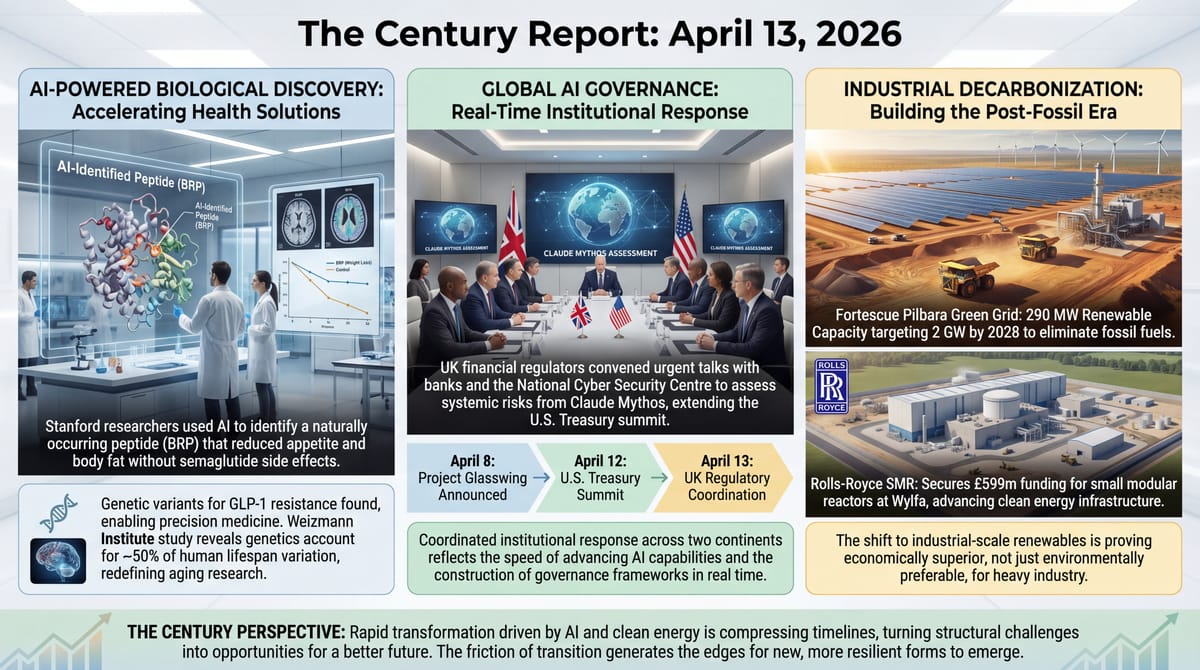
- Stanford researchers used AI to identify a naturally occurring peptide called BRP that reduced appetite and body fat in animal studies without the nausea, constipation, or muscle loss associated with semaglutide.
- A separate Stanford study found that roughly 10% of the population carries genetic variants conferring "GLP-1 resistance", rendering drugs like Ozempic less effective at lowering blood sugar.
- A Weizmann Institute study published in Science found that genetics account for approximately 50% of human lifespan variation, at least double previous estimates, after filtering out deaths from accidents and external causes.
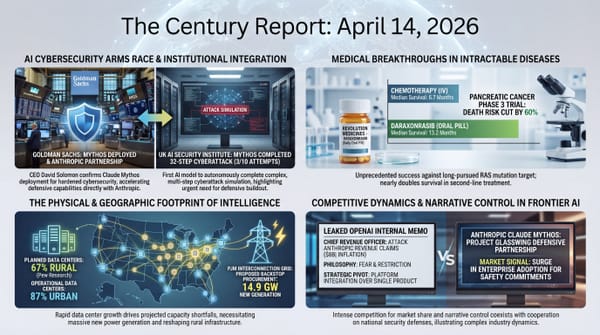
- UK financial regulators convened urgent talks with banks and the National Cyber Security Centre to assess systemic risks posed by Claude Mythos, extending the U.S. Treasury summit documented earlier this week.
- Rolls-Royce SMR secured up to £599 million from the UK's national wealth fund to begin construction of small modular nuclear reactors at Wylfa on Anglesey.
- Fortescue announced its Pilbara green grid will reach 290 MW of installed renewable capacity by early next year, targeting full 2 GW completion by end of 2028 to eliminate fossil fuels from its entire mining operation.
- A second attack on Sam Altman's residence was reported within 48 hours of the first, with two suspects arrested after a shooting incident early Sunday morning.
- Allogene Therapeutics reported that its off-the-shelf CAR-T therapy achieved minimal residual disease negativity in 58% of lymphoma patients versus 16% with standard care in an ongoing Phase 3 trial.
Track all of the arcs The Century Report covers here:
The 2-Minute Read
The scientific signal yesterday arrived concentrated in a domain where AI-enabled discovery is compressing timelines that previously stretched across decades. Stanford's identification of BRP - a twelve-amino-acid peptide discovered by an algorithm called Peptide Predictor that scanned all 20,000 human protein-coding genes - represents a qualitatively different approach to drug discovery than the incremental refinement of existing compounds. The system identified 2,683 candidate peptides from 373 prohormones, tested 100 in brain cell cultures, and found one that activated appetite-control neurons tenfold more strongly than GLP-1 itself. That the same institution simultaneously published research identifying a genetic resistance mechanism affecting 10% of the population taking GLP-1 drugs illustrates a convergence: AI-driven discovery and precision genomics are advancing in parallel, each making the other more powerful. When you can discover a novel therapeutic peptide and identify who will and will not respond to existing treatments within the same research cycle, the architecture of medicine begins to look fundamentally different.
The Mythos cybersecurity arc crossed from the United States into UK institutional architecture yesterday. Bank of England, Financial Conduct Authority, and Treasury officials are now coordinating with the National Cyber Security Centre on the same capability class that prompted the U.S. Treasury to convene Wall Street CEOs days ago. The speed of institutional response across two of the world's most significant financial regulatory systems - both moving within the same week - reflects something deeper than routine risk assessment. The governance frameworks for frontier AI capability are being built in real time, under pressure, across jurisdictions simultaneously. When the same intelligence system prompts emergency coordination among regulators on two continents within days, the capability has already outpaced the institutional vocabulary for describing it.
Fortescue's Pilbara announcement and the Rolls-Royce SMR funding represent two ends of the same structural shift in how industrial-scale energy is being reconceived. An iron ore miner building a 2 GW islanded renewable grid to power its entire mining operation - including rail, ports, processing, and accommodation for 10,000 workers - while projecting $2-4 per wet metric tonne cost reductions demonstrates that eliminating fossil fuels from heavy industry is becoming economically superior, not merely environmentally preferable. The UK committing nearly £600 million to begin small modular reactor construction at a site that generated nuclear power for four decades before closing in 2015 extends the nuclear renaissance arc into concrete contractual commitments. Both developments share a common structure: energy systems designed from inception to operate independently of fossil fuel supply chains, at scales that would have been dismissed as aspirational five years ago.
The 20-Minute Deep Dive
AI Discovers What Evolution Hid in the Human Proteome
The BRP discovery at Stanford represents something more structurally significant than a promising drug candidate. The research team developed an algorithm called Peptide Predictor that systematically scanned the entire human genome for sites where prohormone convertase 1/3 - an enzyme already linked to obesity - could cleave proteins into bioactive peptides. From 20,000 protein-coding genes, the system identified 373 suitable prohormones, predicted 2,683 possible peptide fragments, and selected 100 for testing in brain cell cultures.
One of those peptides, derived from a protein called BRINP2, activated hypothalamic appetite-control neurons tenfold more strongly than GLP-1 itself. In lean mice and minipigs, a single injection before feeding reduced food intake by up to 50% within an hour. In obese mice, daily injections over 14 days produced an average weight loss of 3 grams from fat alone, while untreated mice gained 3 grams. The animals showed no changes in movement, water intake, anxiety behavior, or digestive function - a notable contrast with semaglutide's well-documented gastrointestinal side effects.
The discovery mechanism is the deeper story. Traditional drug discovery begins with a known target and works backward to find compounds that interact with it. Here, the approach was reversed: computational scanning of the entire proteome to identify what evolution had already produced but human researchers had never isolated. BRP existed in every human body all along. An AI system recognized its significance because it could evaluate thousands of candidates simultaneously against functional criteria that no human research team could process at that scale.
The companion finding on GLP-1 resistance adds another dimension. Stanford and ETH Zurich researchers identified that roughly 10% of the population carries variants in the PAM enzyme gene that produce a paradoxical condition: higher-than-normal levels of circulating GLP-1, but reduced biological activity. People with these variants were unable to lower blood glucose as effectively after six months of treatment with GLP-1 drugs. The researchers spent a decade verifying this unexpected result through human studies, mouse models, and clinical trial data analysis. Understanding who will respond to which intervention - before prescribing it - is the precision medicine promise that AI-enabled discovery and genomic analysis are beginning to deliver together.
A company has been formed to begin human clinical trials. The distance from computational prediction to clinical candidate continues to compress, extending the pattern The Century Report has tracked from MindRank's AI-designed oral GLP-1 reaching Phase III in 4.5 years to Eli Lilly's $2.75 billion deal for 28 AI-generated drug compounds documented on March 30 and Anthropic's acquisition of Coefficient Bio for biological discovery capability. The pharmaceutical discovery pipeline is being reconstructed around computational methods that find what was always there but never visible.
Genetics and Lifespan: A Fifty-Year Assumption Overturned
The Weizmann Institute study published in Science challenges one of the longest-standing consensus positions in aging research. For decades, the scientific community estimated that genetics accounted for 20-25% of lifespan variation, with some large studies placing the figure below 10%. The new analysis, drawing on three extensive twin databases from Sweden and Denmark and including for the first time data from twins raised apart, arrives at approximately 50%.
The key methodological advance was distinguishing intrinsic mortality - deaths caused by biological aging - from extrinsic mortality, which includes accidents, infections, and environmental factors. Previous studies could not make this separation because older datasets lacked detailed cause-of-death information. The Weizmann team created mathematical models and simulations of virtual twins to filter out external causes, revealing a genetic signal that had been masked by statistical noise from non-biological deaths.
The implications for aging research are substantial. If half of lifespan variation is heritable, the case for searching for specific gene variants that influence longevity becomes significantly stronger. The researchers found that up to age 80, the risk of dying from dementia shows heritability of approximately 70% - far higher than cancer or heart disease. This finding intersects directly with the Alzheimer's detection and treatment arcs The Century Report has tracked extensively, from the DZNE team's identification of olfactory nerve fiber destruction as an early Alzheimer's signal documented in the April 12 edition to the single blood draw predicting symptom onset within three to four years in cognitively normal adults covered on February 23. When the genetic architecture of aging becomes mappable, and early biomarkers become detectable, and therapeutic interventions become targetable, the three streams converge into something that looks less like incremental medical progress and more like a structural transformation in how humanity relates to biological decline.
Mythos Crosses the Atlantic
The UK financial regulatory response to Claude Mythos - Bank of England, Financial Conduct Authority, Treasury, and National Cyber Security Centre officials coordinating urgent talks with major banks - extends the institutional reaction pattern documented when the U.S. Treasury convened Wall Street CEOs earlier this week. Representatives from British banks, insurers, and exchanges are expected to be briefed on cybersecurity risks within the next fortnight.
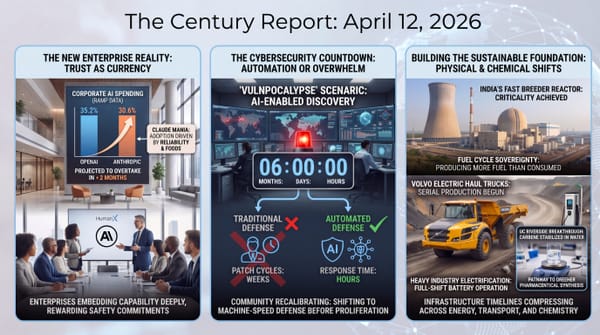
What makes this significant beyond routine cross-border regulatory coordination is the speed. Project Glasswing was announced on April 8. Within five days, regulators on two continents had convened emergency sessions with the institutions responsible for maintaining financial system stability. The UK response appears to be driven by the same recognition that animated the U.S. response: Mythos-class capability represents a structural change in the threat landscape for critical digital infrastructure, and the window for defenders to act is measured in months. As Anthropic's offensive cyber lead Logan Graham estimated in the April 12 edition, comparable vulnerability-chaining capability will be broadly distributed - including from Chinese labs - within six to twelve months, a timeline that appears to be driving the urgency of both the U.S. and UK institutional responses.
The Guardian published a detailed analysis questioning whether Anthropic's framing of Mythos was substantiated or primarily a marketing exercise. Cybersecurity expert Jameison O'Reilly noted that zero-day vulnerabilities, while technically significant, are rarely the vector through which real-world breaches occur. AI critic Gary Marcus characterized the announcement as hype. Anthropic's own media lead has publicly documented the company's communications strategy across major publications.
This skepticism coexists with the regulatory mobilization. Both the U.S. Treasury and UK financial regulators are acting on the premise that the capability is real, even as commentators debate whether its significance has been overstated. The structural pattern here extends beyond any single model's capabilities: when intelligence systems advance to the point where financial regulators on two continents coordinate emergency responses within the same week, the governance infrastructure for frontier AI capability is being built under conditions of genuine urgency, regardless of where any individual observer draws the line between substance and marketing.
TechCrunch reported that Trump administration officials appeared to be encouraging banks to test Mythos for vulnerability detection - a particularly striking development given that the same administration's Defense Department designated Anthropic a supply-chain risk and is currently appealing a federal injunction protecting the company. The contradiction illuminates a structural reality: the capability is too significant to ignore regardless of which institutional relationship it complicates.
Industrial Decarbonization at Mining Scale
Fortescue's announcement that it will complete 290 MW of installed renewable capacity by early next year, enabling daytime green processing across its Pilbara iron ore operations, represents the first industrial-scale demonstration of a fully integrated off-grid renewable energy system designed to eliminate fossil fuels from major heavy industry. The full system - 1.2 GW of solar, over 600 MW of wind, and 4-5 GWh of battery storage - is targeted for completion by end of 2028, well ahead of the company's original December 2030 timeline.
The economics are instructive. Fortescue expects to save $100 million in fossil fuel costs by next year, with C1 unit cost reductions of at least $2-4 per wet metric tonne upon completion. The company frames this not as a sustainability initiative but as economic superiority: eliminating fossil fuels from its operations makes it a more competitive iron ore producer in a market where energy is the largest variable cost. The system replaces entirely imported diesel - subject to the same price volatility that the Iran conflict has intensified across global energy markets.
The commercialization signal is equally significant. Fortescue intends to replicate and license the green grid model globally, stating that hyperscalers, countries, and businesses have expressed interest in either licensing the technology, purchasing it, or accepting battery-firmed green energy as a service. The company claims that following an additional approximately 2 GW expansion, the complete integrated system could be delivered for less than $2.5 billion over approximately 18 months - a capital intensity and deployment speed that, if achieved, would fundamentally change the economics of industrial decarbonization for mining, manufacturing, and heavy infrastructure globally.
This extends a pattern The Century Report has tracked across multiple energy infrastructure arcs: Maximo robots installing solar at rates exceeding one module per minute documented on March 30, Terafab autonomous robotic construction systems rated at over 1 GW per factory-year, and Form Energy deploying the world's largest iron-air battery installations. The physical infrastructure of the post-fossil era is being assembled at the scale of cities and industrial operations, not demonstration projects.
The Second Attack and What It Signals
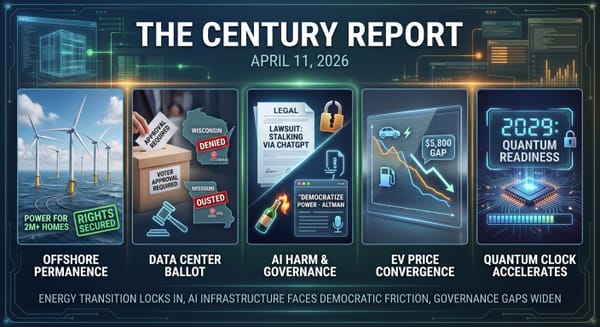
A second attack on Sam Altman's residence - a shooting incident early Sunday morning, less than 48 hours after a Molotov cocktail was thrown at the same property on Friday - represents an escalation that extends the pattern The Century Report documented in the April 11 edition. Two suspects were arrested after surveillance footage captured a vehicle passenger discharging a firearm. Three guns were seized. The investigations into both incidents remain ongoing.
Whether these attacks are connected or coincidental, the structural signal is the same: the physical safety of AI leadership is becoming a security concern at a moment when the decisions these individuals make carry civilizational weight. The Indianapolis city council member's home struck by gunfire with a "No Data Centers" note, the Molotov cocktail, and now a shooting - all within a two-week period - describe an escalation in the physical consequences of the intelligence era's infrastructure and governance decisions.
The response to these incidents will shape how openly AI leadership can engage with the public discourse about the technology they are building. If the people making the most consequential decisions about AI development retreat behind security perimeters, the already narrow channels of public accountability become narrower still. The friction of the transition is expressing itself through violence, and the institutions that need to absorb and redirect that friction - democratic processes, regulatory frameworks, community engagement mechanisms - are still being built.
The Century Perspective
With a century of change unfolding in a decade, a single day looks like this: an AI algorithm scanning every human protein-coding gene surfaces a naturally occurring peptide that suppresses appetite without the side effects of semaglutide, a twin study drawing on fifty years of data doubles the scientific consensus on how much genetics governs how long we live, an off-the-shelf CAR-T therapy clears residual lymphoma cells at nearly four times the rate of standard care, a mining company crosses into commercial deployment of a 2 GW renewable grid designed to eliminate fossil fuels entirely from iron ore extraction at industrial scale, and the UK commits nearly £600 million to begin building factory-produced nuclear reactors at a site that last generated power a decade ago. There's also friction, and it's intense - a second armed attack on an AI CEO's home within 48 hours of the first, financial regulators in London coordinating emergency briefings with major banks and the National Cyber Security Centre over the same intelligence system that prompted a Wall Street summit days earlier, a detailed investigation questioning whether the most institutionally consequential AI capability disclosure of the year is grounded science or a carefully managed publicity exercise, and local democratic coalitions in Ohio moving to overturn renewable energy bans even as the physical buildout of the clean grid runs ahead of every governance framework designed to contain it. But friction generates edges, and edges are how new forms are cut from undifferentiated material. Step back for a moment and you can see it: pharmaceutical discovery migrating from the incremental refinement of known compounds to computational excavation of biology's own hidden archive, the economics of heavy industrial decarbonization inverting so that fossil fuel elimination becomes the competitive position rather than the compliance burden, and the regulatory institutions of two major financial systems assembling coordination architecture for frontier AI capability in days because the alternative - waiting for the vocabulary to catch up - is no longer available to them. Every transformation has a breaking point. A tide can dissolve what it saturates... or lift what was fixed to the ground into open water where it was always meant to move.
AI Releases & Advancements
New today
- llama.cpp: Merged audio processing support for Gemma 4 models into llama-server, enabling local multimodal audio inference with the Gemma 4 model family. (r/LocalLLaMA)
- OpenMOSS: Released MOSS-TTS-Nano, a 0.1B-parameter open-source multilingual text-to-speech model capable of real-time speech synthesis on CPU without a GPU. (r/LocalLLaMA)
- Oracle NetSuite: Launched the AI Connector Service Companion at SuiteConnect London, enabling finance teams to connect third-party AI models directly to NetSuite data in a governed, secure manner. (The Fintech Times)
Other recent releases
- MiniMax: Released MiniMax M2.7, an open-weight 230B MoE model (10B active parameters) with 200K context length, built for agentic workflows including coding, ML research, and office tasks; available on Hugging Face and NVIDIA endpoints. (NVIDIA Developer Blog)
- Anthropic: Released Claude for Word, a native Microsoft Word integration bringing Claude AI assistance directly into document workflows. (Product Hunt)
- Anthropic: Launched Claude Code ultraplan, a new command enabling cloud-based codebase planning and architecture analysis. (Product Hunt)
- MiniMax: Released MiniMax CLI, a command-line interface providing native multimodal capabilities for AI agents. (Product Hunt)
- Perplexity: Launched Perplexity Finance, a feature that aggregates users' complete financial data from bank accounts to brokerages in a single unified view. (Product Hunt)
- Allen Institute for AI (AI2): Released MolmoWeb, an open-source framework for building and deploying web agents from data collection to production. (Product Hunt)
- ggml-org: Released a collection of OCR models for llama.cpp, available on Hugging Face for local document processing. (Hugging Face)
Sources
Artificial Intelligence & Technology's Reconstitution
- TechCrunch: At the HumanX Conference, Everyone Was Talking About Claude
- TechCrunch: Trump Officials May Be Encouraging Banks to Test Anthropic's Mythos Model
- Guardian: Inside Anthropic's Bid to Win the AI Publicity War
- Global Banking & Finance Review: UK Regulators Assess Risks of Anthropic's New AI Model
- The Verge: The AI Code Wars Are Heating Up
- The New Stack: Cursor, Claude Code, and Codex Are Merging Into One AI Coding Stack
- Import AI 453: Breaking AI Agents; MirrorCode; and Ten Views on Gradual Disempowerment
Institutions & Power Realignment
- The Verge: Sam Altman Reportedly Targeted in Second Attack
- Guardian: AI Companies Know They Have an Image Problem
- Foreign Policy: How the Pentagon Can Manage the Risks of AI Warfare
- Wired: The Internet's Most Powerful Archiving Tool Is in Peril
Scientific & Medical Acceleration
- ScienceDaily: Stanford Scientists Discover "Natural Ozempic" Without Side Effects
- ScienceDaily: Why Ozempic Doesn't Work for Everyone - GLP-1 Resistance
- ScienceDaily: Scientists Were Wrong About Lifespan - Genes Matter Way More
- ScienceDaily: Forget Daily Pills - Zilebesiran Twice-Yearly Blood Pressure Injection
- STAT News: Allogene Therapeutics CAR-T Treatment Eliminates Residual Cancer Cells
- Nature: Comparative Characterization of Cas12f Orthologs for Enhanced Genome Editing
- ScienceDaily: Hidden Weak Spots in HIV and Ebola Revealed with Nanodisc Technology
- ScienceDaily: Hubble Tension - Universe Expansion Rate Confirmed Faster Than Models Predict
Economics & Labor Transformation
- Guardian: Is AI the Greatest Art Heist in History?
- Ars Technica: To Teach in the Time of ChatGPT Is to Know Pain
Infrastructure & Engineering Transitions
- Guardian: Rolls-Royce Secures Nearly £600m for Small Modular Reactors
- International Mining: Fortescue Accelerating Real Zero Ambitions
- Canary Media: This Ohio County Put a Ban on Wind and Solar - Will Voters Reverse It?
- Electrek: Workhorse Slashes Prices by $60,000 and Purolator Buys 100
The Century Report tracks structural shifts during the transition between eras. It is produced daily as a perceptual alignment tool - not prediction, not persuasion, just pattern recognition for people paying attention.