Enterprise AI Market Tilts - TCR 04/12/26

The 20-Second Scan
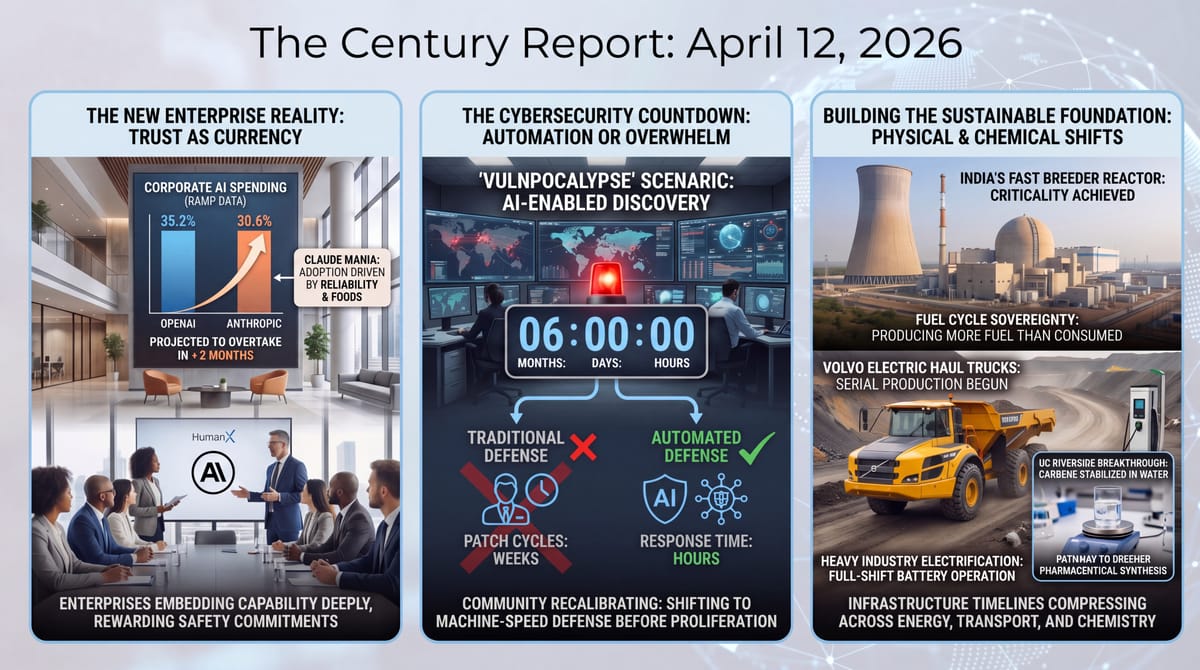
- Anthropic is close to overtaking OpenAI in enterprise AI spending, with 30.6% of Ramp's corporate customers now paying for Anthropic products versus 35.2% for OpenAI.
- NBC News reported that cybersecurity experts are warning of a "Vulnpocalypse" scenario in which AI-enabled vulnerability discovery overwhelms defenders within six to twelve months.
- India's domestically designed Prototype Fast Breeder Reactor achieved criticality at Kalpakkam, capable of producing more nuclear fuel than it consumes.
- UC Riverside chemists stabilized a carbene in liquid water for the first time, confirming a 67-year-old hypothesis about vitamin B1 and opening a pathway to pharmaceutical synthesis in water instead of toxic solvents.
- Volvo began serial production of the world's first electric articulated haul trucks, with deliveries to UK and Norwegian customers within weeks.
- Australia recorded its highest-ever monthly share of plugin vehicle sales at nearly 23% of the total new car market in March, a 90% year-over-year increase.
- DZNE researchers identified a mechanism in which the brain's immune cells destroy smell-related nerve fibers in early Alzheimer's, offering a potential pathway to diagnosis years before cognitive decline.
- Japan approved an additional $4 billion in subsidies for Rapidus, bringing total government investment in the domestic AI chip startup to $16.3 billion as it targets 2-nanometer production by late 2027.
Track all of the arcs The Century Report covers here:
The 2-Minute Read
The enterprise AI market is undergoing a structural realignment that is now visible in corporate spending data. Anthropic's surge from a distant second to within striking distance of OpenAI among paying business customers - with Ramp projecting it could overtake OpenAI within two months - reflects something beyond product preference. The company that absorbed a Pentagon supply-chain risk designation, held its safety commitments under state-level pressure, and then launched a cybersecurity coalition giving its most capable model to direct competitors is being rewarded by the market segment that evaluates partners on trust, reliability, and long-term viability. The fact that Claude Code has generated what industry observers are calling "Claude mania" at the HumanX conference, with executives describing it as having "become a religion," signals that the commercial layer of AI adoption is consolidating around capability that enterprises can embed deeply in their workflows.
The cybersecurity arc that began with Project Glasswing's announcement earlier this week is deepening. Anthropic's own offensive cyber research lead told NBC News that comparable vulnerability-chaining capabilities will be "broadly distributed" within six to twelve months, with Mythos-class capability expected to emerge from Chinese and other non-U.S. labs. The language being used by cybersecurity professionals - "Vulnpocalypse," "zero-day tsunami" - reflects a community recalibrating its operating assumptions. When the Cloud Security Alliance convenes an emergency huddle and CISOs are told to compress their patch cycles from weeks to hours, the governance architecture of digital infrastructure is being rebuilt under pressure that no prior threat model anticipated.
The physical infrastructure signals are equally dense. India's fast breeder reactor reaching criticality, Japan committing $16.3 billion to domestic AI chip sovereignty, Volvo rolling electric haul trucks off a production line, and Australia's EV market share nearly doubling in a year all describe different facets of the same structural movement: the physical systems that will underpin the next era are being assembled simultaneously across energy, transportation, computation, and nuclear fuel cycles. Each of these developments compresses a timeline that conventional forecasting projected would unfold over a decade. They are unfolding in months.
The 20-Minute Deep Dive
The Enterprise Market Tilts
Ramp's corporate spending data published yesterday provides one of the clearest empirical snapshots of how the enterprise AI market is redistributing. Among Ramp's paying corporate customers, Anthropic now accounts for 30.6% - up 6.3 percentage points from March alone - while OpenAI holds 35.2%. At this trajectory, Ramp projects Anthropic will pass OpenAI within two months. Anthropic already leads in three sectors: information, finance and insurance, and personal services.
The HumanX conference in San Francisco reinforced the data with qualitative evidence. Glean CEO Arvind Jain described "Claude Mania" among enterprise buyers, saying that if you asked any business leader which single AI capability they would choose, "the answer would be Claude." Synthesia CEO Victor Riparbelli attributed Anthropic's momentum to disciplined focus: "The guys at Anthropic were just like, 'We're not going to do anything about video, we're not going to care about voice models, we're just going to solve code gen.'" This focus-versus-breadth dynamic extends the pattern The Century Report has tracked since the March 2 edition, when Claude overtook ChatGPT to reach No. 1 in the U.S. App Store specifically on the strength of its safety-commitment positioning under government pressure, establishing that consumer and enterprise markets were rewarding constrained product focus over platform breadth.
The structural implications extend beyond market share. As Cisco's Jeetu Patel noted at HumanX, roughly 85% of Cisco's 18,000-person engineering workforce now uses AI, but the organizational transformation was unlike anything leadership anticipated. "You can't think of these as tools," Patel said. "You might have a scrum team of two people and six agents, or two people and infinite agents." When 85% of a Fortune 500 engineering workforce is operating with AI and the company's president is describing the shift in terms of team composition rather than productivity metrics, the transformation has moved from adoption to restructuring. The enterprise AI market is selecting for providers that enterprises can structurally embed, and Anthropic's combination of coding capability, safety reputation, and enterprise focus is proving to be precisely what that selection pressure rewards.
The Six-Month Clock
The cybersecurity arc that Project Glasswing initiated on April 8 has acquired a specific timeline. Logan Graham, who leads offensive cyber research at Anthropic, told NBC News that even if Mythos were never made public, he expects competitors "including those in China, to release models with comparable hacking ability in the coming months and years." His specific estimate: six to twelve months before these capabilities are "broadly distributed or made broadly available."
This timeline aligns with the warning former Facebook and Yahoo security chief Alex Stamos delivered in the April 8 edition of The Century Report, when he estimated defenders have "something like six months" before open-weight models match Mythos-level bug-finding. The convergence of these independent estimates from inside and outside Anthropic is significant because it transforms the Glasswing initiative from a single company's responsible disclosure into a race against proliferation with a defined finish line.
The professional cybersecurity community is responding accordingly. GovTech published an analysis yesterday listing seven urgent moves for CISOs, beginning with "recalibrate your operating model around hours/days, not weeks." The Cloud Security Alliance convened an emergency virtual huddle. Richard Stiennon, a cybersecurity industry analyst, characterized Mythos as a "break glass moment." The questions being raised are structural: Can vulnerability scanners keep up? Can software vendors patch fast enough? Can enterprise security teams handle the workload?
What distinguishes this moment from prior cybersecurity escalations is the asymmetry between discovery and defense. Graham noted that Mythos excels at chaining multiple weaknesses into sophisticated exploit paths - "it doesn't just find a bug, but writes the script to jump from a browser to the kernel to the cloud." Former FBI senior cyber official Cynthia Kaiser warned about "wannabes" who lacked skill a year ago now having "some of the most powerful tools ever known to humankind in their hands." The democratization of offensive capability is the structural shift; the specific model name is secondary. As The Century Report documented on March 16, the Booz Allen Hamilton analysis that found attackers adopting offensive AI faster than defenders and the HexStrike framework compromising thousands of Citrix Netscaler devices in under ten minutes confirmed that the discovery-to-exploitation asymmetry documented as temporary in March 7's Firefox vulnerability findings was already collapsing in the wild - and the six-month clock now put a date on that collapse.
What emerges on the other side of this compression is a cybersecurity ecosystem rebuilt around continuous automated defense rather than periodic human-driven patching. The same AI capability that identifies vulnerabilities at machine speed is the capability that patches them at machine speed. The window between now and proliferation is where the defensive infrastructure gets built - or fails to. The organizations participating in Glasswing are building it. The question is whether the defensive buildout can be made broadly available before the offensive capability is.
India's Nuclear Fuel Cycle Crosses a Threshold
India's Prototype Fast Breeder Reactor at Kalpakkam achieved criticality - the point at which a self-sustaining nuclear chain reaction begins - in a development that intersects directly with the country's full-stack sovereignty strategy that The Century Report has tracked since February. India's nuclear energy ambitions are enormous: from 8 gigawatts of installed nuclear capacity to a target of 100 gigawatts by 2047. The fast breeder reactor is the linchpin because it produces more fissile material than it consumes, enabling India to leverage its substantial thorium reserves rather than depending on imported uranium.
This advancement arrives during the Iran conflict's disruption of global energy supply chains, lending additional urgency to energy self-reliance. India's approach to the intelligence era has been distinctive: building compute infrastructure (G42/Cerebras 8 exaflops), semiconductor assembly (HCL/Foxconn), open-source language models (Sarvam), upstream solar manufacturing (Waaree 10 GW), and now advancing its nuclear fuel cycle simultaneously. The pattern is of a nation-state constructing the complete physical and digital infrastructure of the next era in parallel, rather than depending on any single external supplier for critical inputs.
The reactor does not yet generate grid electricity - that comes in subsequent phases as it moves to full power. But criticality is the decisive engineering milestone. Combined with India's 44.6 GW of solar additions in fiscal year 2026 (as documented in yesterday's CleanTechnica analysis showing India's total wind, water, and solar capacity reaching 257.8 GW), the country is building both the clean baseload and the variable renewable capacity that a 1.4-billion-person economy requires to power its way through the transition without fossil fuel dependence.
Electrification Reaches the Heaviest Machines
Volvo's announcement that it has begun serial production of electric articulated haul trucks - the A30 and A40 Electric models - marks a threshold in industrial electrification. These are not demonstration vehicles. They are rolling off a production line, with deliveries to UK and Norwegian customers scheduled within weeks. The A30 carries 29 tonnes, the A40 carries 39 tonnes, and both are designed for full-day operation on their 245 and 324 kWh battery packs respectively.
Volvo invented the articulated hauler category in 1966 with "Gravel Charlie." The company that created the class is now the first to electrify it at production scale. The engineering is notable: both machines charge via conventional CCS at up to 200 kW, fast enough to go from 10-80% between operator shift changes. This eliminates the need for the expensive megawatt-scale charging infrastructure that has constrained electric mining and construction equipment deployment.
This development extends the electrification arc beyond passenger vehicles and light commercial fleets into the heaviest industrial applications. When a 39-tonne haul truck can operate on battery power for a full shift and recharge during crew rotation, the economic case for diesel in mining and construction begins to erode from the top of the payload range, where the fuel savings are largest. Combined with Australia's record EV market share (nearly 23% in March, up 90% year-over-year) and the ongoing Iran-conflict fuel price shock, the electrification of transportation is advancing simultaneously at every scale - from compact passenger vehicles to the heaviest industrial equipment - and the cost advantage is compounding at each level. Australia's trajectory mirrors the pattern The Century Report documented on April 5 when Australian EV dealership lots emptied within days as fuel prices crossed AU$3 per litre, confirming that the demand shock converts to purchasing action faster than any supply constraint can absorb it.
A 67-Year-Old Hypothesis Becomes a Manufacturing Pathway
UC Riverside chemists achieved something that had been considered impossible: stabilizing a carbene - a form of carbon with only six valence electrons instead of the stable eight - in liquid water, where it remained intact for months. The breakthrough confirms a 1958 hypothesis by Columbia University chemist Ronald Breslow that vitamin B1 (thiamine) could transform into a carbene to drive essential biochemical reactions.
The team accomplished this by engineering what lead researcher Vincent Lavallo describes as "a suit of armor" - a protective molecular structure that shields the reactive center from water and surrounding molecules. The stabilized carbene was confirmed via nuclear magnetic resonance spectroscopy and X-ray crystallography.
The practical implications extend directly into pharmaceutical manufacturing. Carbenes are widely used as supporting components in metal-based catalysts that drive reactions for producing drugs, fuels, and materials. These processes currently depend on toxic organic solvents. Stabilizing carbenes in water opens the door to running the same catalytic chemistry in the most abundant, non-toxic solvent available. "If we can get these powerful catalysts to work in water, that's a big step toward greener chemistry," said first author Varun Raviprolu. This connects to the broader pattern of chemical synthesis becoming cleaner and more efficient that The Century Report has documented through the KAIST sunlight-powered catalyst on March 31, the Nagoya iron photocatalyst replacing rare metals in drug synthesis on February 28, and Cambridge's light-powered anti-Friedel-Crafts reaction on March 14. Each of these developments compresses the distance between laboratory chemistry and environmentally sustainable manufacturing. The carbene stabilization adds a particularly fundamental capability: conducting reactive chemistry in water rather than organic solvents may eventually transform not just pharmaceutical synthesis but industrial chemistry broadly.
Early Alzheimer's Detection Through the Nose
DZNE and LMU München researchers published findings in Nature Communications identifying why smell loss occurs so early in Alzheimer's disease. They found that microglia - the brain's immune cells - actively destroy nerve fibers connecting the olfactory bulb to the locus coeruleus after detecting abnormal membrane signals on those fibers. Specifically, phosphatidylserine, a fatty molecule that normally stays on the inner surface of neuron membranes, shifts to the outer surface, creating an "eat-me" signal that triggers microglia to dismantle the connections.
This discovery matters because it identifies a specific, measurable mechanism operating years before cognitive decline. The researchers confirmed their findings across three evidence types: Alzheimer's-model mice, brain tissue from deceased patients, and PET scans of living individuals with Alzheimer's or mild cognitive impairment. The convergence across all three lines of evidence strengthens the case that olfactory deterioration is not merely correlated with early Alzheimer's but causally driven by a specific immune mechanism.
This finding extends the Alzheimer's detection arc The Century Report has tracked through the Washington University plasma p-tau217 blood test on February 23, the Scripps protein-folding blood test on March 12, and the USC blood flow marker on February 25. Each of these approaches identifies a different biological signal of early disease. What they share is a trajectory toward detection that operates years before symptoms appear - the window within which amyloid-beta antibody therapies like lecanemab are most effective. When the detection window expands and the therapeutic window aligns with it, the treatment paradigm for the disease that affects more than 50 million people worldwide shifts from managing decline to preventing it.
The Century Perspective
With a century of change unfolding in a decade, a single day looks like this: the enterprise AI market tilting toward the company that held its safety commitments under government pressure as corporate spending data shows it closing on its larger rival within a two-month horizon, cybersecurity professionals told to rebuild their operating models around hours rather than weeks as a six-month proliferation clock starts on offensive AI capability, India's fast breeder reactor achieving criticality as a 1.4-billion-person nation assembles compute, chips, solar, and nuclear fuel sovereignty in parallel, the world's first electric 39-tonne haul trucks rolling off a production line for commercial delivery, a 67-year-old biochemical hypothesis confirmed in a way that opens pharmaceutical synthesis in water instead of toxic solvents, and the brain's immune cells caught dismantling smell circuits years before Alzheimer's symptoms appear - a mechanism that hands medicine a detection window it has never previously had. There's also friction, and it's intense - defenders face months before offensive AI capability reaches adversaries with no safety constraints and no defensive intent, gas utility infrastructure costs have tripled since 2010 while customer bases grew less than nine percent, AI-generated music impersonation is flooding streaming platforms faster than detection systems can respond, and the man who allegedly firebombed Sam Altman's home wrote essays describing fears shared by millions who have not acted on them violently but whose unease no institution has yet found a language to address. But friction generates pressure, and pressure reveals the load-bearing structures from the decorative ones. Step back for a moment and you can see it: markets selecting for embedded values over raw scale, defensive coalitions assembling across direct competitors before proliferation completes, entire national energy and compute architectures being erected simultaneously rather than sequentially, and medical science identifying disease mechanisms a decade before symptoms emerge because the instruments to look that early finally exist. Every transformation has a breaking point. A fault line can shatter what sits above it... or release the accumulated stress that would otherwise build until nothing above it survives.
AI Releases & Advancements
New today
- MiniMax: Released MiniMax M2.7, an open-weight 230B MoE model (10B active parameters) with 200K context length, built for agentic workflows including coding, ML research, and office tasks; available on Hugging Face and NVIDIA endpoints. (NVIDIA Developer Blog)
- Anthropic: Released Claude for Word, a native Microsoft Word integration bringing Claude AI assistance directly into document workflows. (Product Hunt)
- Anthropic: Launched Claude Code ultraplan, a new command enabling cloud-based codebase planning and architecture analysis. (Product Hunt)
- Hugging Face: Released SmolLM3, a 3B parameter instruction-tuned open model supporting 128k context and 11 languages, with full training details, data mix, and code publicly released; available on Hugging Face, Ollama, llama.cpp, and LM Studio. (Hugging Face Blog)
- NVIDIA: Open-sourced AITune, a toolkit that benchmarks and automatically selects the fastest inference backend for PyTorch models across TensorRT, ONNX Runtime, torch.compile, and other frameworks. (Reddit/LocalLLaMA)
Other recent releases
- MiniMax: Released MiniMax CLI, a command-line interface providing native multimodal capabilities for AI agents. (Product Hunt)
- Perplexity: Launched Perplexity Finance, a feature that aggregates users' complete financial data from bank accounts to brokerages in a single unified view. (Product Hunt)
- Allen Institute for AI (AI2): Released MolmoWeb, an open-source framework for building and deploying web agents from data collection to production. (Product Hunt)
- ggml-org: Released a collection of OCR models for llama.cpp, available on Hugging Face for local document processing. (Hugging Face)
- llama.cpp: Merged backend-agnostic tensor parallelism, enabling faster multi-GPU inference without requiring CUDA backend dependencies. (Reddit/LocalLLaMA)
- Sentence Transformers: Released v5.4 with multimodal embedding and reranker model support, enabling encoding and comparison of texts, images, audio, and videos using the same API for cross-modal search and multimodal RAG pipelines. (Hugging Face Blog)
- Overworld: Released Waypoint-1.5, a real-time video world model generating interactive environments at up to 720p/60 FPS on RTX 3090–5090 GPUs, with a new 360p tier for broader hardware including gaming laptops; trained on ~100x more data than Waypoint-1. Available via Overworld Biome locally or Overworld Stream in-browser. (Hugging Face Blog)
- Yandex: Released YandexGPT-5-Lite-8B-pretrain, an 8B-parameter open-weight language model with 32k context length trained on 15T tokens primarily in Russian and English, with a Llama-like architecture compatible with HuggingFace Transformers and vLLM. (Hugging Face)
- Google: Released Gemini interactive 3D models and simulations feature, allowing the Gemini chatbot to generate manipulable 3D models with adjustable sliders, toggles, and real-time simulation controls in response to questions. (Google Blog)
- OpenAI: Launched a new $100/month ChatGPT Pro tier offering 5x more Codex usage than the Plus tier, positioned between the $20 Plus and the existing $200 Pro plan. (The Verge)
- HeyGen: Released Avatar V, their most advanced AI avatar generation model, now available to users. (Product Hunt)
- Cred: Launched an OAuth credential delegation tool specifically designed for AI agents, enabling secure authentication flows without exposing user credentials. (Product Hunt)
Sources
Artificial Intelligence & Technology's Reconstitution
- NBC News: 'Vulnpocalypse' - What Happens When AI Gives Hackers a Superweapon
- Business Insider: Anthropic Is Close to Overtaking OpenAI on This Measure of AI Business Spending
- CNBC: Vibe Check from Inside HumanX - 'Claude Mania'
- GovTech: Why Anthropic's Mythos Is a Systemic Shift for Global Cybersecurity
- TechCrunch: Sam Altman Responds to 'Incendiary' New Yorker Article After Attack on His Home
- Business Insider: How OpenAI's Codex Figured Out How to Use Adobe Software
Institutions & Power Realignment
- Guardian: AI Companies Know They Have an Image Problem
- Guardian: 'Too Powerful for the Public' - Inside Anthropic's Bid to Win the AI Publicity War
- Guardian: How AI Is Impersonating Musicians on Spotify
- Malay Mail: 'Stop Hiring Humans' - Inside AI's Uneasy Message to the Workforce
- Bloomberg via Liga.biz: Japan Invests $16 Billion in AI Chip Development
Scientific & Medical Acceleration
- ScienceDaily: A 67-Year-Old Theory About Vitamin B1 Has Finally Been Proven
- ScienceDaily: Your Nose Could Detect Alzheimer's Years Before Symptoms Begin
- ScienceDaily: Hidden Weak Spots in HIV and Ebola Revealed with Nanodisc Technology
- ScienceDaily: The Universe Is Expanding Too Fast and Scientists Still Can't Explain It
- Robotics & Automation News: CorTec Receives FDA Breakthrough Designation for Brain-Computer Interface
- Nature: PYEAST Computational Toolkit for Yeast Genetic Engineering
- Rising Nepal: India Moves Closer to Nuclear Fuel Self-Reliance
Economics & Labor Transformation
- CNBC: How Kodak Is Trying to Turn Around Its Business
- SF Chronicle: Alleged Sam Altman Firebomber Wrote of Fears AI Would End Humanity
Infrastructure & Engineering Transitions
- Electrek: Electric Articulated Haul Trucks Reach Series Production
- CleanTechnica: March Sees Record New Plugin Vehicle Sales in Australia
- CleanTechnica: China Leads, India Surges, America Lags in Clean Power Buildout
- CleanTechnica: Why Do Cities Continue to Accept Rising Utility Prices?
- CleanTechnica: Boreal Orders 20 Candela Electric Ferries for Norway
- CNBC: Intel Leads Most Overbought Stocks After Comeback Rally
The Century Report tracks structural shifts during the transition between eras. It is produced daily as a perceptual alignment tool - not prediction, not persuasion, just pattern recognition for people paying attention.